Sorafenib
Sorafenib is an orally administered small-molecule multikinase inhibitor used as systemic anticancer therapy, marketed as Nexavar and originally developed as BAY 43-9006.
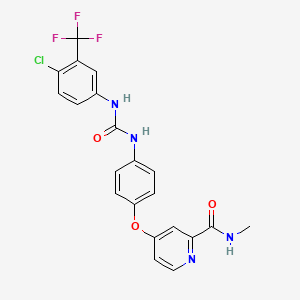
Sorafenib is an orally administered small-molecule multikinase inhibitor used as systemic anticancer therapy, marketed as Nexavar and originally developed as BAY 43-9006. It is approved for advanced hepatocellular carcinoma (HCC), advanced renal cell carcinoma (RCC), and radioiodine-refractory differentiated thyroid carcinoma. Sorafenib inhibits both tumour-cell and vascular targets: it blocks RAF kinases upstream of the MAPK signalling pathway, suppressing RAF-MEK-ERK signal transduction, and inhibits receptor tyrosine kinases that drive angiogenesis, including Vascular endothelial growth factor receptor 2 (VEGFR2) and the platelet-derived growth factor receptors, along with Kit and FLT3. The combined effect is reduced tumour proliferation and reduced neovascularisation. Beyond apoptosis, sorafenib is a recognised inducer of ferroptosis, acting through inhibition of cystine uptake and depletion of glutathione, which limits glutathione peroxidase 4 (Gpx4) activity and permits lethal accumulation of lipid reactive oxygen species.
For more than a decade sorafenib was the reference first-line systemic treatment for unresectable HCC, and it remains the comparator against which newer regimens are measured; immune checkpoint inhibitor–based combinations such as atezolizumab with bevacizumab, and the multikinase inhibitor lenvatinib, have since displaced it from first-line use in many settings, leaving sorafenib an important option in later lines and where immunotherapy is contraindicated. Its clinical benefit is constrained by intrinsic and acquired resistance. Described mechanisms include lysosomal sequestration of the drug, which lowers concentrations at intracellular targets; cytoprotective autophagy and altered Bcl-2/Beclin-1 balance; and suppression of ferroptosis through antioxidant programmes such as nuclear factor erythroid 2-related factor 2 (Nrf2) signalling, alongside adrenergic and Hypoxia-inducible factor 1-alpha (HIF-1α)–linked adaptations in the tumour microenvironment. Poor aqueous solubility also restricts exposure, motivating targeted delivery strategies such as nanoparticle and dendrimer conjugates. These liabilities make sorafenib a common backbone for combination and repurposing research, including pairings with chemotherapeutics, autophagy or lysosome-modulating agents, and immunotherapy.
Where the papers sit
29 papers from the last 6 months study sorafenib directly · updated from PubMed 16 Nov 2026
Study type 0 clinical trials · 2 observational · 1 human data · 24 preclinical · 2 unclassified
Themes one subject · 1 paradigm shift · 1 new direction
Those 29 are all about one subject.
-
Sorafenib-Based Cancer Therapy
Hepatocellular carcinoma remains the main focus, with sorafenib increasingly paired with ferroptosis inducers, metabolic modulators, anti-miR-21, or targeted nanocarriers. Glutathione metabolism, mitochondrial function, calcium entry, and epigenetic control recur as routes to strengthen tumour killing. Resistance is linked to HIF1α-KLF4 signaling, FTH1P7-driven ferroptosis evasion, and EFEMP1 ubiquitination, supporting biomarker-guided combinations. Clinical work is also moving toward response prediction and comparison with atezolizumab plus bevacizumab, while activity outside liver cancer remains exploratory.
Sorafenib resistance is governed by ferroptosis control rather than kinase inhibition alone
The hepatocellular carcinoma models with FTH1P7-driven resistance and the renal cell carcinoma models exposed to stress-induced catecholamines both treated sorafenib resistance as a failure of ferroptotic killing: FTH1P7 increased FTH1-mediated protection from ferroptosis, while β2-adrenergic signaling suppressed ferroptosis under chronic stress; disrupting these resistance mechanisms restored sorafenib sensitivity 42546831Aug 42359705Jun. This shifts the account from sorafenib efficacy being determined chiefly by its direct kinase-targeting activity to ferroptosis susceptibility being a central, context-dependent determinant of response.
Sorafenib is repurposed as a direct antibacterial agent against Streptococcus pneumoniae
The Streptococcus pneumoniae pathogenesis study assigns sorafenib a role outside its anticancer uses by showing dose-dependent activity against multiple pneumococcal serotypes, including multidrug-resistant strains, through inhibition of the bacterial kinase StkP 42300766Jun. Sorafenib therefore functions in this model not as an antitumor kinase inhibitor or ferroptosis-inducing cancer therapy, but as a candidate anti-infective targeting bacterial cell division and peptidoglycan regulation.
Papers
The 29 papers from the last 6 months that study sorafenib directly, newest first, by theme and by study type. Study types come from PubMed publication types and MeSH headings.
By theme
Sorafenib-Based Cancer Therapy (29)
- Discovery of Orally Effective Corydamine Derivatives Targeting Glutathione Metabolism to Sensitize Hepatocellular Carcinoma to Sorafenib. Journal of medicinal chemistry · 12 Nov 2026 PMID 43018634
- Dual-Targeted Galactose-TPP Dendrimers Modulate Mitochondrial Function and Downstream Outcomes in Hepatocellular Carcinoma. Biomacromolecules · 9 Nov 2026 PMID 43002033
- Co-delivery of Sorafenib and Anti-miR-21 via a CD44-guided Nanocarrier for Dual-pathway Inhibition in HCC Cells. In vivo (Athens, Greece) · 29 Oct 2026 PMID 42957275
- Thermosensitive RGD-modified liposomes co-loading Fe3O4 and sorafenib for synergistic photothermal-chemotherapy of hepatocellular carcinoma. Dalton transactions (Cambridge, England : 2003) · 16 Oct 2026 PMID 42885555
- Prediction of treatment response and survival in patients with advanced hepatocellular carcinoma receiving sorafenib: pretreatment prognostic scores. Journal of the Egyptian National Cancer Institute · 9 Oct 2026 PMID 42853364
- Glutamine-tagged Sorafenib and Atorvastatin Coloaded Polymeric Nanoparticles for Hybrid Cell Death Induction in Colorectal Cancer: Part I Formulation, Characterization, In-vitro/In-vivo Safety and Efficacy Evaluation. AAPS PharmSciTech · 2 Oct 2026 PMID 42827216
- HIF1α-KLF4 signaling dictates extra-erythrocyte expression of hemoglobin conferring sorafenib resistance in hepatocellular carcinoma. Signal transduction and targeted therapy · 15 Sept 2026 PMID 42744801
- Synergistic epigenetic modulation and ferroptosis induction via codelivery of Decitabine and Sorafenib for potent anti-tumor therapy. Drug delivery · 3 Sept 2026 PMID 42690017
- Sorafenib/piroxicam therapy with biomarker-defined survival benefit in canine muscle-invasive urothelial carcinoma. Scientific reports · 2 Sept 2026 PMID 42680778
- Magnolol Potentiates Sorafenib-induced Apoptosis and Inhibits Metastatic Signaling in Renal Carcinoma. In vivo (Athens, Greece) · 28 Aug 2026 PMID 42665403
- Pharmacological inhibition of store-operated calcium entry enhances sorafenib-induced antitumor effects in Huh7 hepatocellular carcinoma cells. Cancer chemotherapy and pharmacology · 11 Aug 2026 PMID 42581130
- IGFIIR Aptamer-Functionalized Liposomes for Targeted Delivery of Sorafenib to Ameliorate Liver Fibrosis. Langmuir : the ACS journal of surfaces and colloids · 11 Aug 2026 PMID 42579473
- Induction and propagation of ferroptosis evasion by FTH1P7 drives sorafenib resistance in hepatocellular carcinoma. European journal of pharmacology · 3 Aug 2026 PMID 42546831
- Fine-tuned machine learning models for the discovery of dye nanoparticles with enhanced lung delivery. Journal of controlled release : official journal of the Controlled Release Society · 31 Jul 2026 PMID 42537701
- Real-world evidence for atezolizumab with bevacizumab for unresectable hepatocellular carcinoma: a multicentre UK Midlands cohort. BMC cancer · 20 Jul 2026 PMID 42477572
- SMURF1-mediated EFEMP1 ubiquitination reverses the resistance of HCC cells to sorafenib by promoting ferroptosis. Biochemical and biophysical research communications · 6 Jul 2026 PMID 42407434
- Differential bioenergetic reprogramming driven by sorafenib reveals therapeutic vulnerabilities in biliary tract cancers. Cancer letters · 30 Jun 2026 PMID 42379262
- Clomipramine potentiates sorafenib efficacy in experimental hepatocellular carcinoma by targeting lysosomal sequestration and modulating the cathepsin B/Bcl-2/Beclin-1 axis. Molecular biology reports · 30 Jun 2026 PMID 42377685
- Pelvic desmoid fibromatosis: a diagnostic and therapeutic challenge. BMJ case reports · 29 Jun 2026 PMID 42373202
- Stress‑induced catecholamines attenuate sorafenib efficacy by inhibiting ferroptosis in β2‑adrenergic receptor positive renal cell carcinoma. International journal of oncology · 26 Jun 2026 PMID 42359705
- PSMA-Targeted Dendrimer Delivery of Sorafenib Enhances MAPK Suppression and Anti-Angiogenic Activity in Prostate Cancer. Journal of medicinal chemistry · 24 Jun 2026 PMID 42342430
- Intraocular delivery of crystalline sorafenib provides sustained, potent inhibition of wet age-related macular degeneration. Journal of controlled release : official journal of the Controlled Release Society · 18 Jun 2026 PMID 42314988
- Sorafenib, a clinical kinase inhibitor, attenuates Streptococcus pneumoniae pathogenesis and reduces disease progression in vivo. mBio · 16 Jun 2026 PMID 42300766
- Design, Synthesis, and Evaluation of Bibenzyl Analogues against Hepatocellular Carcinoma by Targeting Pyruvate Carboxylase. Journal of medicinal chemistry · 13 Jun 2026 PMID 42286802
- Second-Line Practices in the Era of Immunotherapy in HCC: The CHIEF Cohort. JHEP reports : innovation in hepatology · 11 Jun 2026 PMID 42276189
- 3D chromatin architecture-related genes orchestrate LUAD evolution and therapy resistance: insights from integrative machine learning and spatial single-cell mapping. Functional & integrative genomics · 4 Jun 2026 PMID 42240917
- Exploring Synergistic Potential of Sorafenib and Atorvastatin to Launch Apoptosis and Ferroptosis-driven Mixed Cell Death Mechanism in Colorectal Cancer. AAPS PharmSciTech · 27 May 2026 PMID 42204072
- Nano-scaffolds for enhanced in-vitro and in-vivo anti-VEGFR drug delivery. Pakistan journal of pharmaceutical sciences · 22 May 2026 PMID 42170960
- Synthesis and biological evaluation of thiophene based oxadiazole derivatives as promising anticancer agents against liver cancer. Pakistan journal of pharmaceutical sciences · 22 May 2026 PMID 42170959
By study type
Observational studies and case reports (2)
- Prediction of treatment response and survival in patients with advanced hepatocellular carcinoma receiving sorafenib: pretreatment prognostic scores. Journal of the Egyptian National Cancer Institute · 9 Oct 2026 PMID 42853364
- Pelvic desmoid fibromatosis: a diagnostic and therapeutic challenge. BMJ case reports · 29 Jun 2026 PMID 42373202
Human data, design not indexed (1)
- 3D chromatin architecture-related genes orchestrate LUAD evolution and therapy resistance: insights from integrative machine learning and spatial single-cell mapping. Functional & integrative genomics · 4 Jun 2026 PMID 42240917
Preclinical: animal, cell and lab studies (24)
- Discovery of Orally Effective Corydamine Derivatives Targeting Glutathione Metabolism to Sensitize Hepatocellular Carcinoma to Sorafenib. Journal of medicinal chemistry · 12 Nov 2026 PMID 43018634
- Dual-Targeted Galactose-TPP Dendrimers Modulate Mitochondrial Function and Downstream Outcomes in Hepatocellular Carcinoma. Biomacromolecules · 9 Nov 2026 PMID 43002033
- Co-delivery of Sorafenib and Anti-miR-21 via a CD44-guided Nanocarrier for Dual-pathway Inhibition in HCC Cells. In vivo (Athens, Greece) · 29 Oct 2026 PMID 42957275
- Thermosensitive RGD-modified liposomes co-loading Fe3O4 and sorafenib for synergistic photothermal-chemotherapy of hepatocellular carcinoma. Dalton transactions (Cambridge, England : 2003) · 16 Oct 2026 PMID 42885555
- Glutamine-tagged Sorafenib and Atorvastatin Coloaded Polymeric Nanoparticles for Hybrid Cell Death Induction in Colorectal Cancer: Part I Formulation, Characterization, In-vitro/In-vivo Safety and Efficacy Evaluation. AAPS PharmSciTech · 2 Oct 2026 PMID 42827216
- HIF1α-KLF4 signaling dictates extra-erythrocyte expression of hemoglobin conferring sorafenib resistance in hepatocellular carcinoma. Signal transduction and targeted therapy · 15 Sept 2026 PMID 42744801
- Synergistic epigenetic modulation and ferroptosis induction via codelivery of Decitabine and Sorafenib for potent anti-tumor therapy. Drug delivery · 3 Sept 2026 PMID 42690017
- Sorafenib/piroxicam therapy with biomarker-defined survival benefit in canine muscle-invasive urothelial carcinoma. Scientific reports · 2 Sept 2026 PMID 42680778
- Magnolol Potentiates Sorafenib-induced Apoptosis and Inhibits Metastatic Signaling in Renal Carcinoma. In vivo (Athens, Greece) · 28 Aug 2026 PMID 42665403
- Pharmacological inhibition of store-operated calcium entry enhances sorafenib-induced antitumor effects in Huh7 hepatocellular carcinoma cells. Cancer chemotherapy and pharmacology · 11 Aug 2026 PMID 42581130
- IGFIIR Aptamer-Functionalized Liposomes for Targeted Delivery of Sorafenib to Ameliorate Liver Fibrosis. Langmuir : the ACS journal of surfaces and colloids · 11 Aug 2026 PMID 42579473
- Induction and propagation of ferroptosis evasion by FTH1P7 drives sorafenib resistance in hepatocellular carcinoma. European journal of pharmacology · 3 Aug 2026 PMID 42546831
- Fine-tuned machine learning models for the discovery of dye nanoparticles with enhanced lung delivery. Journal of controlled release : official journal of the Controlled Release Society · 31 Jul 2026 PMID 42537701
- SMURF1-mediated EFEMP1 ubiquitination reverses the resistance of HCC cells to sorafenib by promoting ferroptosis. Biochemical and biophysical research communications · 6 Jul 2026 PMID 42407434
- Differential bioenergetic reprogramming driven by sorafenib reveals therapeutic vulnerabilities in biliary tract cancers. Cancer letters · 30 Jun 2026 PMID 42379262
- Clomipramine potentiates sorafenib efficacy in experimental hepatocellular carcinoma by targeting lysosomal sequestration and modulating the cathepsin B/Bcl-2/Beclin-1 axis. Molecular biology reports · 30 Jun 2026 PMID 42377685
- Stress‑induced catecholamines attenuate sorafenib efficacy by inhibiting ferroptosis in β2‑adrenergic receptor positive renal cell carcinoma. International journal of oncology · 26 Jun 2026 PMID 42359705
- PSMA-Targeted Dendrimer Delivery of Sorafenib Enhances MAPK Suppression and Anti-Angiogenic Activity in Prostate Cancer. Journal of medicinal chemistry · 24 Jun 2026 PMID 42342430
- Intraocular delivery of crystalline sorafenib provides sustained, potent inhibition of wet age-related macular degeneration. Journal of controlled release : official journal of the Controlled Release Society · 18 Jun 2026 PMID 42314988
- Sorafenib, a clinical kinase inhibitor, attenuates Streptococcus pneumoniae pathogenesis and reduces disease progression in vivo. mBio · 16 Jun 2026 PMID 42300766
- Design, Synthesis, and Evaluation of Bibenzyl Analogues against Hepatocellular Carcinoma by Targeting Pyruvate Carboxylase. Journal of medicinal chemistry · 13 Jun 2026 PMID 42286802
- Exploring Synergistic Potential of Sorafenib and Atorvastatin to Launch Apoptosis and Ferroptosis-driven Mixed Cell Death Mechanism in Colorectal Cancer. AAPS PharmSciTech · 27 May 2026 PMID 42204072
- Nano-scaffolds for enhanced in-vitro and in-vivo anti-VEGFR drug delivery. Pakistan journal of pharmaceutical sciences · 22 May 2026 PMID 42170960
- Synthesis and biological evaluation of thiophene based oxadiazole derivatives as promising anticancer agents against liver cancer. Pakistan journal of pharmaceutical sciences · 22 May 2026 PMID 42170959
Unclassified: not yet indexed with MeSH (2)
- Real-world evidence for atezolizumab with bevacizumab for unresectable hepatocellular carcinoma: a multicentre UK Midlands cohort. BMC cancer · 20 Jul 2026 PMID 42477572
- Second-Line Practices in the Era of Immunotherapy in HCC: The CHIEF Cohort. JHEP reports : innovation in hepatology · 11 Jun 2026 PMID 42276189
Written from 29 PubMed abstracts, each one listed by PMID above. Published: 2026-06-16. Last written: 2026-09-17 by GPT. Reviewed by a human editor on 2026-07-23. Drafted by language models from published abstracts; not medical advice.