Meropenem
Meropenem is a carbapenem β-lactam antibacterial agent used to treat serious bacterial infections.
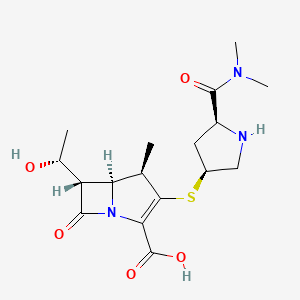
Meropenem is a carbapenem β-lactam antibacterial agent used to treat serious bacterial infections. Its antibacterial activity results from binding to bacterial penicillin-binding proteins and inhibiting peptidoglycan cross-linking, thereby impairing cell-wall synthesis and promoting bacterial cell death. As a β-lactam, its activity is generally related to the duration for which drug concentrations remain above the organism’s minimum inhibitory concentration.
Meropenem has clinical importance against severe infections caused by Gram-negative organisms, including Escherichia coli, Klebsiella pneumoniae, Pseudomonas aeruginosa, and Acinetobacter baumannii, although susceptibility is limited by β-lactamase-mediated resistance. Metallo-β-lactamases (MBLs), including VIM-1 and New Delhi metallo-β-lactamase-5 (NDM-5), can hydrolyze carbapenems and compromise meropenem activity. Recent research has therefore examined meropenem in combination with enzyme-directed ligands, natural products, metal-oxide nanoparticles, and drug-delivery materials. Other work has addressed its use in meningitis and its comparative safety in antibiotic combinations involving vancomycin, piperacillin/tazobactam, or cefepime.
Rebuilt from PubMed 18 Sept 2026 · no new papers today
Where the papers sit
10 papers study meropenem directly. The themes below are drawn from those 10. 1 paradigm shift and 1 new direction follow.
-
Meropenem Resistance Reversal : Metallo-β-lactamase inhibition is being pursued to restore meropenem activity, using zinc-binding ligands, SKQ1, primin and essential oils against resistant bacteria. Stability testing also supports practical meropenem formulation and storage. 5 papers · 50%
-
Antimicrobial Nanomaterials and Wound Care : Plant-derived CoO nanoparticles and Aloe vera–Sterculia hydrogels point toward multifunctional antibacterial materials for wound treatment and drug delivery. The work repeatedly combines antimicrobial testing with structural and microscopic characterization. 2 papers · 20%
-
Others — Antimicrobial Treatment and Safety : Clinical infection management and antibiotic toxicity sit alongside experimental antimicrobial peptides, with no single mechanistic direction. Recurring concerns are antibacterial efficacy, meningitis treatment and acute kidney injury during combination therapy. 3 papers · 30%
Metallo-β-lactamase resistance does not make meropenem irretrievable: enzyme-targeting adjuvants can restore its activity
The NDM-1-producing Escherichia coli study of SKQ1, the VIM-1-producing Klebsiella pneumoniae study of zinc-binding ligands, and the NDM-5-producing E. coli study of primin all assume that metallo-β-lactamase-mediated hydrolysis has compromised meropenem, but independently find that the antibiotic can be rescued by a separate compound that blocks the resistance mechanism. SKQ1 inhibited NDM-1 and synergized with meropenem in vitro and in vivo, D-penicillamine and chlorpropamide restored meropenem activity against VIM-1-producing bacteria, and primin restored activity against NDM-5-producing E. coli (PMIDs 42711660, 42644634, 41985229). The resulting change is from treating meropenem resistance as a reason to abandon the antibiotic to treating meropenem as a recoverable component of combination therapy.
Meropenem is also being studied as a room-temperature infusion formulation whose chemical stability, rather than antibacterial synergy, is the endpoint
The meropenem-in-normal-saline extended-infusion study examines meropenem diluted in 0.9% sodium chloride and stored at 23–25 °C, rather than using it as an antibacterial partner against resistant organisms. It tests whether the drug remains above the 90% concentration threshold for as long as 24 hours, challenging the package-insert assumption that room-temperature stability is limited to 1 hour and redirecting meropenem research toward practical formulation and administration conditions 41935840Apr.
Recent Findings on meropenem
Metallo-β-lactamase Inhibition: SKQ1, D-penicillamine, and chlorpropamide restored meropenem activity against NDM-1-producing Escherichia coli or VIM-1-producing Klebsiella pneumoniae. SKQ1 directly inhibited NDM-1, with molecular and in vivo findings supporting its potentiator activity 42711660Sep42644634Aug. Primin was identified as a plant-derived inhibitor of NDM-5 that restores meropenem activity in E. coli 41985229Apr. Clove essential oil, eugenol, and isoeugenol also potentiated meropenem, but synergy varied across methicillin-resistant Staphylococcus aureus, Acinetobacter baumannii, and Bacillus spp. 42470444Jul. Meropenem formulation testing further showed chemical stability for 12 hours in 0.9% sodium chloride injection at 23–25 °C 41935840Apr.
Antimicrobial Wound Materials: Salvia officinalis-mediated cobalt oxide nanoparticles combined direct antibacterial activity against extended-spectrum beta-lactamase-producing isolates with enhanced meropenem activity 42156860May. The nanoparticles showed inhibition zones of 24–26 mm and minimum inhibitory concentrations of 0.312–0.625 mg/ml, but they also produced dose-dependent effects in normal cell lines 42156860May. An Aloe vera–Sterculia gum hydrogel provided sustained meropenem release through a non-Fickian mechanism described by the Korsmeyer–Peppas model 41995147Apr. The hydrogel showed low hemolysis, high cell viability, antioxidant activity, oxygen and water-vapour permeability, and mechanical strength suited to wound dressing applications 41995147Apr.
Self-assembling amphiphilic cationic peptide nanospheres killed Gram-positive and Gram-negative bacteria by permeabilizing bacterial membranes. The peptides also sensitized multidrug-resistant isolates to meropenem and remained non-cytotoxic to HEK-293 cells at bactericidal doses 42573017Aug. In a Turkish pediatric case series, clinicians used ampicillin-based therapy in 10 of 11 children with Listeria monocytogenes meningitis, including meropenem in nine 42570017Aug. Mortality and severe sequelae each occurred in 18.2%, while candidate associations with unfavorable outcomes lost significance after Bonferroni correction 42570017Aug. A large Chinese cohort found no increased risk of acute kidney injury or major adverse kidney events with vancomycin plus piperacillin/tazobactam compared with vancomycin plus meropenem 42405788Jul.
Written from 10 PubMed abstracts, each one cited by PMID above. Published: 2026-08-28. Last written: 2026-09-11 by GPT. Drafted by language models from published abstracts; not medical advice.