vancomycin
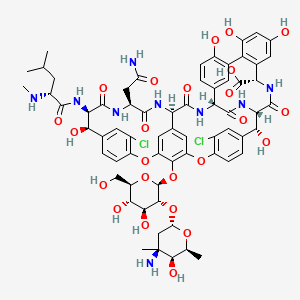
Overview
Vancomycin is a glycopeptide antibiotic used primarily for serious infections caused by gram-positive bacteria, especially methicillin-resistant Staphylococcus aureus (MRSA). It remains an important therapy in hospital practice because of its activity against resistant staphylococci and other susceptible gram-positive pathogens. Its clinical use is often guided by pharmacokinetic monitoring because efficacy and toxicity are both closely tied to exposure.
Biologically, vancomycin acts by binding to the D-Ala-D-Ala terminus of peptidoglycan precursors, thereby inhibiting bacterial cell-wall synthesis. In recent biomedical literature, it is frequently used as a comparator standard for new anti-MRSA agents, as a component of combination regimens, and as a reference drug in studies of infection control, drug delivery, and antibiotic safety. Its limitations, including poor pulmonary bioavailability, limited tissue retention, and dose-limiting nephrotoxicity, continue to motivate research into improved formulations and alternatives.
Recent Publications Focus
Recent studies have focused on improving vancomycin screening, monitoring, and delivery. An automated microfluidic screening platform combining micromixers with concentration-gradient chips was used to test vancomycin against methicillin-resistant Staphylococcus aureus, narrowing the apparent MIC range to 0.78–1.01 µg/mL and demonstrating a rapid, flexible approach for antimicrobial concentration screening 42471438Jul. In parallel, multiple sensing platforms were developed for point-of-care or in-matrix vancomycin measurement, including a machine learning-assisted molecularly imprinted polymer electrochemical sensor for undiluted human serum with a detection limit of 0.848 µg/mL and strong agreement with LC-MS/MS in patient samples 42166153May, a lubricin-protected plasmonic nanoslide enabling subnanomolar detection in unprocessed whole blood with retained performance after storage and repeated use 42381442Jul, and a tetra-PEG hydrogel coating that reduced fouling and drift in whole blood while preserving signal gain across tested vancomycin concentrations 42030442Apr.
Several publications examined vancomycin in combination therapies and safety outcomes. A large multicenter retrospective cohort study from China found that concomitant vancomycin and piperacillin-tazobactam was not associated with increased risk of acute kidney injury or major adverse kidney events at 60 days compared with vancomycin plus other beta-lactams, including meropenem and cefepime 42405788Jul. A separate retrospective review also addressed the incidence of acute kidney injury with vancomycin-piperacillin/tazobactam therapy, reflecting ongoing concern about nephrotoxicity in this regimen 42269076Jun. Case-based evidence further highlighted vancomycin-induced acute kidney injury in a patient with type 2 diabetes and augmented renal clearance, where high-dose therapy led to toxic trough levels and kidney injury that improved after discontinuation and hydration, underscoring the need for individualized dosing and close renal monitoring 41793706Mar. Another case report described vancomycin-associated DRESS syndrome complicated by kidney injury and distributive shock, emphasizing that clinical improvement after corticosteroids may precede normalization of eosinophil and lymphocyte counts 42175544May.
Other studies explored vancomycin as a comparator or component of advanced antimicrobial formulations. In Clostridioides difficile infection, a star-shaped poly(l-lysine) dendrimer microgel system showed superior spore inhibition compared with vancomycin and preserved commensal gut microbiota more effectively than vancomycin in a murine model 42015920Apr. For methicillin-resistant Staphylococcus aureus keratitis, EGCG-Zn-VAN nanoparticles combined prolonged ocular retention, pH-responsive release, and anti-inflammatory effects, achieving >95% reduction in bacterial burden at a lower antibiotic dose than free vancomycin 41992746Apr. A vancomycin-functionalized cerium oxide nanotheranostic platform also showed antibacterial activity, acceptable cytotoxicity, and preferential accumulation in inflamed tissues after 99mTc labeling for imaging 42002147Apr. In addition, vancomycin was used as a benchmark in studies of new antimicrobial candidates, including a stapled antimicrobial peptide analog that outperformed vancomycin against resistant Staphylococcus aureus strains and matched its in vivo efficacy in a skin wound infection model 42262908Jun, and a xanthotoxin derivative that surpassed vancomycin in early bactericidal activity while showing comparable efficacy in an MRSA mouse abscess model 41911663Mar.
What Changes, What Holds
1. Vancomycin measurement and screening are becoming faster and more matrix-tolerant, but this does not change its therapeutic role
METHOD These studies mainly improve how vancomycin is assayed and screened, not what vancomycin is. The practical consequence is better point-of-care or in-sample monitoring and faster antimicrobial testing, which could support exposure-guided dosing and lab workflows. The baseline’s emphasis on pharmacokinetic monitoring is reinforced, while the new platforms suggest that monitoring may become more accessible in serum and whole blood 42166153May42381442Jul.
2. Nephrotoxicity concerns remain, but the vancomycin–piperacillin/tazobactam signal is not settled
NEW DIRECTION The new cohort data do not overturn the baseline’s warning that vancomycin toxicity is exposure-linked and that kidney injury remains a dose-limiting concern; instead, they complicate the specific belief that vancomycin plus piperacillin-tazobactam is uniquely nephrotoxic. Case evidence still shows that high exposure can produce kidney injury and that rare immune-mediated reactions can be severe, so individualized dosing and renal surveillance remain necessary 42405788Jul41793706Mar.
3. Vancomycin is increasingly a benchmark and payload in advanced antimicrobial systems rather than only a stand-alone comparator
REINFORCES These studies extend the baseline’s description of vancomycin as a reference drug in formulation and infection-control research. The main change is not in vancomycin’s core biology, but in how often it is used to judge newer agents or to anchor delivery platforms that try to outperform it in difficult infections. That keeps the established account intact while showing its continuing role as a standard against which newer approaches are measured 42015920Apr42262908Jun.
Overview update candidates: improved vancomycin monitoring/screening methods; unresolved specificity of vancomycin–piperacillin/tazobactam kidney risk; continued use as comparator in advanced antimicrobial development.
vancomycin
Background Contexts
In the literature, the biological baseline, pathological conditions, or disease models commonly surrounding vancomycin are described as follows:
- clostridium difficile infection (Disease) — 2 papers: PMIDs 42148578, 42015920
- methicillin-resistant Staphylococcus aureus (Organism) — 2 papers: PMIDs 42345583, 41992746
- acute kidney injury (Disease) — 1 paper: PMIDs 42269076
- antimicrobial resistance (Other) — 1 paper: PMIDs 41734691
- Augmented renal clearance (Biological Process) — 1 paper: PMIDs 41793706
- bacterial multiple drug resistance (Other) — 1 paper: PMIDs 42262908
- biofilm-related infections (Disease) — 1 paper: PMIDs 41734691
- Clostridium difficile (Organism) — 1 paper: PMIDs 42148578
- drug reaction with eosinophilia and systemic symptoms (DRESS) (Disease) — 1 paper: PMIDs 42175544
- Electrochemical aptamer-based sensors (Technology) — 1 paper: PMIDs 42030442
- Feleucin-K3 (Protein) — 1 paper: PMIDs 42262908
- gram-negative bacterial strains (Disease) — 1 paper: PMIDs 42002147
Methodologies & Technologies Used
Researchers utilize the following experimental methods, imaging platforms, computational models, or biological reagents to study vancomycin:
- propensity score matching (Technology) — 2 papers: PMIDs 42405788, 42168788
- (-)-epigallocatechin gallate (Chemical) — 1 paper: PMIDs 41992746
- (S)-2-(4-pentenyl) alanine (Chemical) — 1 paper: PMIDs 42262908
- amoxicillin (Therapy) — 1 paper: PMIDs 42446531
- ATP quantification assay (Technology) — 1 paper: PMIDs 41734691
- AUC-based protocols (Technology) — 1 paper: PMIDs 41793706
- automated multi-drug combination screening platform (Technology) — 1 paper: PMIDs 42471438
- biodistribution studies (Clinical Metric) — 1 paper: PMIDs 42002147
- Caenorhabditis elegans (Organism) — 1 paper: PMIDs 42148578
- ceftriaxone (Therapy) — 1 paper: PMIDs 42446531
- Cerium Oxide Nanoparticles (Technology) — 1 paper: PMIDs 42002147
- clindamycin (Therapy) — 1 paper: PMIDs 42446531
Molecular Interventions & Targets
The primary molecular pathways, regulatory genes, enzymes, or therapeutic agents actively targeted and manipulated in relation to vancomycin include:
- methicillin-resistant Staphylococcus aureus (Organism) — 2 papers: PMIDs 42471438, 41793706
- Staphylococcus aureus (Organism) — 2 papers: PMIDs 42101848, 41734691
- (RS)-econazole (Therapy) — 1 paper: PMIDs 42148578
- 13F (Chemical) — 1 paper: PMIDs 41763021
- 1c, 1d, and 1j (Chemical) — 1 paper: PMIDs 41734691
- Beta-1,4-N-acetyl-galactosaminyltransferase 2 (Gene) — 1 paper: PMIDs 42059571
- cefepime (Therapy) — 1 paper: PMIDs 42405788
- Colistin sulfate (Therapy) — 1 paper: PMIDs 42471438
- Compound H1 (Chemical) — 1 paper: PMIDs 41911663
- compound I-9 (Chemical) — 1 paper: PMIDs 41985264
- derivative 5c (Chemical) — 1 paper: PMIDs 42345583
- EGCG-Zn-VAN nanoparticles (Therapy) — 1 paper: PMIDs 41992746
Observed Outcomes & Phenotypes
The phenotypic changes, physiological endpoints, or clinical metrics observed and measured in connection with vancomycin include:
- proinflammatory cytokine (Biological Process) — 3 papers: PMIDs 42446531, 42101848, 41992746
- minimum inhibitory concentration (Clinical Metric) — 2 papers: PMIDs 42471438, 42345583
- subnanomolar antifungal activity (Clinical Metric) — 2 papers: PMIDs 42002147, 41763021
- 10% lower incidence of VIN (Clinical Metric) — 1 paper: PMIDs 42168788
- 116 (0.9%) received vitamin E (Clinical Metric) — 1 paper: PMIDs 42168788
- 12,411 eligible patients (Clinical Metric) — 1 paper: PMIDs 42168788
- 2267 (18.3%) developed VIN (Clinical Metric) — 1 paper: PMIDs 42168788
- 75% peak intensity (Clinical Metric) — 1 paper: PMIDs 42381442
- Aada (Gene) — 1 paper: PMIDs 42059571
- Aade (Gene) — 1 paper: PMIDs 42059571
- abscess size (Clinical Metric) — 1 paper: PMIDs 42345583
- acute kidney injury (Disease) — 1 paper: PMIDs 41793706
General Takeaways & Clinical Potentials
The high-level concepts, clinical translations, and overarching conclusions proposed in the research surrounding vancomycin are summarized below:
- 20 min UV-Ozone cleaning (Other) — 1 paper: PMIDs 42381442
- antimicrobial resistance (Other) — 1 paper: PMIDs 42471438
- CDI pathogenesis (Biological Process) — 1 paper: PMIDs 42015920
- clinical translation (Other) — 1 paper: PMIDs 42015920
- dose-sparing strategy (Other) — 1 paper: PMIDs 41992746
- drug discovery processes (Other) — 1 paper: PMIDs 42471438
- dysbiosis-related health outcomes (Other) — 1 paper: PMIDs 42059571
- EGCG-Zn-VAN nanoparticles (Therapy) — 1 paper: PMIDs 41992746
- epidemiological surveillance (Other) — 1 paper: PMIDs 42446531
- favorable safety profiles (Other) — 1 paper: PMIDs 41911663
- immunodeficiency (Other) — 1 paper: PMIDs 42446531
- in vivo monitoring (Other) — 1 paper: PMIDs 42030442