tamoxifen
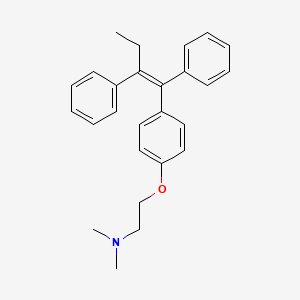
Overview
Tamoxifen is a selective estrogen receptor modulator (SERM) and one of the most widely used endocrine therapies in oncology, particularly for the treatment of hormone receptor-positive (HR+) breast cancer. It acts by competitively binding to estrogen receptors (ERs), thereby blocking estrogen-driven transcription and inhibiting the proliferation of ER-positive tumor cells. Approved for both early-stage and metastatic breast cancer, tamoxifen is prescribed over extended durations of 5–10 years, often alongside or in sequence with aromatase inhibitors such as letrozole, anastrozole, and exemestane, collectively constituting the standard hormone therapy (HT) armamentarium. Beyond oncology, tamoxifen has been investigated in non-malignant conditions, including Duchenne muscular dystrophy (DMD), where its pleiotropic cellular effects may confer therapeutic benefit independent of its antiestrogenic activity.
The drug's mechanism extends beyond direct ER antagonism: tamoxifen modulates downstream signaling cascades including the PI3K/Akt signaling pathway, NF-κB signaling, and Rac1/P-Rex1 GTPase activity, which collectively regulate cell survival, proliferation, and metastatic potential. These multi-pathway interactions underlie both its therapeutic efficacy and the complexity of resistance mechanisms that limit its long-term effectiveness in a significant subset of patients.
Recent Publications Summary
Recent research has focused on predicting tamoxifen efficacy and understanding resistance mechanisms in breast cancer. A secondary analysis of the Stockholm Tamoxifen (STO-3) trial involving 513 postmenopausal patients with ER+/HER2- breast cancer demonstrated that tumor microenvironment composition, assessed through immune and stromal cell profiling, influences long-term tamoxifen benefit 42557562Aug. Mechanistic studies identified actin-regulated plasticity as a key determinant of a bidirectional switch between chemoresistance and resensitization in triple-positive breast cancer, where tamoxifen-induced chemoresistance drives cancer cell survival, progression, and metastasis 41819223Mar.
Clinical investigations have explored tamoxifen combination strategies and extended its therapeutic applications beyond breast cancer. Treatment of metastatic HR+/HER2- breast cancer with taselisib, a selective PI3K inhibitor, combined with tamoxifen was evaluated for safety and efficacy 41632450Feb. Additionally, a phase 3 trial (TAMDMD) and open-label extension demonstrated the safety and efficacy of tamoxifen in boys with Duchenne muscular dystrophy, examining whether earlier treatment initiation reduces disease progression compared to delayed initiation 41691937Feb.
Drug delivery innovation and characterization of tamoxifen interactions in the tumor microenvironment represent emerging areas of investigation. Tamoxifen-loaded solid lipid nanoparticle and nanostructured lipid carriers were developed and comprehensively characterized for activity against triple-negative breast cancer, achieving particles smaller than 200 nm with entrapment efficiency exceeding 90% 42366314Jun. Among breast cancer survivors on long-term hormone therapy including tamoxifen—prescribed for 5–10 years in approximately 80% of ER+ cases—concerns about generic medication switching and associated side effects prompted development of supportive interventions to improve treatment acceptance 42190242May. Furthermore, hemoglobin-fructose glycation products were shown to attenuate tamoxifen-induced loss of cell viability in MCF-7 breast cancer cells, suggesting that advanced glycation end products may modulate tamoxifen efficacy within the tumor microenvironment 42143445May.
What Changes, What Holds
1. tumor microenvironment composition stratifies long-term tamoxifen response in ER+ breast cancer
NEW DIRECTION Immune and stromal cell profiling from early tumors predicts sustained benefit from tamoxifen, stratifying response heterogeneity the Overview's pathway-centric account does not address 42557562Aug. Actin-regulated plasticity gates a bidirectional switch between chemoresistance and resensitization in triple-positive disease 41819223Mar, adding a non-canonical cellular adaptation mechanism to the PI3K/Akt and NF-κB signaling pathways the baseline describes. These findings anchor resistance not solely to dysregulated intracellular signaling but to tumor microenvironment composition and cellular plasticity.
2. Taselisib safely combines with tamoxifen for HR+ metastatic disease, and phase 3 trial confirms efficacy in Duchenne muscular dystrophy
REINFORCES Selective PI3K inhibitor taselisib was evaluated with tamoxifen in metastatic HR+/HER2− disease 41632450Feb, extending the established principle of pairing tamoxifen with targeted agents already exemplified by aromatase inhibitors in the baseline. A phase 3 trial in DMD validates the benefit the Overview describes as "investigated," establishing clinical efficacy and safety in boys and examining whether earlier initiation improves outcomes 41691937Feb. Both findings deepen existing territory rather than overturn it.
3. Advanced glycation end products attenuate tamoxifen-induced cell death, revealing metabolic modulation of drug efficacy in the tumor microenvironment
NEW DIRECTION Hemoglobin-fructose glycation products suppress tamoxifen cytotoxicity in breast cancer cells 42143445May, identifying AGE-mediated metabolic adaptation as a resistance pathway the Overview does not address. Concurrently, tamoxifen-loaded nanoparticles (>90% entrapment efficiency) represent formulation innovation 42366314Jun, and adherence barriers with long-term therapy prompted supportive interventions 42190242May. The glycation finding most substantially expands mechanistic understanding of how metabolic factors within the tumor microenvironment constrain drug efficacy.
Overview update candidates: tumor microenvironment immune/stromal profiling as a response predictor; actin-regulated plasticity as a resistance mechanism; and AGE products as metabolic modulators of drug efficacy.
tamoxifen
Background Contexts
In the literature, the biological baseline, pathological conditions, or disease models commonly surrounding tamoxifen are described as follows:
- breast cancer (Disease) — 2 papers: PMIDs 42557562, 41686189
- hormone therapy (Technology) — 2 papers: PMIDs 42115169, 41686189
- rectum adenocarcinoma (Disease) — 2 papers: PMIDs 42399552, 42375537
- advanced glycation end-product (Other) — 1 paper: PMIDs 42143445
- aromatase inhibitors (Therapy) — 1 paper: PMIDs 41686189
- ATC code L02 (Therapy) — 1 paper: PMIDs 42309024
- blood–brain barrier (Biological Process) — 1 paper: PMIDs 42413643
- breast cancer patients (Organism) — 1 paper: PMIDs 42126751
- Breast cancer progression (Disease) — 1 paper: PMIDs 42557562
- Cancer (Disease) — 1 paper: PMIDs 41686189
- cancer cell (Cellular Component) — 1 paper: PMIDs 42442342
- checkpoint inhibitor (Therapy) — 1 paper: PMIDs 42413643
Methodologies & Technologies Used
Researchers utilize the following experimental methods, imaging platforms, computational models, or biological reagents to study tamoxifen:
- aromatase inhibitors (Therapy) — 2 papers: PMIDs 42474572, 42360361
- MCF-7 breast cancer cells (Cell Line) — 2 papers: PMIDs 42143445, 41932111
- triple-negative breast adenocarcinoma (Cell Line) — 2 papers: PMIDs 42406471, 42366314
- 4T1 (Cell Line) — 1 paper: PMIDs 42406471
- Age (Other) — 1 paper: PMIDs 42557562
- AI/machine learning (Technology) — 1 paper: PMIDs 42399552
- antioxidant lipid nanoparticles (Technology) — 1 paper: PMIDs 42366314
- ATC code L02 (Therapy) — 1 paper: PMIDs 42309024
- azoxymethane plus dextran sulfate sodium (AOM/DSS) (Chemical) — 1 paper: PMIDs 41974235
- Biochemical techniques (Technology) — 1 paper: PMIDs 42143445
- biocompatibility (Other) — 1 paper: PMIDs 42366314
- biomarker analysis (Other) — 1 paper: PMIDs 42474572
Molecular Interventions & Targets
The primary molecular pathways, regulatory genes, enzymes, or therapeutic agents actively targeted and manipulated in relation to tamoxifen include:
- anastrozole (Therapy) — 2 papers: PMIDs 42190242, 41686189
- Secreted phosphoprotein 1 (SPP1) (Protein) — 2 papers: PMIDs 42442342, 42399552
- (25R)-cholest-5-ene-3β,26-diol (Chemical) — 1 paper: PMIDs 42399552
- 1,2,3-Triazole (Chemical) — 1 paper: PMIDs 41932111
- 7b (Chemical) — 1 paper: PMIDs 42378404
- abemaciclib (Therapy) — 1 paper: PMIDs 42474572
- acetate (Chemical) — 1 paper: PMIDs 42413643
- Apolipoprotein E4 (APOE4) (Protein) — 1 paper: PMIDs 42399552
- ATC code H02 (Chemical) — 1 paper: PMIDs 41691937
- bevacizumab (Therapy) — 1 paper: PMIDs 42375537
- CALCR (Protein) — 1 paper: PMIDs 42378404
- cetuximab (Therapy) — 1 paper: PMIDs 42375537
Observed Outcomes & Phenotypes
The phenotypic changes, physiological endpoints, or clinical metrics observed and measured in connection with tamoxifen include:
- distant recurrence-free interval (Clinical Metric) — 2 papers: PMIDs 42557562, 41787605
- tumor cell proliferation (Clinical Metric) — 2 papers: PMIDs 42105865, 41974235
- tumor metastasis (Clinical Metric) — 2 papers: PMIDs 42442342, 41819223
- Acceptance of HT (Clinical Metric) — 1 paper: PMIDs 42190242
- adjusted hazard ratio (Clinical Metric) — 1 paper: PMIDs 42557562
- Adverse Effects (Clinical Metric) — 1 paper: PMIDs 42190242
- Allograft Rejection (Disease) — 1 paper: PMIDs 42557562
- anastrozole (Therapy) — 1 paper: PMIDs 41686189
- apoptotic process (Biological Process) — 1 paper: PMIDs 42366314
- aromatase inhibitors (Therapy) — 1 paper: PMIDs 42309024
- ARPC1B (Gene) — 1 paper: PMIDs 42375537
- attitudes toward older adults (Other) — 1 paper: PMIDs 42190242
General Takeaways & Clinical Potentials
The high-level concepts, clinical translations, and overarching conclusions proposed in the research surrounding tamoxifen are summarized below:
- anastrozole (Therapy) — 1 paper: PMIDs 41686189
- aromatase inhibitors (Therapy) — 1 paper: PMIDs 41932111
- Cell membrane (Cellular Component) — 1 paper: PMIDs 42143445
- Chemotherapeutic response (Biological Process) — 1 paper: PMIDs 42143445
- Clinical Practice (Other) — 1 paper: PMIDs 41686189
- Cost-effective Therapies (Therapy) — 1 paper: PMIDs 41686189
- drug bioavailability (Clinical Metric) — 1 paper: PMIDs 42143445
- ENABLE Study (Other) — 1 paper: PMIDs 42190242
- Endocrine treatment efficacy (Biological Process) — 1 paper: PMIDs 42557562
- Immune compartment (Cellular Component) — 1 paper: PMIDs 42557562
- inflammation-to-cancer cascade (Biological Process) — 1 paper: PMIDs 41974235
- lipid-associated disorders (Disease) — 1 paper: PMIDs 42399552