salvianolic acid B
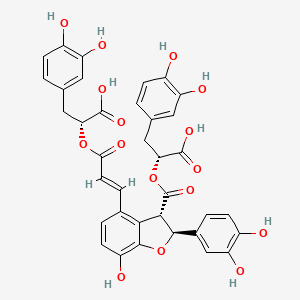
Overview
Salvianolic acid B (Sal B) is a water-soluble, polyphenolic bioactive compound derived from Salvia miltiorrhiza (Danshen), a widely used medicinal herb in traditional Chinese medicine. As a major constituent of Danshen extracts, salvianolic acid B has emerged as a subject of significant scientific interest in recent years due to its multi-targeted pharmacological properties. The compound exhibits potent antioxidant, anti-inflammatory, and neuroprotective effects, operating through modulation of multiple intracellular signaling pathways including the NF-κB axis, ferroptosis regulation, and various growth factor signaling cascades. Its therapeutic potential spans a diverse range of acute and chronic diseases—from cerebrovascular and cardiovascular conditions to inflammatory disorders—though clinical translation has been limited by challenges including poor penetration across the blood–brain barrier and suboptimal bioavailability, which have prompted recent advances in nanoparticle-based delivery strategies.
Recent Publications Summary
Recent studies have continued to examine salvianolic acid B (Sal B) as a neuroprotective and vasculoprotective compound, particularly in ischemic and vascular brain injury. In a transient cerebral ischemia model, Sal B was reported to attenuate excitotoxic neuronal injury, addressing calcium-overload-associated neuronal death after ischemia 42379790Jun. In a separate cerebral infarction/reperfusion study, Sal B reduced infarct volume and improved neurological outcomes while preserving microvascular integrity by suppressing ferroptosis through the ACSL4/Nrf2 axis; this was associated with reduced iron deposition, lipid peroxidation, and neuroinflammation, and the Nrf2 inhibitor ML385 was used to probe mechanism 42186809May. Another ischemia-reperfusion study evaluated Sal B alongside tanshinone IIA, salvianic acid A, and hydroxysafflor yellow A, reporting reduced cerebral injury and implicating the TGF-β1/Smad3 pathway 42102961May.
Several publications focused on Sal B in inflammatory and barrier-injury settings. In sepsis-induced acute lung injury and pulmonary-intestinal epithelial barrier damage, Sal B was investigated as a TNFR1-targeting agent and was reported to alleviate lung and intestinal injury while inhibiting NF-κB-related signaling, necroptosis, and p-MLCK/p-MLC2-associated barrier dysfunction 42176509May. In rheumatoid arthritis, Sal B was studied in fibroblast-like synoviocytes and was reported to attenuate disease progression by targeting 5-methylcytosine RNA methylation-mediated CX26/IκBα/NF-κB signaling 42160901May. These findings place Sal B in a broader anti-inflammatory context, with effects linked to suppression of proinflammatory cytokine signaling.
Sal B has also been explored in cardiovascular injury models and as a component of delivery systems designed to improve pharmacologic performance. In myocardial ischemia-reperfusion injury, Sal B-loaded organic nano-quantum dots modified with cypate improved myocardial accumulation, enabled near-infrared imaging, and reduced infarct area and inflammatory cytokine expression through the SIRT2/NLRP3 pathway; the study also identified Sal B as a natural SIRT2 agonist binding SER-263 41512601Jan. In vascular dementia, intranasally administered liquid crystalline nanoparticles loaded with Sal B were developed to bypass the blood–brain barrier and provide sustained release; the formulation showed good biocompatibility, reduced oxidative damage in neuronal cells, and improved learning and memory in a rat model while lowering reactive oxygen species and IL-1β 42481908Jul. Collectively, these publications highlight Sal B’s recurring roles in modulating oxidative stress, inflammation, ferroptosis, and barrier integrity across diverse disease models.
What Changes, What Holds
1. Sal B now has direct evidence for limiting ischemic excitotoxic and ferroptotic neuronal injury, but the core neuroprotective account stands
REINFORCES These studies sharpen the baseline’s ischemia-related neuroprotection by adding mechanistic support for calcium-overload injury control and ACSL4/Nrf2-linked ferroptosis suppression 42379790Jun42186809May. They do not displace the established view that Sal B acts through antioxidant and anti-inflammatory pathways; instead, they extend that framework into more specific ischemic injury mechanisms and microvascular preservation.
2. Sal B’s anti-inflammatory profile now extends to barrier failure and RNA-methylation-linked synovial signaling
NEW DIRECTION The new work broadens the baseline’s inflammation story into sepsis-associated lung and gut barrier injury and rheumatoid arthritis, areas the overview did not specifically cover 42176509May42160901May. That leaves the established NF-κB-centered anti-inflammatory account intact while adding evidence that Sal B may also act on TNFR1-linked necroptosis, epithelial barrier dysfunction, and CX26/IκBα signaling in disease contexts beyond the original summary.
3. Sal B is being positioned as both a cardiovascular imaging payload and a BBB-bypassing formulation candidate
REINFORCES These studies reinforce the baseline’s delivery problem rather than overturning it: they respond to poor bioavailability and blood–brain barrier penetration with nano-enabled myocardial targeting and intranasal nanoparticle delivery 41512601Jan42481908Jul. The main update is practical, not conceptual—Sal B remains the same bioactive compound, but the recent work strengthens the case that formulation engineering may be necessary to realize its antioxidant and anti-inflammatory potential in vivo.
Overview update candidates: ischemic excitotoxic injury control; ACSL4/Nrf2-linked ferroptosis suppression; TNFR1-linked barrier protection; RNA-methylation-mediated NF-κB signaling in rheumatoid arthritis; nanoparticle and intranasal delivery strategies to improve bioavailability and brain access.
salvianolic acid b
Background Contexts
In the literature, the biological baseline, pathological conditions, or disease models commonly surrounding salvianolic acid b are described as follows:
- blood–brain barrier (Biological Process) — 2 papers: PMIDs 42481908, 42140391
- Cerebral ischemia-reperfusion injury (Disease) — 2 papers: PMIDs 42379790, 42102961
- (chemo)radiotherapy (Biological Process) — 1 paper: PMIDs 41864114
- 5-methylcytosine RNA methylation (Biological Process) — 1 paper: PMIDs 42160901
- apoptotic pathways (Biological Process) — 1 paper: PMIDs 42379790
- brain ischemia (Disease) — 1 paper: PMIDs 42431282
- calcium (Chemical) — 1 paper: PMIDs 42379790
- Carthamus tinctorius L. (Organism) — 1 paper: PMIDs 42102961
- fibroblast-like synoviocyte (Cellular Component) — 1 paper: PMIDs 42160901
- GJB2 (Gene) — 1 paper: PMIDs 42160901
- Glutamatergic signaling (Biological Process) — 1 paper: PMIDs 42379790
- host-directed therapeutics (Therapy) — 1 paper: PMIDs 42176509
Methodologies & Technologies Used
Researchers utilize the following experimental methods, imaging platforms, computational models, or biological reagents to study salvianolic acid b:
- 2,3,5-Triphenyltetrazolium Chloride Staining (Technology) — 2 papers: PMIDs 42186809, 42102961
- ELISA (Technology) — 2 papers: PMIDs 42176509, 42102961
- immunohistochemistry (Technology) — 2 papers: PMIDs 42176509, 42160901
- in vitro and in vivo experiments (Technology) — 2 papers: PMIDs 42379790, 41864114
- RNA sequencing (Technology) — 2 papers: PMIDs 42186809, 42160901
- 5-ethynyl-2'-deoxyuridine (Technology) — 1 paper: PMIDs 42160901
- 5-methylcytosine RNA methylation (Biological Process) — 1 paper: PMIDs 42160901
- 808 nm laser irradiation (Technology) — 1 paper: PMIDs 41512601
- A-549 (Cell Line) — 1 paper: PMIDs 42176509
- balance beam test (Clinical Metric) — 1 paper: PMIDs 42431282
- bEnd.3 (Cell Line) — 1 paper: PMIDs 42431282
- Bilateral common carotid artery occlusion (Technology) — 1 paper: PMIDs 42481908
Molecular Interventions & Targets
The primary molecular pathways, regulatory genes, enzymes, or therapeutic agents actively targeted and manipulated in relation to salvianolic acid b include:
- Acyl-CoA synthetase long-chain family member 4 (ACSL4) (Protein) — 1 paper: PMIDs 42186809
- angiogenesis (Biological Process) — 1 paper: PMIDs 42431282
- carnitine metabolic process (Biological Process) — 1 paper: PMIDs 42431282
- CPT1A (Gene) — 1 paper: PMIDs 42431282
- danshensu (Chemical) — 1 paper: PMIDs 42102961
- Dimethyl bisphenolate (Chemical) — 1 paper: PMIDs 41864114
- GJB2 (Gene) — 1 paper: PMIDs 42160901
- heme oxygenase 1 (Gene) — 1 paper: PMIDs 42186809
- ligustilide (Chemical) — 1 paper: PMIDs 42431282
- mitochondrion (Cellular Component) — 1 paper: PMIDs 42140391
- Myosin light chain 2 (Protein) — 1 paper: PMIDs 42176509
- Myosin light-chain kinase (Protein) — 1 paper: PMIDs 42176509
Observed Outcomes & Phenotypes
The phenotypic changes, physiological endpoints, or clinical metrics observed and measured in connection with salvianolic acid b include:
- Interleukin-1β (IL-1β) (Protein) — 2 papers: PMIDs 42481908, 41512601
- oxidative stress (Biological Process) — 2 papers: PMIDs 42481908, 42140391
- tumor necrosis factor‑α (Protein) — 2 papers: PMIDs 42176509, 42160901
- 5-methylcytosine RNA methylation (Biological Process) — 1 paper: PMIDs 42160901
- anti-ovarian cancer effect (Other) — 1 paper: PMIDs 41864114
- autophagy (Biological Process) — 1 paper: PMIDs 42140391
- Barrier damage (Biological Process) — 1 paper: PMIDs 42176509
- biocompatibility (Other) — 1 paper: PMIDs 42481908
- Caspase 1 (Protein) — 1 paper: PMIDs 42481908
- cell death (Biological Process) — 1 paper: PMIDs 42481908
- Cerebral Infarct Volume (Clinical Metric) — 1 paper: PMIDs 42102961
- excitotoxic neuronal injury (Biological Process) — 1 paper: PMIDs 42379790
General Takeaways & Clinical Potentials
The high-level concepts, clinical translations, and overarching conclusions proposed in the research surrounding salvianolic acid b are summarized below:
- BBB integrity (Clinical Metric) — 1 paper: PMIDs 42186809
- blood–brain barrier (Biological Process) — 1 paper: PMIDs 42481908
- CPT1/HIF-1α signaling pathway (Pathway) — 1 paper: PMIDs 42431282
- early inflammatory storms (Biological Process) — 1 paper: PMIDs 42102961
- GJB2 (Gene) — 1 paper: PMIDs 42160901
- host-directed therapeutics (Therapy) — 1 paper: PMIDs 42176509
- inflammation (Biological Process) — 1 paper: PMIDs 42481908
- metal-phenolic nanozymes (Therapy) — 1 paper: PMIDs 42140391
- mitochondrial delivery (Biological Process) — 1 paper: PMIDs 42140391
- neuronal injury (Clinical Metric) — 1 paper: PMIDs 42186809
- neuroprotection (Biological Process) — 1 paper: PMIDs 42481908
- neuroprotective effect (Other) — 1 paper: PMIDs 42102961