rutin
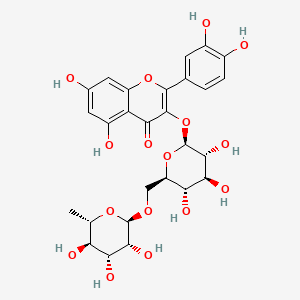
Overview
Rutin is a naturally occurring flavonoid glycoside, widely distributed in plants and commonly discussed in biomedical research for its antioxidant, anti-inflammatory, anti-angiogenic, and broader cytoprotective properties. It is frequently identified in botanical and food matrices such as Sophora japonica, Fagopyrum esculentum (buckwheat), Morus alba leaves, citrus cultivars, pitaya peels, and other polyphenol-rich materials. In recent studies, rutin has been considered both as a bioactive constituent of complex extracts and as a standalone compound with potential therapeutic relevance.
Biologically, rutin is often investigated in relation to oxidative stress, inflammatory signaling, and disease pathways involving nuclear factor kappa B (NF-κB), toll like receptor 4 (TLR4), RUNX1, and related mediators. Across the provided studies, it was associated with antioxidant defense, modulation of proinflammatory cytokines, protection of the intestinal barrier, effects on metabolic dysfunction–associated steatotic liver disease, and antiangiogenic activity. It is also being explored in formulation strategies, including PEG-β-cyclodextrin and other delivery systems, to improve its in vivo performance.
Recent Publications Summary
Recent studies have continued to evaluate rutin as a bioactive therapeutic candidate and as a functional component in delivery systems designed to improve its performance. In a preclinical wound-healing study, rutin was incorporated into a cerium-rutin nanocomplex within an injectable gellan gum hydrogel crosslinked by 1,4-phenylenediboronic acid. The formulation was designed to enhance reactive oxygen species scavenging, provide controlled and sustained release, and support structural stability and injectability for wound repair applications 42377005Jun. In another materials-focused study, rutin was used as a coating agent for iron oxide nanoparticles, where its binding to the cancer-associated chaperone GRP78 was explored as part of a theranostic anticancer strategy 42067522May. Rutin was also formulated into PEG-β-cyclodextrin polymer complexes to address its poor water solubility and improve antiangiogenic activity in vivo 41903785Mar.
Several publications examined rutin as a direct therapeutic agent in disease models. In a rat model of Henoch-Schönlein purpura, rutin at 12.05 mg/kg alleviated skin purpura, renal injury, and systemic inflammation, while also improving vascular endothelial injury, intestinal barrier integrity, gut microbiota composition, and short-chain fatty acid and amino acid metabolism 42103052May. In a mouse model of cuprizone-induced schizophrenia, rutin-loaded polymer/lipid hybrid nanoparticles and their glucosamine/chitosan-coated version improved rutin release and showed therapeutic benefit in behavioral, biochemical, and histopathological assessments, supporting neuroprotective activity 42310329Jun. Rutin was also co-loaded with siBACE1 in a multifunctional neuroenhancer for Alzheimer’s disease, where it suppressed Amyloid beta (Aβ) aggregation, reduced mitochondrial dysfunction and Intracellular ROS in neuronal cells, and contributed to reduced microgliosis, astrogliosis, and synapse loss in mice 41696149Feb.
Mechanistic studies identified specific molecular targets for rutin in inflammatory and metabolic disease contexts. In non-alcoholic fatty liver disease, rutin directly bound RUNX1, disrupted the RUNX1/TET2 complex, and was associated with reduced hepatic steatosis, oxidative stress, inflammatory cytokines, and liver injury markers in both HFD-fed ApoE-/- mice and FFA-exposed HepG2 cells 41997405Apr. In atopic dermatitis, network pharmacology and experimental work were used to investigate rutin targeting of PD-L1, although the abstract provided here does not include the final experimental outcomes 41931959Apr. In glioblastoma, structure-based screening identified rutin as a direct binder of YANK2, a protein involved in met-driven chemoresistance, suggesting a potential role in disrupting this oncogenic axis 42337173Jun. Additional studies also highlighted rutin as a major phenolic constituent in plant-derived foods and extracts with antioxidant relevance, including pitaya peel flour, Yinxingye tablets, acerola fruits, and a Korean lemon cultivar, where it contributed to the measured phytochemical and antioxidant profiles 42128980May42104588May41944642Apr41875772Mar.
Other recent work focused on rutin’s physicochemical interactions with biomolecules and its potential in food and preservation applications. Rutin was shown to form stable noncovalent complexes with myoglobin, improving beef color stability during refrigerated storage and increasing thermal stability of the protein 42047409Apr. In a study of pitaya peel flour and chocolate truffles, rutin was among the major flavonoids identified and contributed to the antioxidant-rich profile of the formulation 42128980May. Together, these publications portray rutin as a multifunctional flavonoid studied both as a direct therapeutic agent and as a bioactive component in advanced delivery systems, with reported activities spanning antioxidant, anti-inflammatory, neuroprotective, antiangiogenic, and disease-targeting applications 42377005Jun42103052May41997405Apr41696149Feb41903785Mar.
What Changes, What Holds
1. Rutin is now being used as a scaffold for controlled-release and targeting systems rather than only as a free bioactive flavonoid
REINFORCES These studies extend the delivery-strategy theme already present in the Overview: rutin is being engineered into hydrogels, nanoparticle coatings, and polymer complexes to improve stability, solubility, release, and local performance 42377005Jun41903785Mar. The main change is practical rather than conceptual, but the wound-healing and theranostic uses suggest a broader formulation role that may matter for translation.
2. Rutin’s disease relevance now extends into vascular, renal, gut, and neuropsychiatric models with multi-system benefit
NEW DIRECTION The new work adds Henoch-Schönlein purpura, schizophrenia, and Alzheimer’s-related neuroprotection to the Overview’s inflammatory, metabolic, and barrier-protective framing, so it broadens the disease map without displacing any established claim 42103052May42310329Jun. What remains unsettled is whether these benefits reflect a shared core mechanism or model-specific effects, especially given the heavy reliance on preclinical systems and delivery-enhanced formulations.
3. Direct target engagement is sharpening rutin’s mechanistic profile in metabolic and oncogenic pathways
REINFORCES Binding to RUNX1 fits the Overview’s emphasis on NF-κB, TLR4, and related inflammatory mediators, and the additional target discoveries in PD-L1 and YANK2 mainly extend the list of candidate pathways rather than overturning it 41997405Apr42337173Jun. The important implication is that rutin is moving from a generic antioxidant description toward a more targetable small-molecule profile, though the causal weight of each interaction still needs validation.
4. Rutin is also being positioned as a functional ingredient in food and preservation contexts, not just a therapeutic lead
NEW DIRECTION Stable complex formation with myoglobin and its contribution to phytochemical-rich foods expand rutin into a materials and food-science role that the Overview does not cover 42047409Apr42128980May. This does not challenge its antioxidant reputation, but it does show that rutin’s utility may include quality stabilization and formulation effects outside disease treatment, which should be kept separate from therapeutic claims.
Overview update candidates: rutin as a scaffold in advanced delivery systems; rutin’s expanded preclinical activity in vascular; renal; gut; and neuropsychiatric disease models; direct RUNX1 binding as a mechanistic detail; food/preservation applications involving protein stabilization.
rutin
Background Contexts
In the literature, the biological baseline, pathological conditions, or disease models commonly surrounding rutin are described as follows:
- Alzheimer's disease (Disease) — 1 paper: PMIDs 41696149
- anti-inflammatory agent (Other) — 1 paper: PMIDs 41931959
- antioxidant (Other) — 1 paper: PMIDs 41931959
- Atopic diseases (Disease) — 1 paper: PMIDs 41931959
- Beta amyloid (Protein) — 1 paper: PMIDs 41696149
- biofilm-forming capacity (Other) — 1 paper: PMIDs 42025853
- Cardiovascular Pathology (Biological Process) — 1 paper: PMIDs 41231614
- Citrus limon 'Frost Lisbon' (Other) — 1 paper: PMIDs 41875772
- Citrus limon 'Meyer' (Other) — 1 paper: PMIDs 41875772
- cytoprotective (Other) — 1 paper: PMIDs 41931959
- drug-resistant glioblastoma (Disease) — 1 paper: PMIDs 42337173
- end stage renal failure (Disease) — 1 paper: PMIDs 41231614
Methodologies & Technologies Used
Researchers utilize the following experimental methods, imaging platforms, computational models, or biological reagents to study rutin:
- molecular docking studies (Technology) — 2 papers: PMIDs 42104588, 42047409
- preparative HPLC (Technology) — 2 papers: PMIDs 42104588, 42025853
- (+)-catechin (Chemical) — 1 paper: PMIDs 42025853
- (E)-chlorogenic acid (Chemical) — 1 paper: PMIDs 42025853
- 2,2'-azino-bis(3-ethylbenzothiazoline-6-sulfonic acid) (Other) — 1 paper: PMIDs 41875772
- 2,2-diphenyl-1-picrylhydrazyl (Technology) — 1 paper: PMIDs 41875772
- 2,2-diphenyl-1-picrylhydrazyl (DPPH) (Technology) — 1 paper: PMIDs 41944642
- ApoE-/- mice (Organism) — 1 paper: PMIDs 41997405
- benzothiazole-based oxadiazole derivatives (Chemical) — 1 paper: PMIDs 42337173
- Bird's Opening (Other) — 1 paper: PMIDs 42310329
- botanical dietary fiber (Other) — 1 paper: PMIDs 41935456
- Captex® (Chemical) — 1 paper: PMIDs 42310329
Molecular Interventions & Targets
The primary molecular pathways, regulatory genes, enzymes, or therapeutic agents actively targeted and manipulated in relation to rutin include:
- alpha-glucosidase (Protein) — 2 papers: PMIDs 41944642, 41935456
- Escherichia coli (Organism) — 2 papers: PMIDs 41935456, 41794477
- Staphylococcus aureus (Organism) — 2 papers: PMIDs 41935456, 41794477
- 2-phenylchromane flavonoid (Chemical) — 1 paper: PMIDs 42128980
- acarbose (Therapy) — 1 paper: PMIDs 41944642
- antipyretic activity (Biological Process) — 1 paper: PMIDs 41544480
- apoptotic markers (Clinical Metric) — 1 paper: PMIDs 42104588
- Astragalin (Chemical) — 1 paper: PMIDs 41544480
- beef (Organism) — 1 paper: PMIDs 42047409
- Beta-secretase 1 (Protein) — 1 paper: PMIDs 41696149
- bilobalide (Chemical) — 1 paper: PMIDs 42104588
- CA4 (Therapy) — 1 paper: PMIDs 41875772
Observed Outcomes & Phenotypes
The phenotypic changes, physiological endpoints, or clinical metrics observed and measured in connection with rutin include:
- (E/Z)-cinnamic acid (Chemical) — 1 paper: PMIDs 42417885
- 12.05 mg/kg of rutin (Therapy) — 1 paper: PMIDs 42103052
- 2-phenylchromane flavonoid (Chemical) — 1 paper: PMIDs 41935456
- 3,4-dihydroxybenzoic acid (Chemical) — 1 paper: PMIDs 41794477
- Amino Acids (Chemical) — 1 paper: PMIDs 42103052
- anti-virulence (Other) — 1 paper: PMIDs 42025853
- antiangiogenic effect (Biological Process) — 1 paper: PMIDs 41903785
- antibacterial and bactericidal activity (Biological Process) — 1 paper: PMIDs 42025853
- anticancer activity (Biological Process) — 1 paper: PMIDs 42025853
- antioxidant activity (Biological Process) — 1 paper: PMIDs 41794477
- antioxidant and anti-inflammatory activity (Biological Process) — 1 paper: PMIDs 41875772
- Antioxidant compounds (Chemical) — 1 paper: PMIDs 41794477
General Takeaways & Clinical Potentials
The high-level concepts, clinical translations, and overarching conclusions proposed in the research surrounding rutin are summarized below:
- Astrogliosis (Other) — 1 paper: PMIDs 41696149
- brain uptake (Other) — 1 paper: PMIDs 42310329
- chemoresistance characteristics (Other) — 1 paper: PMIDs 42067522
- clinical application of rutin (Other) — 1 paper: PMIDs 42103052
- clinical investigations (Other) — 1 paper: PMIDs 42310329
- cognitive function (Other) — 1 paper: PMIDs 41696149
- delivery system (Other) — 1 paper: PMIDs 41903785
- functional food (Other) — 1 paper: PMIDs 41944642
- functional potential of SB juice (Other) — 1 paper: PMIDs 41935456
- further mechanistic research and in vivo validation (Other) — 1 paper: PMIDs 41935456
- high-value cultivar (Other) — 1 paper: PMIDs 41875772
- high-value resources (Other) — 1 paper: PMIDs 41544480