paclitaxel
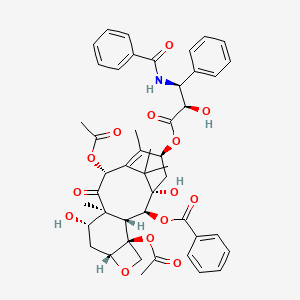
Overview
Paclitaxel is a cytotoxic chemotherapy drug — a diterpene natural product originally isolated from the bark of the Pacific yew tree (Taxus brevifolia) and now one of the most widely administered anticancer agents in oncology. It belongs to the taxane class, alongside docetaxel, and acts by binding the β-tubulin (TUBB) subunit of assembled microtubules. Rather than depolymerizing microtubules as vinca alkaloids do, paclitaxel hyperstabilizes tubulin polymers, disrupting the dynamic instability the mitotic spindle requires for chromosome segregation; cells arrest at the G2/M transition and undergo apoptosis. Because the effect falls hardest on rapidly dividing cells, paclitaxel has broad-spectrum activity across breast, ovarian, lung, pancreatic, and other malignancies, and it is a standard component of combination regimens — with carboplatin, gemcitabine, doxorubicin, or the HER2-directed antibodies trastuzumab and pertuzumab, among others. Its characteristic toxicities, notably peripheral neuropathy and myelosuppression, constrain dosing.
Paclitaxel is highly lipophilic and poorly water-soluble, and conventional formulations rely on the surfactant Cremophor EL as a vehicle, which contributes hypersensitivity reactions and nonlinear pharmacokinetics of its own. This has driven sustained work on alternative delivery: albumin-bound nanoparticle paclitaxel (nab-paclitaxel), oral lipid-based preparations that avoid Cremophor EL entirely, and polymeric, glycopolymer, and chitosan-based nanocarriers designed for pH-responsive or tumor-targeted release, sometimes co-loading a photosensitizer for combined chemo- and photochemotherapy. Delivery format is not merely pharmacokinetic: formulation appears to shape the tumor microenvironment and immune response differently, which is relevant as paclitaxel is increasingly paired with immune checkpoint inhibitors such as pembrolizumab, atezolizumab, and durvalumab, and with the anti-angiogenic antibody bevacizumab. Resistance to paclitaxel remains a central clinical problem and has been linked to signaling through the PI3K/Akt and MAPK pathways, CD44/JAK2/STAT3 signaling, altered microtubule-associated proteins such as tau (MAPT), and adaptive changes in oxidative stress and mitochondrial metabolism.
Recent Publications Summary (latest 30 papers)
Recent clinical studies have broadened paclitaxel's therapeutic applications through novel combination strategies. In triple-negative breast cancer, durvalumab plus paclitaxel with or without capivasertib or oleclumab was evaluated, with the oleclumab-containing arm showing improved tolerability 42189888May. Paclitaxel-based regimens achieved meaningful responses in other indications: ramucirumab plus paclitaxel following nivolumab-based chemotherapy produced pathological complete response in esophagogastric junction cancer 42541665Aug, perioperative serplulimab combined with paclitaxel or nab-paclitaxel and carboplatin demonstrated feasibility in resectable squamous non-small cell lung cancer 42114951May, and neoadjuvant paclitaxel-carboplatin proved safe and tolerable in pregnant patients with cervical cancer 42489393Jul. Dostarlimab plus carboplatin-paclitaxel was economically favorable for endometrial cancer treatment 42535775Jul. In HER2-positive breast cancer, eribulin produced equivalent survival outcomes to paclitaxel or docetaxel when combined with trastuzumab and pertuzumab, while demonstrating reduced peripheral sensory neuropathy 42420599Jul. A planned study is investigating bevacizumab and paclitaxel induction prior to atezolizumab and nab-paclitaxel in PD-L1-positive metastatic triple-negative breast cancer to overcome VEGF-associated resistance mechanisms 42128502May.
Mechanistic studies have identified molecular drivers of paclitaxel resistance amenable to therapeutic targeting. Sphingomyelin synthase 1 (SMS1) silencing enhanced paclitaxel sensitivity in ovarian cancer cells 42593674Aug, while carboxy-terminal domain small phosphatase like 2 (CTDSPL2) knockdown reversed paclitaxel resistance in breast cancer by restoring SCYL1 phosphorylation and suppressing extracellular vesicle secretion 42041204Apr. In nasopharyngeal carcinoma, MARCH3-mediated ubiquitination of hexokinase 2 enhanced paclitaxel sensitivity 42044316Apr. Multi-omics profiling of high-grade serous ovarian cancer revealed that nab-paclitaxel outperformed conventional paclitaxel in promoting B-cell-mediated humoral immunity and antibody responses 42474029Jul, and identified mitochondrial complex I dependency as a bioenergetic vulnerability in chemotherapy-resistant tumors; Complex I inhibition selectively restored carboplatin sensitivity in resistant cells and xenograft models 42474029Jul.
Paclitaxel-induced peripheral neuropathy, a major treatment-limiting adverse effect, was successfully mitigated in preclinical models with celecoxib through COX-2/PGE2 pathway modulation, reducing thermal and mechanical hypersensitivity while promoting dorsal root ganglia neuronal survival 42048120Apr.
Advances in paclitaxel delivery have centered on nanotechnology platforms to improve bioavailability and enable dual or combination therapies. Amphiphilic glycopolymer nanoparticles enabled pH-responsive paclitaxel release in pancreatic cancer, with gemcitabine co-delivery significantly enhancing tumor suppression and survival 42138136May. Poly(2-oxazoline) micelles co-encapsulating paclitaxel and metronidazole benzoate simultaneously targeted tumor cells and intratumoral bacteria 42579029Aug. Reengineered albumin-paclitaxel nanoparticles co-delivering Padi4 and RAGE inhibitors prevented chemotherapy-driven metastasis in triple-negative breast cancer by suppressing histone citrullination and RAGE/ERK signaling 42085319May. A fluorinated chitosan-based theranostic platform co-delivered paclitaxel with a photosensitizer for image-guided hepatocellular carcinoma therapy with pH/laser-responsive release 42252614Jun. CD44-targeted cyclodextrin nanoparticles loaded with paclitaxel and gemcitabine showed enhanced activity in drug-resistant pancreatic cancer 41966415Apr, while reactive oxygen species-responsive nanoparticles co-delivering a paclitaxel prodrug and TLR7/8 agonist R848 synchronized chemo-immunotherapeutic delivery 41944671Apr. Additional formulations included silk fibroin nanoparticles for glioblastoma 42011846Apr, β-cyclodextrin-functionalized metal-organic frameworks for breast and lung cancer with pH-responsive kinetics 41831952Mar, and targeted nanoparticles co-loaded with piperine and paclitaxel prodrug for synergistic ovarian cancer therapy 42011733Apr. Paclitaxel-biotin conjugates demonstrated programmable self-assembly into nanoparticles with tunable properties based on linker length 41895687Mar, and injectable modular microgels enabled temporally coordinated multi-drug delivery 41846001Mar.
Emerging technological approaches have accelerated paclitaxel development and personalized therapy assessment. The oral paclitaxel formulation DHP107, employing novel lipid-based delivery without Cremophor EL, was profiled for pharmacokinetic food effects in patients with advanced solid tumors 42215716May. Surface-enhanced Raman spectroscopy biosensors enabled rapid, label-free assessment of paclitaxel chemosensitivity across drug-resistant breast cancer cells, xenografts, and patient-derived tissues, with mechanistic analysis linking drug sensitivity fingerprints to metabolic reprogramming of arginine and methionine-cysteine pathways 41863959Mar. Biotechnology advances included engineering Salvia miltiorrhiza hairy roots as a scalable platform for high-yield production of taxadiene, a paclitaxel precursor, through metabolic engineering and transcriptional reprogramming 41858113Mar.
What Changes, What Holds
Eribulin achieves equivalent efficacy with reduced peripheral neuropathy versus paclitaxel in HER2-positive breast cancer
NEW DIRECTION Equivalent survival outcomes at substantially lower peripheral sensory neuropathy 42420599Jul reframe paclitaxel's characteristic dose-limiting toxicity as addressable through agent substitution rather than dose reduction, shifting the clinical problem from managing a toxicity burden to selecting among equivalent agents based on tolerability.Mitochondrial Complex I inhibition reverses paclitaxel resistance while nab-paclitaxel formulation enhances B-cell immunity
NEW DIRECTION Complex I emerges as a druggable metabolic vulnerability in resistant tumors; selective inhibition restored paclitaxel sensitivity in preclinical models. Nab-paclitaxel simultaneously outperforms conventional paclitaxel in promoting B-cell-mediated humoral immunity in ovarian cancer 42474029Jul. The Overview acknowledges formulation effects but doesn't specify Complex I as a therapeutic target or immunological advantages differentiating paclitaxel variants.COX-2 inhibition with celecoxib prevents paclitaxel-induced peripheral neuropathy while preserving neuronal survival
NEW DIRECTION celecoxib mitigated paclitaxel-induced peripheral neuropathy in preclinical models via COX-2/PGE2 pathway inhibition, reducing thermal and mechanical hypersensitivity while promoting dorsal root ganglia neuronal survival 42048120Apr. The Overview identifies peripheral neuropathy as a characteristic dose-limiting toxicity; this finding suggests neuropathy might be preventable through co-medication rather than dose reduction alone.Nanoparticulate formulations prevent paclitaxel-associated metastatic dissemination through co-delivery of anti-metastatic agents
NEW DIRECTION Albumin-paclitaxel nanoparticles co-delivering Padi4 and RAGE inhibitors prevented metastatic progression in triple-negative breast cancer by suppressing histone citrullination and RAGE/ERK signaling 42085319May. The Overview covers nanoparticle delivery and immune modulation but doesn't address prevention of metastatic recurrence, a clinical consequence that advanced formulations can now mitigate through complementary agent co-delivery.Arginine and methionine-cysteine metabolism predict paclitaxel chemosensitivity independent of known resistance pathways
NEW DIRECTION Rapid label-free biosensors revealed that paclitaxel chemosensitivity fingerprints correlate with distinct arginine and methionine-cysteine metabolic reprogramming patterns in resistant breast cancer cells and patient tissues 41863959Mar. This identifies metabolic biomarkers for predicting drug response, complementing but distinct from the PI3K/Akt, MAPK, and CD44/JAK2/STAT3 pathways the Overview emphasizes as resistance drivers.
Overview update candidates: Entry 1 (eribulin comparison in HER2-positive breast cancer) represents sufficient clinical evidence for the toxicity management section. Entries 2–5 remain preclinical or exploratory and warrant further validation before integration.
paclitaxel
Background Contexts
In the literature, the biological baseline, pathological conditions, or disease models commonly surrounding paclitaxel are described as follows:
- triple-negative breast cancer (Disease) — 5 papers: PMIDs 42579029, 42535874, 42442848, 42189888, etc.
- ovarian cancer (Disease) — 3 papers: PMIDs 42593674, 42138099, 41833656
- Paclitaxel-induced peripheral neuropathy (Disease) — 3 papers: PMIDs 42097147, 42065994, 42048120
- adenocarcinoma (Disease) — 2 papers: PMIDs 42541665, 42207168
- breast cancer (Disease) — 2 papers: PMIDs 42503543, 42041204
- Chemotherapy-Induced Alopecia (Other) — 2 papers: PMIDs 42594101, 42475686
- endometrial cancer (Disease) — 2 papers: PMIDs 42535775, 41690202
- hepatocellular carcinoma (Disease) — 2 papers: PMIDs 42418047, 42252614
- lung cancer (Disease) — 2 papers: PMIDs 42241811, 41831952
- Non-small cell lung cancer (Disease) — 2 papers: PMIDs 42241811, 42207168
- taxane (Therapy) — 2 papers: PMIDs 42594101, 42593920
- triple-negative (Other) — 2 papers: PMIDs 42085319, 41833656
Methodologies & Technologies Used
Researchers utilize the following experimental methods, imaging platforms, computational models, or biological reagents to study paclitaxel:
- carboplatin (Therapy) — 7 papers: PMIDs 42535974, 42521492, 42503543, 42478852, etc.
- cyclophosphamide (Therapy) — 5 papers: PMIDs 42594101, 42535974, 42478852, 42475686, etc.
- epirubicin (Therapy) — 3 papers: PMIDs 42594101, 42475686, 42442848
- pembrolizumab (Therapy) — 3 papers: PMIDs 42535874, 42521492, 42442848
- bevacizumab (Therapy) — 2 papers: PMIDs 42521492, 42478852
- breast cancer (Disease) — 2 papers: PMIDs 42594101, 42478852
- chemotherapy (Therapy) — 2 papers: PMIDs 42594101, 42593674
- ClinicalTrials.gov (Other) — 2 papers: PMIDs 42594101, 42535874
- docetaxel (Therapy) — 2 papers: PMIDs 42594101, 42503543
- Hyaluronan sodium (Chemical) — 2 papers: PMIDs 42011733, 41966415
- polyethylene glycol (Chemical) — 2 papers: PMIDs 42011846, 41903398
- (E)-chlorogenic acid (Chemical) — 1 paper: PMIDs 41638952
Molecular Interventions & Targets
The primary molecular pathways, regulatory genes, enzymes, or therapeutic agents actively targeted and manipulated in relation to paclitaxel include:
- carboplatin (Therapy) — 8 papers: PMIDs 42593674, 42535775, 42489393, 42474029, etc.
- Nab-Paclitaxel (Therapy) — 3 papers: PMIDs 42474029, 42128502, 42114951
- durvalumab (Therapy) — 2 papers: PMIDs 42189888, 41690202
- gemcitabine (Therapy) — 2 papers: PMIDs 42138136, 41966415
- pembrolizumab (Therapy) — 2 papers: PMIDs 42535874, 41732954
- resiquimod (Therapy) — 2 papers: PMIDs 41944671, 41638952
- (20S)-protopanaxadiol (Chemical) — 1 paper: PMIDs 41858113
- 2i (Chemical) — 1 paper: PMIDs 41951086
- 3PVP (Chemical) — 1 paper: PMIDs 41499860
- 4PVP (Chemical) — 1 paper: PMIDs 41499860
- 5,10,15,20-tetrakis[3,5-bis(trifluoromethyl)phenyl]porphyrin (Chemical) — 1 paper: PMIDs 42252614
- 8-aminoguanine (Chemical) — 1 paper: PMIDs 41948937
Observed Outcomes & Phenotypes
The phenotypic changes, physiological endpoints, or clinical metrics observed and measured in connection with paclitaxel include:
- apoptotic process (Biological Process) — 4 papers: PMIDs 42418047, 42011733, 41966415, 41951086
- cytotoxicity (Clinical Metric) — 3 papers: PMIDs 42138099, 42041204, 42011733
- overall survival (Clinical Metric) — 3 papers: PMIDs 42535874, 42489393, 42207168
- oxidative stress (Biological Process) — 3 papers: PMIDs 42593674, 42474029, 42420599
- progression-free survival (Clinical Metric) — 3 papers: PMIDs 42535874, 42420599, 42207168
- survival rate (Clinical Metric) — 3 papers: PMIDs 42138136, 42085319, 42048120
- systemic toxicity (Clinical Metric) — 3 papers: PMIDs 42241811, 42011733, 41903398
- CD274 molecule (Protein) — 2 papers: PMIDs 42521492, 42189888
- dendritic cell maturation (Biological Process) — 2 papers: PMIDs 41944671, 41237436
- encapsulation efficiency (Clinical Metric) — 2 papers: PMIDs 41903398, 41895687
- ferroptosis (Biological Process) — 2 papers: PMIDs 42241811, 41951086
- half maximal inhibitory concentration (Clinical Metric) — 2 papers: PMIDs 42252614, 41903398
General Takeaways & Clinical Potentials
The high-level concepts, clinical translations, and overarching conclusions proposed in the research surrounding paclitaxel are summarized below:
- Chemoimmunotherapy (Therapy) — 3 papers: PMIDs 41903398, 41638952, 41237436
- mechanical allodynia (Clinical Metric) — 2 papers: PMIDs 41948937, 41894848
- 5-HT2AR Activation (Biological Process) — 1 paper: PMIDs 42065994
- Advanced Esophagogastric Junction Cancer (Disease) — 1 paper: PMIDs 42541665
- Adverse Events (Other) — 1 paper: PMIDs 41732954
- aggressive cancers (Disease) — 1 paper: PMIDs 41833656
- alternative strategies (Other) — 1 paper: PMIDs 42521492
- analgesic effects (Other) — 1 paper: PMIDs 42118387
- anti-tumor drug development (Other) — 1 paper: PMIDs 41577017
- Antinociceptive Properties (Biological Process) — 1 paper: PMIDs 42065994
- antitumor efficacy (Clinical Metric) — 1 paper: PMIDs 41628534
- autophagy pathways (Biological Process) — 1 paper: PMIDs 41833656