naringenin
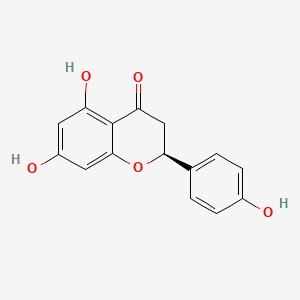
Overview
Naringenin (Wikidata: Q418374) is a flavanone — a flavonoid subclass — abundant in citrus fruit, tomatoes and various medicinal herbs. It is the aglycone of naringin, systematically (2S)-5,7-dihydroxy-2-(4-hydroxyphenyl)-2,3-dihydrochromen-4-one, and occupies a branch point in plant flavonoid biosynthesis, serving as the precursor from which isoflavone synthase directs flux toward isoflavones such as genistein. In mammals it is studied as a bioactive compound with antioxidant, anti-inflammatory, hepatoprotective and metabolic-regulatory activity, and its capacity to touch many targets at once — oxidative stress pathways, inflammatory cascades and lipid metabolism networks — has made it a recurring subject of network pharmacology and multi-target drug discovery.
Reported effects run through several signaling axes: activation of the Nrf2/NQO-1 antioxidant programme, suppression of proinflammatory mediators including interleukin-6 and high mobility group box 1 (HMGB1), and modulation of ferroptosis, the iron-dependent cell death increasingly implicated in inflammatory organ injury.
The obstacle to all of it is exposure. Dietary intake is mostly as the glycoside naringin, which must be cleaved by gut microbial rhamnosidases before absorption; the released aglycone is poorly water-soluble and then extensively glucuronidated and sulfated in the enterocyte and liver, so plasma concentrations of free naringenin are orders of magnitude below those used in the cell experiments that motivate interest in it, and its half-life is short. This is the standard reason in vitro potency does not predict dietary effect, and it is why formulation work — nanocarriers, phospholipid complexes, and semisynthetic derivatives — accompanies most therapeutic proposals. Naringenin remains a plausible lead for metabolic, hepatic and inflammatory disease, with the qualification that a compound this poorly absorbed must be reformulated or redesigned before its pharmacology can be tested properly.
Recent Publications Summary
Recent publications have examined naringenin in several contexts, including as a phytochemical constituent of medicinal plants, a target for analytical assay development, and a bioactive compound in disease models. In phytochemical studies, naringenin was identified among compounds isolated from Encephalartos ferox and detected in Achillea arabica extracts, alongside other flavonoids such as apigenin and kaempferol-related constituents 42443245Jul42126671May. It was also identified as one of the active components associated with Shenling Baizhu Powder in an integrated network pharmacology and chinmedomics analysis of ulcerative colitis with spleen deficiency and dampness stagnation 42089391May.
Several publications focused on naringenin delivery and quantification. A nanobody-based indirect competitive ELISA was developed for naringenin detection, using two naringenin-specific nanobodies with improved thermal stability and strong agreement with UPLC-MS/MS measurements in pomelo and herbal samples 42300510Jun. In another study, naringenin was encapsulated in a shellac nanoparticle-based composite sponge for pH-responsive release in infected diabetic wound microenvironments, where the formulation showed antioxidant, antibacterial, and hemostatic properties 41887025Mar. Naringenin was also incorporated into a nanosuspension embedded in a glycyrrhizin-based hydrogel, which improved solubility, oral bioavailability, and hepatic accumulation in a mouse model of cholestatic liver injury 41576734Jan. In pomelo peel-derived pectin delivery research, simulated digestion indicated that about 70% of encapsulated naringenin was available for intestinal release 42056777Apr.
Therapeutic studies reported anti-inflammatory, antioxidant, and organ-protective effects of naringenin in disease models. In interstitial cystitis/bladder pain syndrome with metabolic syndrome, naringenin was shown to bind NFE2, downregulate its expression, activate the Nrf2/NQO-1 pathway, and reduce bladder dysfunction, inflammation, and fibrosis while inhibiting ferroptosis 41806694Mar. In cholestatic liver injury, the naringenin nanosuspension-hydrogel system improved hepatoprotection by inhibiting oxidative stress and HMGB1-mediated inflammation 41576734Jan. In diabetic wound repair, naringenin-loaded composite sponge formulations supported rapid hemostasis and antimicrobial activity against Staphylococcus aureus and Escherichia coli 41887025Mar. These findings collectively position naringenin as a bioactive flavonoid of interest for antioxidant, anti-inflammatory, and delivery-oriented biomedical applications 41806694Mar41576734Jan41887025Mar.
What Changes, What Holds
1. Naringenin’s role is broadened from a plant and mammalian bioactive to a documented phytochemical marker and formula-associated constituent
NEW DIRECTION The new work does not challenge the established flavanone, precursor, or pharmacology account; it extends naringenin’s relevance into phytochemical profiling and formula-network analyses, showing it can be tracked as a constituent in specific medicinal plants and in Shenling Baizhu Powder 42443245Jul42089391May. That supports its continued use as a chemical marker in natural-product and systems-pharmacology studies, but it does not yet add a new biological mechanism.
2. Naringenin is now being used as a measurable and engineerable payload, not just a bioactive compound
METHOD Nanobody-based ELISA, nanoparticle sponges, nanosuspensions, hydrogels, and pectin encapsulation change how naringenin is detected and delivered rather than what it is known to do biologically 42300510Jun41887025Mar. The main update is methodological: improved quantification, solubility, release control, and tissue targeting make the compound more tractable for translational work. These studies reinforce its practical development potential, but they do not displace the baseline pharmacology.
3. Naringenin’s anti-inflammatory and organ-protective profile is reinforced, with added evidence for ferroptosis-linked disease control
REINFORCES The recent disease-model work fits the baseline’s antioxidant, anti-inflammatory, hepatoprotective, and ferroptosis-modulating description, while sharpening it with a specific Nrf2/NQO-1-linked mechanism and HMGB1 suppression in injury settings 41806694Mar41576734Jan. The bladder-pain and cholestatic-liver findings strengthen the idea that naringenin acts through the same stress-response and inflammatory axes already recognized, rather than introducing a new therapeutic direction.
naringenin
Background Contexts
In the literature, the biological baseline, pathological conditions, or disease models commonly surrounding naringenin are described as follows:
- Achillea arabica Kotschy (Organism) — 1 paper: PMIDs 42126671
- cardiovascular disease (Disease) — 1 paper: PMIDs 41538970
- cholestatic liver injury (Disease) — 1 paper: PMIDs 41576734
- dampness stagnation (Other) — 1 paper: PMIDs 42089391
- diabetic chronic wound (Disease) — 1 paper: PMIDs 41887025
- genistein (Chemical) — 1 paper: PMIDs 41775304
- glucose and lipid metabolism (Biological Process) — 1 paper: PMIDs 41538970
- Interstitial cystitis/bladder pain syndrome (Disease) — 1 paper: PMIDs 41806694
- metabolic syndrome (Other) — 1 paper: PMIDs 41806694
- spleen deficiency (Other) — 1 paper: PMIDs 42089391
- triple-negative breast cancer (TNBC) (Disease) — 1 paper: PMIDs 42268988
Methodologies & Technologies Used
Researchers utilize the following experimental methods, imaging platforms, computational models, or biological reagents to study naringenin:
- A. arabica ethanolic extract (Other) — 1 paper: PMIDs 42126671
- Bradyrhizobium japonicum (Organism) — 1 paper: PMIDs 41775304
- calcium carbonate (Chemical) — 1 paper: PMIDs 42056777
- chitosan-gelatin hydrogel (Technology) — 1 paper: PMIDs 41887025
- dielectric barrier discharge (Technology) — 1 paper: PMIDs 42056777
- Escherichia coli (Organism) — 1 paper: PMIDs 41887025
- Fourier transform infrared (Technology) — 1 paper: PMIDs 42056777
- FrrA (Protein) — 1 paper: PMIDs 41775304
- genistein-specific biosensor (Technology) — 1 paper: PMIDs 41775304
- glucono-δ-lactone (Chemical) — 1 paper: PMIDs 42056777
- glycyrrhizin (Therapy) — 1 paper: PMIDs 41576734
- molecular docking and dynamics simulations (Technology) — 1 paper: PMIDs 42089391
Molecular Interventions & Targets
The primary molecular pathways, regulatory genes, enzymes, or therapeutic agents actively targeted and manipulated in relation to naringenin include:
- (E)-chlorogenic acid (Chemical) — 1 paper: PMIDs 42126671
- Anoectochilus roxburghii (Therapy) — 1 paper: PMIDs 41538970
- apigenin (Chemical) — 1 paper: PMIDs 42126671
- apoptotic markers (Clinical Metric) — 1 paper: PMIDs 42089391
- B-cell lymphoma 2 (Protein) — 1 paper: PMIDs 42089391
- butein (Chemical) — 1 paper: PMIDs 42089391
- calycosin 7-O-β-D-glucoside (Chemical) — 1 paper: PMIDs 42089391
- cyanidin-3-O-glucoside (Chemical) — 1 paper: PMIDs 42126671
- delphinidin-3-O-β-glucopyranoside (Chemical) — 1 paper: PMIDs 42126671
- Emulsion gel (Other) — 1 paper: PMIDs 42056777
- FGF2-PI3K-Akt1 signaling (Pathway) — 1 paper: PMIDs 42089391
- glabridin (Chemical) — 1 paper: PMIDs 42089391
Observed Outcomes & Phenotypes
The phenotypic changes, physiological endpoints, or clinical metrics observed and measured in connection with naringenin include:
- 1OSE-cosmosiin complex (Protein) — 1 paper: PMIDs 42126671
- 2-phenylchromane flavonoid (Chemical) — 1 paper: PMIDs 42268988
- 3.1 times that of the wild-type (Clinical Metric) — 1 paper: PMIDs 41775304
- 3.8-fold reduced binding affinity for genistein (Clinical Metric) — 1 paper: PMIDs 41775304
- 6.6-fold increase in the product inhibition constant (Clinical Metric) — 1 paper: PMIDs 41775304
- ABTS+• radicals (Other) — 1 paper: PMIDs 42126671
- anti-inflammatory properties (Other) — 1 paper: PMIDs 42089391
- anti-TNBC effects (Other) — 1 paper: PMIDs 42268988
- apigenin (Chemical) — 1 paper: PMIDs 42126671
- apoptotic markers (Clinical Metric) — 1 paper: PMIDs 42089391
- B-cell lymphoma 2 (Protein) — 1 paper: PMIDs 42089391
- binding affinities (Clinical Metric) — 1 paper: PMIDs 42089391
General Takeaways & Clinical Potentials
The high-level concepts, clinical translations, and overarching conclusions proposed in the research surrounding naringenin are summarized below:
- A. arabica (Organism) — 1 paper: PMIDs 42126671
- Anoectochilus roxburghii (Therapy) — 1 paper: PMIDs 41538970
- chronic wound management (Other) — 1 paper: PMIDs 41887025
- combination drug (Therapy) — 1 paper: PMIDs 42268988
- enzyme feedback inhibition (Biological Process) — 1 paper: PMIDs 41775304
- glycyrrhizin-based matrices (Other) — 1 paper: PMIDs 41576734
- high-throughput screening strategy (Other) — 1 paper: PMIDs 41775304
- homologous combination (Other) — 1 paper: PMIDs 42268988
- multiple components, targets, and pathways (Other) — 1 paper: PMIDs 42089391
- novel pathogenic link (Other) — 1 paper: PMIDs 41806694
- plant-derived natural products (Other) — 1 paper: PMIDs 41775304
- therapeutic agent (Therapy) — 1 paper: PMIDs 41806694