mesalazine
Overview
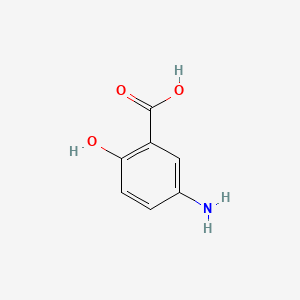
Mesalazine, also known as mesalamine or 5-aminosalicylic acid (5-ASA), is an anti-inflammatory therapeutic agent used primarily in the management of inflammatory bowel diseases, especially ulcerative colitis. It acts locally within the intestinal lumen and colonic mucosa, where it helps suppress inflammatory signaling and reduce mucosal injury. In pharmaceutical development, mesalazine is notable for its high oral dose requirement and for the need to deliver the drug to the colon while minimizing premature release in the upper gastrointestinal tract.
From a formulation and biopharmaceutic perspective, mesalazine is a challenging active pharmaceutical ingredient because its therapeutic effect depends strongly on dissolution behavior, gastrointestinal pH, fluid volume, buffer capacity, transit time, and product design. Recent work has continued to examine how its physicochemical properties, including particle size, crystal habit, crystallinity, wetting, and packing, influence performance in oral and rectal dosage forms.
Recent Publications Summary
Recent publications on mesalazine have focused largely on formulation science, local delivery strategies, and its role within ulcerative colitis treatment regimens. One protocol for a Cochrane Review is evaluating whether switching adults with ulcerative colitis from sulphasalazine or another oral 5-aminosalicylic acid (5-ASA) drug to a different oral 5-ASA agent affects maintenance of clinical or endoscopic remission at 52 weeks, as well as safety outcomes 42504800Jul. In a retrospective multicenter cohort study of ulcerative colitis patients receiving Janus kinase inhibitors, concomitant 5-ASA use did not significantly change time to clinical remission, with similar remission probabilities at week 48 in patients with and without 5-ASA 41786642Mar.
Several recent studies have explored mesalazine delivery systems designed to improve colonic targeting and reduce premature drug loss. Mesalamine colon-retentive microparticles were developed using a mannosylated ethyl cellulose coating and an enteric layer to enhance colon retention and promote adhesion to macrophages at the ulcerative colitis site after the enteric coating dissolves in the colon 42248222Jun. Another study developed an in vitro permeation test using excised porcine rectal tissue to assess rectal mesalamine suppositories, reporting a reproducible and discriminatory method for evaluating local bioavailability in transmucosal products 42155617May. A separate dissolution study examined how pH, molarity, and buffer capacity influence product-specific dissolution behavior of mesalamine prolonged-release granules and MMX tablets, finding that lower molarity slowed release of prolonged-release granules and that MMX tablets were sensitive to buffer molarity, with some generic differences becoming apparent under less aggressive conditions 42086958May. In addition, a solid-state characterization study of multiple mesalamine API samples found differences in crystal habit, packing, wettability, and dissolution behavior across manufacturers, despite similar particle size ranges 42204009May.
Mesalazine has also been used as a comparator or payload in experimental anti-inflammatory delivery systems for inflammatory bowel disease. A cobalt coordination microparticle platform incorporating olsalazine was designed to protect the drug in the stomach, prolong intestinal residence, and release 5-ASA at diseased sites in response to reactive oxygen species and hypoxic conditions, with in vitro and in vivo results showing improved sustained release and reduced side effects 42263142Jun. Likewise, a single-cell probiotic encapsulation system loaded with 5-ASA used a sandwich-structured nanocoating to enable intestinal-targeted delivery and inflammation-responsive release in dextran sulfate sodium-induced colitis, improving intestinal barrier restoration, gut microbiota balance, and colonic inflammation 41845980Mar. Another experimental study found that diosmin alleviated experimental colitis with efficacy comparable to 5-aminosalicylic acid, supporting its use as a benchmark anti-inflammatory therapy in ulcerative colitis models 42191164May.
What Changes, What Holds
1. Concomitant 5-ASA may not materially alter remission maintenance in modern ulcerative colitis regimens
REINFORCES The new cohort data and review protocol do not displace mesalazine’s established role in ulcerative colitis, but they do suggest its incremental value may be limited when patients are already treated with other advanced therapies. That leaves the baseline intact while sharpening the question of whether oral 5-ASA adds measurable benefit in some maintenance settings, especially alongside Janus kinase inhibitors 42504800Jul41786642Mar.
2. Colon-targeted and rectal delivery remain the main frontier, but product performance is more formulation-sensitive than the baseline implies
METHOD These studies do not change what mesalazine is used for; they refine how it should be evaluated and manufactured. The work shows that dissolution and local bioavailability depend strongly on test conditions, solid-state form, and rectal permeability methods, so apparent product equivalence can disappear under less aggressive or more discriminating assays 42086958May42155617May42204009May. That strengthens the case for product-specific characterization rather than assuming class-wide interchangeability.
3. Mesalazine is increasingly serving as a benchmark and payload in experimental inflammation-responsive delivery systems
NEW DIRECTION The baseline covers mesalazine as a local anti-inflammatory for inflammatory bowel disease, but not its use as a comparator or cargo in engineered platforms. These studies extend its relevance into responsive materials and microbiota/barrier-restoring systems, while also positioning 5-ASA as a reference standard in preclinical colitis models 42263142Jun41845980Mar42191164May. This broadens the research role of the drug without altering its established therapeutic identity.
Overview update candidates: product-specific dissolution sensitivity; solid-state variability across manufacturers; and the limited incremental benefit of concomitant 5-ASA in some advanced-treatment settings.
mesalazine
Background Contexts
In the literature, the biological baseline, pathological conditions, or disease models commonly surrounding mesalazine are described as follows:
- ulcerative colitis (Disease) — 7 papers: PMIDs 42504800, 42248222, 42191164, 42025668, etc.
- inflammatory bowel diseases (Disease) — 2 papers: PMIDs 42263142, 41719918
- active pharmaceutical ingredients (Other) — 1 paper: PMIDs 42204009
- adult (Organism) — 1 paper: PMIDs 42504800
- BCS class IV (Other) — 1 paper: PMIDs 42204009
- bioequivalence (Clinical Metric) — 1 paper: PMIDs 42155617
- excised mucosal tissue (Other) — 1 paper: PMIDs 42155617
- host-pathogen interaction data (Other) — 1 paper: PMIDs 42249966
- ion pairing (Other) — 1 paper: PMIDs 42070740
- Network medicine (Other) — 1 paper: PMIDs 42249966
- pH (Other) — 1 paper: PMIDs 42070740
- rectal drug products (Therapy) — 1 paper: PMIDs 42155617
Methodologies & Technologies Used
Researchers utilize the following experimental methods, imaging platforms, computational models, or biological reagents to study mesalazine:
- dextran sulfate sodium (Chemical) — 2 papers: PMIDs 42191164, 41845980
- acetic acid (Chemical) — 1 paper: PMIDs 42025668
- buffer capacity (Other) — 1 paper: PMIDs 42086958
- bulk properties (Biological Process) — 1 paper: PMIDs 42204009
- C57BL/6J mice (Organism) — 1 paper: PMIDs 41719918
- Catalase (CAT) (Protein) — 1 paper: PMIDs 42025668
- centrality metrics (Other) — 1 paper: PMIDs 42249966
- Cobalt(II) ion (Chemical) — 1 paper: PMIDs 42263142
- CoOL-HA-DA (Other) — 1 paper: PMIDs 42263142
- crystal morphology (Biological Process) — 1 paper: PMIDs 42204009
- crystallinity (Clinical Metric) — 1 paper: PMIDs 42204009
- dissolution media (Other) — 1 paper: PMIDs 42086958
Molecular Interventions & Targets
The primary molecular pathways, regulatory genes, enzymes, or therapeutic agents actively targeted and manipulated in relation to mesalazine include:
- Arthrospira platensis-derived peptide P1 (Therapy) — 1 paper: PMIDs 41719918
- CAV1 (Gene) — 1 paper: PMIDs 42249966
- CDC42 (Gene) — 1 paper: PMIDs 42249966
- diosmin (Therapy) — 1 paper: PMIDs 42191164
- generic type (Other) — 1 paper: PMIDs 42086958
- Janus kinase inhibitors (Therapy) — 1 paper: PMIDs 41786642
- Jun proto-oncogene, AP-1 transcription factor subunit (Gene) — 1 paper: PMIDs 42249966
- Peroxisome Proliferator Activated Receptor Gamma Co-activator 1 Alpha (Protein) — 1 paper: PMIDs 42249966
- quercetin (Chemical) — 1 paper: PMIDs 42025668
- Ras homolog family member A (RHOA) (Gene) — 1 paper: PMIDs 42249966
- reactive oxygen species (Chemical) — 1 paper: PMIDs 42263142
- setmelanotide (Therapy) — 1 paper: PMIDs 42070740
Observed Outcomes & Phenotypes
The phenotypic changes, physiological endpoints, or clinical metrics observed and measured in connection with mesalazine include:
- proinflammatory cytokine (Biological Process) — 3 papers: PMIDs 42191164, 42025668, 41719918
- anti-inflammatory cytokines (Biological Process) — 2 papers: PMIDs 42191164, 41719918
- clinical remission (Clinical Metric) — 2 papers: PMIDs 42504800, 41786642
- oxidative stress (Biological Process) — 2 papers: PMIDs 42025668, 41719918
- Zonula occludens-1 (ZO-1) (Protein) — 2 papers: PMIDs 42191164, 41719918
- 52 Weeks (Clinical Metric) — 1 paper: PMIDs 42504800
- burst release (Clinical Metric) — 1 paper: PMIDs 42070740
- Cadherin 1 (CDH1) (Protein) — 1 paper: PMIDs 42191164
- cannabidiol (Chemical) — 1 paper: PMIDs 42249966
- CD4+ IFN-γ+ cells (Cellular Component) — 1 paper: PMIDs 42025668
- cGAS-STING/NF-κB signaling pathway (Pathway) — 1 paper: PMIDs 42191164
- colon length (Clinical Metric) — 1 paper: PMIDs 42025668
General Takeaways & Clinical Potentials
The high-level concepts, clinical translations, and overarching conclusions proposed in the research surrounding mesalazine are summarized below:
- anti-inflammatory and antioxidant activities (Other) — 1 paper: PMIDs 42025668
- bioequivalence failures (Other) — 1 paper: PMIDs 42086958
- diosmin (Therapy) — 1 paper: PMIDs 42191164
- discriminatory power (Other) — 1 paper: PMIDs 42086958
- dissolution methods (Other) — 1 paper: PMIDs 42086958
- dosage form (Other) — 1 paper: PMIDs 42204009
- host-directed therapeutic discovery (Other) — 1 paper: PMIDs 42249966
- irritable bowel syndrome (Disease) — 1 paper: PMIDs 42263142
- local drug bioavailability (Clinical Metric) — 1 paper: PMIDs 42155617
- locally-acting rectal semisolid drug products (Therapy) — 1 paper: PMIDs 42155617
- multi-target therapeutic candidate (Other) — 1 paper: PMIDs 41719918
- nanosized enteric polymer-coated liposomes (Other) — 1 paper: PMIDs 42025668