L-glutamine
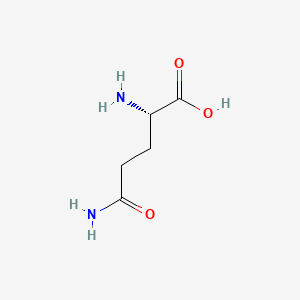
Overview
L-glutamine is the biologically active L-enantiomer of glutamine, a proteinogenic amino acid and one of the most abundant free amino acid in human tissues and circulation. It serves as a key nitrogen donor in intermediary metabolism and supports multiple cellular processes, including amino acid biosynthesis, nucleotide synthesis, redox balance, and energy metabolism. Because of these roles, L-glutamine is often described as a conditionally essential amino acid, particularly during physiological stress, illness, or rapid growth.
In biomedical research, L-glutamine is frequently studied in relation to mitochondrial function, immune and intestinal metabolism, and amino-acid–dependent signaling. Recent work has also linked glutamine availability to disease-relevant metabolic rewiring, including cancer metastasis, muscle and joint metabolism, and neuro-metabolic changes. In these contexts, glutamine intersects with pathways involving mitochondrion function, glutamic acid, tryptophan, and broader amino acid networks, and it may be influenced by interventions such as semaglutide, fluoxetine, butyric acid, or engineered microbial therapies.
Recent Publications Summary
Recent publications on L-glutamine focused mainly on its role in cancer metabolism, supportive care, and systemic metabolic regulation. In oncology, a conference review highlighted glutamine metabolism as a metabolic vulnerability in myeloma, alongside other emerging targets in precision cancer care 42388021Jul. A mechanistic study in squamous cell carcinoma found that oxidative stress induced senescent macrophages in the tumor microenvironment, with the glutamine-glutamate pathway acting as a central metabolic hub; glutaminase 2 was upregulated, linked to IL-1β expression, and targeting this glutamine metabolism-regulated IL-1β/IL-1R2 axis suppressed tumor invasion 42333921Jun.
L-glutamine was also evaluated in supportive treatment settings. During carbon-ion radiotherapy for head and neck cancer, a prospective exploratory study assessed continuous oral supplementation with β-hydroxy-β-methylbutyrate, arginine, and glutamine, with the aim of supporting tissue repair and protein metabolism in patients at risk for acute mucositis and dermatitis 42379751Jun. Although the abstract emphasizes feasibility rather than efficacy outcomes, it indicates ongoing interest in glutamine-containing nutritional strategies to improve tolerability of radiotherapy 42379751Jun.
Several studies linked glutamine to broader metabolic and interorgan signaling pathways. In osteoarthritis, semaglutide was reported to target muscle mitochondria and regulate glutamine metabolism; inhibition of muscle glutaminase activity increased circulating glutamine, and glutamine produced by semaglutide-stimulated C2C12 cells alleviated chondrocyte inflammation, pain, and cartilage damage in mice 42305583Jun. In hepatic encephalopathy, an engineered probiotic was described as a strategy to neutralize toxic ammonia and L-glutamine while replenishing essential amino acid, underscoring glutamine’s relevance in gut-liver-brain metabolic dysregulation 42269583Jun.
At the methodological level, one study used all-atom molecular dynamics simulations and electrophysiology to improve recognition of glutamine by a substrate-binding domain protein in ClyA nanopores, showing that mutagenesis near the constriction amplified the signal and improved single-molecule monitoring of protein conformational changes 42328825Jun. Together, these publications portray L-glutamine as a metabolically active molecule implicated in tumor invasion, treatment support, musculoskeletal inflammation, and engineered biosensing applications 42333921Jun42379751Jun42305583Jun42269583Jun42328825Jun.
What Changes, What Holds
1. Glutamine metabolism now looks like an actionable tumor-microenvironment axis rather than only a general cancer fuel source
NEW DIRECTION A mechanistic link is added to the baseline’s broad cancer-metabolism framing: glutamine-glutamate handling appears to sit upstream of macrophage senescence, IL-1β signaling, and invasion in squamous cell carcinoma 42333921Jun. That does not overturn the established view that glutamine supports malignant metabolism, but it does extend it toward a more specific inflammatory control point that may matter for tumor progression.
2. Glutamine-containing supplementation remains investigational support care rather than proven radiotherapy protection
REINFORCES Continuous oral glutamine with other amino acids is being explored as a tolerability strategy during carbon-ion radiotherapy, which fits the baseline’s description of glutamine as relevant in illness and stress-related metabolic support 42379751Jun. The new work does not establish efficacy, so it strengthens interest in supportive nutrition without changing the settled account.
3. semaglutide-linked muscle glutamine production suggests an interorgan mechanism for osteoarthritis benefit, but it is still preclinical
NEW DIRECTION A new muscle-to-joint signaling model is proposed in which semaglutide alters muscle mitochondria and glutamine metabolism, with downstream anti-inflammatory effects in chondrocytes 42305583Jun. That goes beyond the baseline’s general note that glutamine intersects with musculoskeletal metabolism by identifying a specific therapeutic pathway, but it remains an animal and cell-based claim that needs confirmation in humans.
4. Engineered probiotics may need to be understood as glutamine-modulating tools in hepatic encephalopathy, not just ammonia scavengers
NEW DIRECTION The probiotic strategy described here adds glutamine handling to the gut-liver-brain axis, which the baseline does not specifically cover 42269583Jun. Because the work frames L-glutamine as something to neutralize while replenishing essential amino acids, it broadens the entity’s role in metabolic detoxification and replacement therapy rather than contradicting prior knowledge.
5. Glutamine sensing can be improved experimentally, which changes how the molecule is measured rather than what it does biologically
METHOD All-atom simulation plus nanopore electrophysiology refine single-molecule recognition of glutamine and protein conformational changes 42328825Jun. This does not alter the baseline’s biological account of L-glutamine; it improves the toolkit for studying glutamine-binding events and could support future mechanistic work.
Overview update candidates: glutamine metabolism as a tumor-microenvironment regulator of invasion and IL-1β signaling; semaglutide-associated regulation of muscle glutamine metabolism in osteoarthritis; glutamine modulation in engineered microbial therapy for hepatic encephalopathy; improved nanopore-based glutamine sensing and conformational monitoring.
l-glutamine
Background Contexts
In the literature, the biological baseline, pathological conditions, or disease models commonly surrounding l-glutamine are described as follows:
- biological nanopores (Technology) — 1 paper: PMIDs 42328825
- butyric acid (Chemical) — 1 paper: PMIDs 42104939
- conformational fluctuations (Other) — 1 paper: PMIDs 42328825
- Depressive symptoms, heart rate and heart rate variability among police officers (Disease) — 1 paper: PMIDs 41796893
- dermatitis (Biological Process) — 1 paper: PMIDs 42379751
- Frontiers in Cancer Science (Other) — 1 paper: PMIDs 42388021
- hepatic encephalopathy (Disease) — 1 paper: PMIDs 42269583
- ion channel complex (Protein) — 1 paper: PMIDs 42321971
- knee osteoarthritis (Disease) — 1 paper: PMIDs 42305583
- lung cancer brain metastases (Disease) — 1 paper: PMIDs 42013364
- oral mucositis (Disease) — 1 paper: PMIDs 42379751
- oxidative stress (Biological Process) — 1 paper: PMIDs 42333921
Methodologies & Technologies Used
Researchers utilize the following experimental methods, imaging platforms, computational models, or biological reagents to study l-glutamine:
- adaptive radiation (Therapy) — 1 paper: PMIDs 42333921
- AI/machine learning (Technology) — 1 paper: PMIDs 42388021
- C2C12 cells (Cell Line) — 1 paper: PMIDs 42305583
- carbon-ion radiotherapy (Therapy) — 1 paper: PMIDs 42379751
- CD7-directed chimeric antigen receptor T cells (Therapy) — 1 paper: PMIDs 42388021
- cisplatin/fluorouracil (Therapy) — 1 paper: PMIDs 42333921
- Clya (Protein) — 1 paper: PMIDs 42328825
- d-galactose-induced aging mice (Organism) — 1 paper: PMIDs 42104939
- electrophysiology experiments (Technology) — 1 paper: PMIDs 42328825
- ESM2-t33 (Technology) — 1 paper: PMIDs 42321971
- Filter-Aided Sample Preparation (Technology) — 1 paper: PMIDs 42314122
- Fragmentomics (Technology) — 1 paper: PMIDs 42388021
Molecular Interventions & Targets
The primary molecular pathways, regulatory genes, enzymes, or therapeutic agents actively targeted and manipulated in relation to l-glutamine include:
- Activating transcription factor 4 (Protein) — 1 paper: PMIDs 42013364
- Alternaria alternata (Other) — 1 paper: PMIDs 42212725
- Alternaria longipes (Organism) — 1 paper: PMIDs 42212725
- Alternaria solani (Organism) — 1 paper: PMIDs 42212725
- Alternaria tenuissima (Organism) — 1 paper: PMIDs 42212725
- beta-hydroxy beta-methylbutyric acid (Chemical) — 1 paper: PMIDs 42379751
- BNMS2 (Chemical) — 1 paper: PMIDs 42104939
- butyrylated starch (Chemical) — 1 paper: PMIDs 42104939
- calcium (Chemical) — 1 paper: PMIDs 42321971
- Crtc (Pathway) — 1 paper: PMIDs 42388021
- fluoxetine (Therapy) — 1 paper: PMIDs 41796893
- GLS2 (Protein) — 1 paper: PMIDs 42333921
Observed Outcomes & Phenotypes
The phenotypic changes, physiological endpoints, or clinical metrics observed and measured in connection with l-glutamine include:
- triphala (Therapy) — 2 papers: PMIDs 42321971, 42314122
- tryptophan (Chemical) — 2 papers: PMIDs 42314122, 42104939
- acetylcholinesterase (Protein) — 1 paper: PMIDs 42104939
- adenosine monophosphate (Chemical) — 1 paper: PMIDs 42314122
- AIF1 (Protein) — 1 paper: PMIDs 42104939
- Ala176 (Protein) — 1 paper: PMIDs 41956049
- Alistipes (Other) — 1 paper: PMIDs 42104939
- amino acid metabolism (Biological Process) — 1 paper: PMIDs 41796893
- Amino Acids (Chemical) — 1 paper: PMIDs 42104939
- aminolevulinic acid (Chemical) — 1 paper: PMIDs 42321971
- Area Under the Receiver Operating Characteristic Curve (Clinical Metric) — 1 paper: PMIDs 42321971
- Automatic Data Processing (Chemical) — 1 paper: PMIDs 41796893
General Takeaways & Clinical Potentials
The high-level concepts, clinical translations, and overarching conclusions proposed in the research surrounding l-glutamine are summarized below:
- antifungal (Therapy) — 1 paper: PMIDs 42212725
- Application of semaglutide in OA treatment (Other) — 1 paper: PMIDs 42305583
- computational approach (Other) — 1 paper: PMIDs 41956049
- experimental validation (Other) — 1 paper: PMIDs 41956049
- glutaminolysis (Biological Process) — 1 paper: PMIDs 42333921
- high-resolution disease models (Other) — 1 paper: PMIDs 42388021
- hypoxic-microenvironment-responsive therapeutic strategy (Therapy) — 1 paper: PMIDs 42333921
- interceptive management (Other) — 1 paper: PMIDs 42388021
- Mitochondrial regulatory mechanism (Other) — 1 paper: PMIDs 42305583
- molecular mechanisms (Other) — 1 paper: PMIDs 41796893
- neurotoxin (Other) — 1 paper: PMIDs 42321971
- precision oncology therapeutics (Other) — 1 paper: PMIDs 42388021