Irinotecan
Irinotecan is a semisynthetic camptothecin derivative and antineoplastic chemotherapy agent.
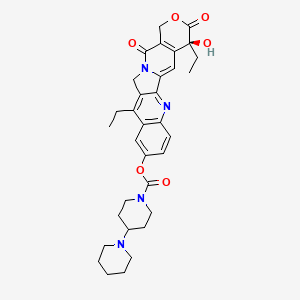
Irinotecan is a semisynthetic camptothecin derivative and antineoplastic chemotherapy agent. It is administered as a prodrug that is converted principally to SN-38, the pharmacologically active metabolite. Irinotecan and SN-38 inhibit DNA topoisomerase I by stabilizing the transient complex formed between topoisomerase I and DNA during DNA-strand relaxation. This prevents efficient re-ligation of DNA and can produce replication-associated DNA damage, leading to cell-cycle arrest and Cancer-cell death.
Irinotecan is used particularly in chemotherapy regimens for colorectal Cancer and is also investigated in other solid Tumors, including pancreatic ductal adenocarcinoma. Its clinical use is limited by toxicities such as diarrhea and myelosuppression; delayed-onset diarrhea is a characteristic treatment-related complication. irinotecan hydrochloride is one pharmaceutical form, while liposomal formulations have been developed to alter drug distribution and release. The drug has also been studied in combination with agents and approaches involving capecitabine, chemoradiotherapy, immune-microenvironment modulation, autophagy-related pathways, and targeted delivery systems.
Rebuilt from PubMed 18 Sept 2026 · no new papers today
Where the papers sit
16 papers study irinotecan directly. Those 16 are one subject: Irinotecan Therapeutic Applications. Clinical studies test irinotecan in rectal cancer, pancreatic cancer and neuroblastoma, while mechanistic work addresses ferroptosis, tumor heterogeneity and liposomal delivery. No single direction dominates. No way of splitting those 16 scores better than chance.
Recent Findings on irinotecan
A preliminary exploratory clinical study evaluated Xiao-Chai-Hu-Tang (XCHT) administered together with irinotecan-based chemotherapy in patients with advanced colorectal Cancer. The study was motivated in part by earlier preclinical work reporting that XCHT attenuated irinotecan-induced severe delayed-onset diarrhea (SDOD). The publication therefore examined a traditional herbal medicine–chemotherapy combination in the clinical setting, with diarrhea representing an important toxicity endpoint associated with irinotecan treatment 42002120Apr.
An ACS Nano study investigated an oral drug-delivery system based on engineered ginger-derived extracellular vesicles. The vesicles used in situ transferrin-mediated, sandwich-like targeting and were loaded with irinotecan, designated CPT-11 in the report. The resulting CPT@cp-GEVs formulation was reported to enhance intracellular irinotecan delivery, reprogram immunosuppressive M2-like tumor-associated Macrophages toward a pro-inflammatory phenotype, and disrupt Cancer stem cell-enriched, drug-resistant niches in colorectal Cancer. These findings place irinotecan within a delivery strategy designed to combine cytotoxic chemotherapy with remodeling of the tumor microenvironment and immune-cell state 42486784Jul.
A formulation study examined how different trapping agents influence the molecular state and release behavior of irinotecan-loaded liposomes. The work addressed the relationship between drug encapsulation, physicochemical state, and release from liposomal carriers. It also noted that a liposomal formulation encapsulating irinotecan is commercially available under the name Onyvide. Such formulations are relevant to efforts to modify irinotecan pharmacokinetics and delivery while preserving its anticancer activity 42425915Jul.
The ARISTOTLE trial was a multicentre, open-label, phase 3, randomised controlled trial assessing the addition of concomitant irinotecan to standard-of-care chemoradiotherapy as preoperative treatment for locally advanced rectal Cancer. Its stated objective was to determine the effect of adding irinotecan to the established chemoradiotherapy approach. The provided publication context identifies the trial design and treatment question but does not report its clinical outcomes 42508427Jul.
A study of photodynamic priming and minocycline examined strategies to overcome chemoresistance by reprogramming the pancreatic tumor immune microenvironment in vivo. Irinotecan was included as the cytotoxic chemotherapy component, alongside the immune-microenvironment intervention. The work is therefore relevant to pancreatic ductal adenocarcinoma research exploring combinations of chemotherapy with modulation of tumor-associated inflammatory and immune processes; the supplied context does not specify the irinotecan-specific efficacy results 41995149Apr.
Written from 16 PubMed abstracts, each one cited by PMID above. Published: 2026-08-20. Drafted by language models from published abstracts; not medical advice.