gallic acid
Overview
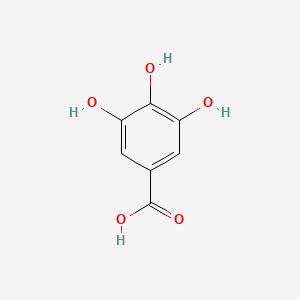
Gallic acid is a naturally occurring phenolic acid widely distributed in plants and plant-derived foods. Chemically, it is a trihydroxybenzoic acid and is commonly discussed in biomedical research as a bioactive phytochemical with antioxidant, anti-inflammatory, antibacterial, and formulation-relevant properties. In the recent literature provided, gallic acid is treated less as a conventional drug target and more as a functional bioactive compound or delivery cargo whose physicochemical and biological properties can be leveraged in pharmaceutical and biomaterial systems.
Its biomedical interest stems from a combination of intrinsic activity and formulation challenges. Gallic acid is repeatedly associated with redox-modulating and antimicrobial effects, but its hydrophilic nature can limit membrane permeation and localized bioavailability, as noted in skin-delivery research. As a result, recent studies have focused on encapsulation, co-delivery, and surface-functionalized delivery platforms to improve intestinal adhesion, tissue retention, sustained release, and therapeutic performance in contexts such as oral supplementation, wound healing, atopic dermatitis, food preservation, and antibacterial materials.
Recent Publications Summary
Recent studies have examined gallic acid as a bioactive phenolic with antioxidant, anti-inflammatory, antimicrobial, antiviral, and neuroprotective potential across diverse experimental systems. In a SH-SY5Y cell model of Parkinson’s disease, gallic acid was evaluated for protection against MPP⁺-induced neurotoxicity, reflecting interest in its ability to counter oxidative-stress-mediated dopaminergic injury 42319576Jun. In influenza research, gallic acid was identified as a main component of Ganhuangcao extracts and tested in MDCK cells and H1N1-infected BALB/c mice, where the study aimed to define its antiviral effects and mechanism, including effects on host JAK2/STAT1 signaling and immune-cell infiltration 42160896May.
Several publications focused on gallic acid as a marker compound or analytical target in plant matrices. In Paeoniae Radix Alba, gallic acid increased markedly with stir-baking intensity and was identified by PLS-DA as a key discriminatory marker among processing grades 42289366Jun. A magnetic molecularly imprinted polymer was developed for selective enrichment and sensitive HPLC determination of gallic acid in tea, achieving high adsorption capacity, strong selectivity, and low detection limits 41950704Apr. Gallic acid was also detected among the major Phenolic Acids in Fagonia cretica and Chaerophyllum aksekiense extracts, contributing to broader phytochemical profiling alongside antioxidant and enzyme-inhibition assessments 42168772May42051056Apr.
Other studies explored gallic acid in delivery systems designed to improve local or functional bioactivity. For acne vulgaris, gallic acid-modified ε-poly-L-lysine was incorporated into dissolving microneedles with chitosan oligosaccharides, producing a patch that penetrated the stratum corneum, dissolved in the dermis, and released active ingredients with enhanced antibacterial action; the formulation also reduced TNF-α, IL-6, and IL-1β while increasing IL-10 and maintaining VEGF at a moderate level in a P. acnes-induced mouse model 42359722Jun. For atopic dermatitis, gallic acid-loaded trehalosomes were optimized and then embedded in an HPMC hydrogel to improve dermal retention and sustained release, leveraging its antioxidant and anti-inflammatory properties 41864443Mar. Gallic acid was also co-delivered with pterostilbene in an O1/W/O2 bigel system, where digestion increased intestinal release of gallic acid compared with conventional bigels and improved cream-cheese-like texture performance 41833138Mar.
Additional work linked gallic acid to antibacterial and targeting strategies. A cyclodextrin-siderophore conjugate study synthesized gallic acid-containing derivatives as part of a Trojan horse approach for bacterial targeting, investigating their use as doxycycline carriers against Escherichia coli and Staphylococcus aureus 41724131Feb. In Fagonia cretica, gallic acid was among the predominant Phenolic Acids in an extract that showed moderate antioxidant activity, selective antibacterial effects, and weak to modest α-amylase inhibition 42168772May. Together, these publications position gallic acid as both a bioactive compound of therapeutic interest and a useful analytical marker in natural products research 42359722Jun42319576Jun42289366Jun42168772May42160896May42129402May42051056Apr41950704Apr41864443Mar41833138Mar41724131Feb.
What Changes, What Holds
1. Gallic acid now has a plausible neuroprotective and antiviral research role beyond its established antioxidant profile
NEW DIRECTION These studies extend gallic acid from a broadly bioactive phenolic into disease-model work in dopaminergic neurotoxicity and influenza, which the baseline does not cover. That does not displace its established antioxidant, anti-inflammatory, and antimicrobial framing, but it does suggest the compound is being tested as a mechanistically active lead in neurologic and viral settings rather than only as a general phytochemical. Evidence remains preclinical and mechanistic 42319576Jun42160896May.
2. Gallic acid is becoming both a processing marker and an analytical target in natural products work
METHOD The main change here is not what gallic acid does biologically, but how it is used: as a discriminator of herbal processing intensity and as a selectively measurable analyte in complex plant matrices. That sharpens its role in quality control and phytochemical profiling, while leaving the baseline’s therapeutic and formulation account intact. The biological assays attached to these studies are secondary to the measurement and classification utility 42289366Jun41950704Apr.
3. Gallic acid is being repurposed into local delivery systems that aim to intensify site-specific anti-inflammatory and antibacterial effects
REINFORCES These formulations do not change the baseline view that gallic acid is a bioactive cargo suited to encapsulation and surface engineering; they strengthen it by showing the same logic applied to acne, atopic dermatitis, and oral co-delivery. The new work mainly confirms that its hydrophilicity and local bioactivity make it a candidate for retention-enhancing platforms rather than a conventional systemic drug 42359722Jun41864443Mar41833138Mar.
4. Gallic acid is being explored as a targeting component in antibacterial carrier chemistry, but this extends rather than overturns its antimicrobial framing
REINFORCES The Trojan-horse carrier work fits the baseline’s emphasis on antibacterial materials and delivery platforms, adding a more engineered route to bacterial targeting without contradicting the established account. The natural-products study in the same paragraph also keeps gallic acid in its familiar role as a phenolic acid contributing to antioxidant and enzyme-inhibition profiles. Together, these findings broaden use cases but do not alter the core understanding 41724131Feb42168772May.
Overview update candidates: neuroprotective and antiviral preclinical roles; use as a processing/quality-control marker and analytical target; engineered bacterial-targeting carrier chemistry.
gallic acid
Background Contexts
In the literature, the biological baseline, pathological conditions, or disease models commonly surrounding gallic acid are described as follows:
- Antibacterial hydrogel packaging (Technology) — 1 paper: PMIDs 41921443
- antimicrobial resistance (Other) — 1 paper: PMIDs 41724131
- atopic dermatitis (Disease) — 1 paper: PMIDs 41864443
- biofilm-forming capacity (Other) — 1 paper: PMIDs 42025853
- diabetic nephropathy (Disease) — 1 paper: PMIDs 42216852
- Fagonia cretica L. (Organism) — 1 paper: PMIDs 42168772
- fibroblast (Cell Line) — 1 paper: PMIDs 42047288
- Ficus natalensis (Organism) — 1 paper: PMIDs 42129402
- high internal phase emulsions (Other) — 1 paper: PMIDs 41932022
- Metal-polyphenol networks (Other) — 1 paper: PMIDs 41921443
- Moraceae (Other) — 1 paper: PMIDs 42129402
- multiple drug resistance (Other) — 1 paper: PMIDs 42025853
Methodologies & Technologies Used
Researchers utilize the following experimental methods, imaging platforms, computational models, or biological reagents to study gallic acid:
- molecular docking studies (Technology) — 2 papers: PMIDs 42168772, 41932022
- tannic acid (Chemical) — 2 papers: PMIDs 41932022, 41921443
- (+)-catechin (Chemical) — 1 paper: PMIDs 42025853
- (E)-chlorogenic acid (Chemical) — 1 paper: PMIDs 42025853
- 2,2'-azino-bis(3-ethylbenzothiazoline-6-sulfonic acid) (Other) — 1 paper: PMIDs 42168772
- 2,2-diphenyl-1-picrylhydrazyl (Technology) — 1 paper: PMIDs 42168772
- 4-vinylpyridine (Chemical) — 1 paper: PMIDs 41950704
- absorption, distribution, metabolism, excretion, and toxicity (ADMET) (Other) — 1 paper: PMIDs 42168772
- alpha,alpha-trehalose (Chemical) — 1 paper: PMIDs 41864443
- chitosan gel (Chemical) — 1 paper: PMIDs 41921443
- CUPRAC (Technology) — 1 paper: PMIDs 42168772
- cyclodextrin conjugates (Chemical) — 1 paper: PMIDs 41724131
Molecular Interventions & Targets
The primary molecular pathways, regulatory genes, enzymes, or therapeutic agents actively targeted and manipulated in relation to gallic acid include:
- (+)-catechin (Chemical) — 2 papers: PMIDs 42289366, 42168772
- amylase alpha 1C (Protein) — 2 papers: PMIDs 42168772, 42051056
- resveratrol (Chemical) — 2 papers: PMIDs 42168772, 42129402
- (E)-sinapic acid (Chemical) — 1 paper: PMIDs 42168772
- 1,2,3,4,6-O-pentagalloylglucose (Chemical) — 1 paper: PMIDs 42289366
- acarbose (Therapy) — 1 paper: PMIDs 42168772
- Albiflorin (Chemical) — 1 paper: PMIDs 42289366
- alpha-glucosidase (Protein) — 1 paper: PMIDs 42051056
- Anti-inflammatory Activity (Biological Process) — 1 paper: PMIDs 42129402
- Bambusa nutans Wall. ex Munro (Organism) — 1 paper: PMIDs 42216852
- Benzoylpaeoniflorin (Chemical) — 1 paper: PMIDs 42289366
- betulinic acid (Therapy) — 1 paper: PMIDs 42129402
Observed Outcomes & Phenotypes
The phenotypic changes, physiological endpoints, or clinical metrics observed and measured in connection with gallic acid include:
- antibacterial and bactericidal activity (Biological Process) — 2 papers: PMIDs 42168772, 42025853
- Escherichia coli (Organism) — 2 papers: PMIDs 42168772, 42047288
- particle size stability (Clinical Metric) — 2 papers: PMIDs 42108626, 41932022
- Staphylococcus aureus (Organism) — 2 papers: PMIDs 42168772, 42047288
- (E)-chlorogenic acid (Chemical) — 1 paper: PMIDs 42216852
- 4-fold improvement of its minimal inhibitory concentration (Clinical Metric) — 1 paper: PMIDs 41724131
- anti-virulence (Other) — 1 paper: PMIDs 42025853
- anticancer activity (Biological Process) — 1 paper: PMIDs 42025853
- antioxidant activity (Biological Process) — 1 paper: PMIDs 42051056
- antioxidant capacity (Clinical Metric) — 1 paper: PMIDs 42168772
- benzoic acid (Chemical) — 1 paper: PMIDs 42289366
- binding affinities (Clinical Metric) — 1 paper: PMIDs 42168772
General Takeaways & Clinical Potentials
The high-level concepts, clinical translations, and overarching conclusions proposed in the research surrounding gallic acid are summarized below:
- adipose retention (Biological Process) — 1 paper: PMIDs 42108626
- B. nutans extracts (Therapy) — 1 paper: PMIDs 42216852
- chronic wounds (Disease) — 1 paper: PMIDs 42047288
- Durable, low-cost technique (Other) — 1 paper: PMIDs 41950704
- F. natalensis fruit (Organism) — 1 paper: PMIDs 42129402
- Fat-reduced and Nutrient-enhanced Dual-functional Foods (Other) — 1 paper: PMIDs 41833138
- freeze-stable HIPE systems (Other) — 1 paper: PMIDs 41932022
- functional food (Other) — 1 paper: PMIDs 42216852
- Future directions (Other) — 1 paper: PMIDs 42168772
- future mechanistic and application-oriented studies (Other) — 1 paper: PMIDs 42051056
- intestinal adhesion (Biological Process) — 1 paper: PMIDs 42108626
- long-term management of AD (Therapy) — 1 paper: PMIDs 41864443