finerenone
Overview
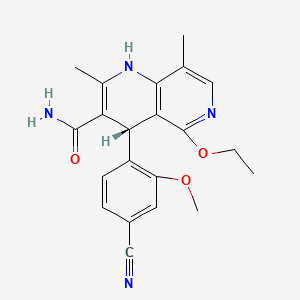
Finerenone is a non-steroidal mineralocorticoid receptor antagonist used as a therapy in cardiorenal disease. By antagonizing mineralocorticoid receptor signaling, it is associated with anti-inflammatory and anti-fibrotic effects, which are relevant to diseases characterized by progressive kidney injury, albuminuria, fibrosis, and cardiovascular complications. In recent biomedical literature, finerenone has been studied primarily in the context of diabetic kidney disease (DKD) and heart failure, with expanding interest in other chronic kidney disease populations.
Unlike older steroidal mineralocorticoid receptor antagonists, finerenone has been developed as a more selective non-steroidal agent and has attracted attention for its potential to improve both renal and cardiovascular outcomes. Recent studies also suggest broader mechanistic relevance to pathways such as autophagy pathways and tissue fibrosis, including work in peritoneal fibrosis and myocardial remodeling.
Recent Publications Summary
Recent publications on finerenone have focused heavily on real-world effectiveness, safety, and treatment patterns in diabetic kidney disease and related cardiorenal populations. Observational studies from China and Saudi Arabia were designed to evaluate finerenone in routine practice for diabetic kidney disease, including patients with preserved glomerular filtration rate, reflecting ongoing interest in how the drug performs outside randomized trials 42121102May42384643Jul42082185May. A U.S. analysis of prescriptions from 2021 to 2024 also examined use by physician specialty and highlighted that, despite evidence from clinical trials, finerenone appears to be infrequently used in practice 42261987Jun.
Several studies extended finerenone evaluation to specific subgroups and combinations of therapies. In patients with chronic kidney disease and type 2 diabetes, one study assessed whether pre-treatment glomerular filtration rate trajectory modified finerenone’s renoprotective effects on kidney function and albuminuria 41855767Mar. Another reported that finerenone reduced albuminuria in people with CKD, type 2 diabetes, and a history of nephrectomy, with generally similar adverse event rates compared with those without nephrectomy, suggesting potential to delay kidney disease progression regardless of nephrectomy status 41533467Jan. In IgA nephropathy, finerenone was studied both as add-on therapy to ACEI/ARB regimens and in combination with SGLT2 inhibitors, with the stated aim of evaluating renal protection and safety 41217264Nov41206667Nov.
Finerenone has also been investigated in heart failure and fibrosis-related settings. A transportability analysis of the FINEARTS-HF trial examined whether findings for finerenone in symptomatic heart failure with left ventricular ejection fraction of at least 40% could be generalized to a real-world U.S. population, and a Bayesian reanalysis of FINEARTS-HF estimated the probability of different magnitudes of benefit and safety outcomes 42089841May41697954Feb. Preclinical work in swine with repetitive pressure overload found that finerenone reduced myocardial interstitial fibrosis, although these reductions were dissociated from left ventricular chamber stiffness 41818164Mar. Another experimental study reported that finerenone attenuated peritoneal fibrosis by restoring autophagy flux in peritoneal mesothelial cells 42209198May.
Additional publications explored broader mechanistic and translational contexts. One study in rats examined finerenone, alone or with bosentan, for amelioration of cardiac dysfunction in benign prostatic hyperplasia 42377399Jun. A medicinal chemistry paper on mineralocorticoid receptor antagonists referenced finerenone as part of the expanding therapeutic interest in this class for chronic kidney disease and heart failure with preserved ejection fraction 42060830Apr. Finally, two recent real-world studies specifically highlighted the need for more evidence on ischemic stroke outcomes in patients with type 2 diabetes and chronic kidney disease and on cardiorenal outcomes in diabetic kidney disease, underscoring ongoing efforts to define finerenone’s clinical impact beyond composite endpoints 42398671Jul42384643Jul.
What Changes, What Holds
1. Real-world use remains sparse despite trial-backed indications
REINFORCES Recent prescribing and observational work does not alter the established view of finerenone as a cardiorenal therapy; instead, it shows that uptake in routine diabetic kidney disease care is still limited even as investigators test performance in preserved glomerular filtration rate and other real-world settings 42261987Jun42121102May. The main implication is practical rather than conceptual: effectiveness and safety are being checked outside trials, but the baseline account of its therapeutic role stands.
2. Subgroup studies sharpen, but do not overturn, the kidney-protective story
REINFORCES Finerenone’s renoprotective and albuminuria-lowering profile is being probed in narrower CKD populations and treatment combinations, which extends the baseline rather than challenging it 41855767Mar41533467Jan. The nephrectomy and glomerular filtration rate-trajectory analyses suggest that benefit may persist across clinically distinct subgroups, while the IgA nephropathy combination studies mainly indicate that its use is moving beyond diabetic kidney disease into other proteinuric kidney diseases. None of this displaces the established cardiorenal framing.
3. Heart-failure and fibrosis studies broaden the drug’s translational reach
NEW DIRECTION Work in symptomatic heart failure with preserved or mildly reduced ejection fraction sits within the Overview’s mention of heart failure, but the transportability and Bayesian reanalysis mainly change how confidently trial findings can be generalized and how benefit-risk uncertainty is framed 42089841May41697954Feb. The preclinical fibrosis studies also extend the baseline by linking finerenone to myocardial interstitial fibrosis and peritoneal autophagy flux, areas the Overview already flags only generally. These are additions, not reversals, and they remain mechanistic or inferential rather than definitive clinical proof.
4. Finerenone is being tested in new mechanistic and outcome contexts, but the core account is unchanged
NEW DIRECTION The rat study in benign prostatic hyperplasia and the medicinal chemistry discussion do not contradict the established description of finerenone as a non-steroidal mineralocorticoid receptor antagonist; they simply place it in broader translational and class-development contexts 42377399Jun42060830Apr. The stroke-focused real-world analyses likewise identify unanswered outcome questions rather than new established effects. Together, these papers widen the map of where finerenone is being examined, but they do not yet add a settled clinical role beyond cardiorenal disease.
Overview update candidates: broader real-world uptake patterns; subgroup evidence in CKD beyond standard DKD populations; translational links to heart failure generalizability and fibrosis/autophagy; ongoing uncertainty about stroke and other non-core outcomes.
finerenone
Background Contexts
In the literature, the biological baseline, pathological conditions, or disease models commonly surrounding finerenone are described as follows:
- chronic renal insufficiency (Disease) — 6 papers: PMIDs 42398671, 42337699, 42060830, 41855767, etc.
- diabetic nephropathy (Disease) — 4 papers: PMIDs 42384643, 42121102, 42082185, 42060830
- type 2 diabetes (Disease) — 4 papers: PMIDs 42384643, 41855767, 41780000, 41533467
- Immunoglobulin A nephropathy (Disease) — 2 papers: PMIDs 41217264, 41206667
- 12-year-old boy (Organism) — 1 paper: PMIDs 42337699
- chronic heart failure (Disease) — 1 paper: PMIDs 42089841
- Gitelman syndrome (Disease) — 1 paper: PMIDs 42337699
- glomerular filtration rate (Clinical Metric) — 1 paper: PMIDs 42121102
- heart failure (Disease) — 1 paper: PMIDs 42060830
- heart failure with mildly reduced or preserved ejection fraction (Disease) — 1 paper: PMIDs 41697954
- Heart failure with preserved ejection fraction (Disease) — 1 paper: PMIDs 41818164
- hyperinsulinemic T2D patients (Disease) — 1 paper: PMIDs 42337699
Methodologies & Technologies Used
Researchers utilize the following experimental methods, imaging platforms, computational models, or biological reagents to study finerenone:
- FINEARTS-HF (Other) — 2 papers: PMIDs 42089841, 41697954
- angiotensin-converting enzyme inhibitor/angiotensin-receptor blocker (Therapy) — 1 paper: PMIDs 41217264
- autophagy pathways (Biological Process) — 1 paper: PMIDs 42209198
- Bayesian inference (Other) — 1 paper: PMIDs 41697954
- captopril (Therapy) — 1 paper: PMIDs 42337699
- human MR reporter gene assay (Technology) — 1 paper: PMIDs 42060830
- interventional clinical trials (Other) — 1 paper: PMIDs 42261987
- intracoronary saline (Therapy) — 1 paper: PMIDs 41818164
- L-alanine (Chemical) — 1 paper: PMIDs 42060830
- magnesium (Chemical) — 1 paper: PMIDs 42337699
- mineralocorticoid receptor antagonist (Chemical) — 1 paper: PMIDs 42384643
- peritoneal mesothelial cells (Cellular Component) — 1 paper: PMIDs 42209198
Molecular Interventions & Targets
The primary molecular pathways, regulatory genes, enzymes, or therapeutic agents actively targeted and manipulated in relation to finerenone include:
- Mineralocorticoid receptor (Protein) — 2 papers: PMIDs 42261987, 42060830
- Asn770 (Protein) — 1 paper: PMIDs 42060830
- bosentan (Therapy) — 1 paper: PMIDs 42377399
- Cardiosphere-derived cells (Therapy) — 1 paper: PMIDs 41818164
- estimated glomerular filtration rate (Clinical Metric) — 1 paper: PMIDs 41855767
- p.Thr60Met (Gene) — 1 paper: PMIDs 42337699
- placebo capsules (Therapy) — 1 paper: PMIDs 41697954
- SLC12A3 (Gene) — 1 paper: PMIDs 42337699
- sodium glucose cotransporter-2 (SGLT2) inhibitors (Therapy) — 1 paper: PMIDs 41206667
Observed Outcomes & Phenotypes
The phenotypic changes, physiological endpoints, or clinical metrics observed and measured in connection with finerenone include:
- acute urinary electrolyte excretion (Clinical Metric) — 1 paper: PMIDs 42060830
- albuminuria (Clinical Metric) — 1 paper: PMIDs 41855767
- anti-fibrotic and anti-inflammatory effects (Other) — 1 paper: PMIDs 42209198
- beneficial and safe (Clinical Metric) — 1 paper: PMIDs 41697954
- Cardiovascular outcomes (Clinical Metric) — 1 paper: PMIDs 42261987
- composite renal and cardiovascular outcomes (Other) — 1 paper: PMIDs 42398671
- gynecomastia (Clinical Metric) — 1 paper: PMIDs 42337699
- heart failure outcomes (Clinical Metric) — 1 paper: PMIDs 42261987
- kidney disease progression (Biological Process) — 1 paper: PMIDs 42261987
- kidney function (Clinical Metric) — 1 paper: PMIDs 41855767
- left ventricular chamber stiffness (Clinical Metric) — 1 paper: PMIDs 41818164
- mammary gland development (Clinical Metric) — 1 paper: PMIDs 42337699
General Takeaways & Clinical Potentials
The high-level concepts, clinical translations, and overarching conclusions proposed in the research surrounding finerenone are summarized below: