ferulic acid
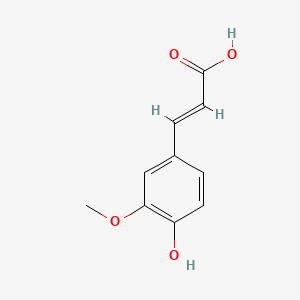
Overview
Ferulic acid is a naturally occurring phenolic acid in the hydroxycinnamic acid family and a common plant secondary metabolite. It is widely distributed in cereals, fruits, vegetables, and medicinal plants, where it contributes to cell-wall structure and participates in phenylpropanoid metabolism. Biologically, ferulic acid is of interest because it is associated with antioxidant activity and with broader roles in plant defense, lignification, and stress responses.
In biomedical and pharmaceutical research, ferulic acid is frequently studied as a bioactive phytochemical and as a precursor or intermediate in biotransformation and synthesis pathways. Recent work has also examined its relevance in antimicrobial, antidiabetic, and anti-inflammatory contexts, as well as its use in biocatalytic vanillin production and in systems pharmacology analyses of complex herbal preparations. In these settings, ferulic acid is often investigated alongside related phenolic compounds such as caffeic acid, p-coumaric acid, gallic acid, quercetin, luteolin, apigenin, resveratrol, and trans-caffeic acid.
Recent Publications Summary
Recent studies have examined ferulic acid as a bioactive component in several delivery systems and natural product extracts, with a strong emphasis on formulation, release behavior, and wound repair. In a rat full-thickness wound model, ferulic acid was incorporated into temperature-sensitive chitosan/Aloe vera hydrogels and the resulting scaffolds were characterized by SEM, FTIR, water absorption, degradation, and antibacterial testing; the hydrogels were highly porous, confirmed to contain ferulic acid, and showed increasing water uptake, degradation, and antibacterial activity with higher Aloe vera content 42376901Jun. The same study evaluated wound closure and histopathology over 14 days, indicating that the formulation was designed to support skin regeneration in chronic wounds 42376901Jun.
Ferulic acid has also been investigated as a payload in controlled-release materials. A bigel system based on hydroxypropyl methylcellulose and glycerol monostearate was developed specifically for ferulic acid delivery, and the study compared different oleogel-to-hydrogel ratios and phase-addition orders to determine their effects on physicochemical properties and ferulic acid release under simulated intestinal conditions 42066030May. These findings highlight ongoing interest in using structured lipid-polymer systems to modulate ferulic acid release for potential oral or topical applications 42066030May.
Beyond formulation studies, ferulic acid has appeared as a constituent in phytochemical profiling of medicinal plant extracts with reported antioxidant, antibacterial, and enzyme-inhibitory activities. LC-ESI-MS/MS analysis of Fagonia cretica identified ferulic acid among major Phenolic Acids, alongside salicylic acid, sinapic acid, gallic acid, quercetin, luteolin, apigenin, catechin, epicatechin, and resveratrol; the extract showed moderate antioxidant activity, selective antibacterial effects, and weak to modest α-amylase inhibition relative to acarbose 42168772May. Similarly, ferulic acid was detected in Opuntia ficus-indica aqueous extract, which also contained other phenolics and flavonoids and showed moderate antibacterial activity, greater efficacy against Gram-positive bacteria such as Staphylococcus aureus, and dose-dependent pancreatic α-amylase inhibition 41875753Mar.
Ferulic acid has additionally been used as a starting substrate in biocatalytic vanillin production. In engineering studies of 4-vinylguaiacol oxygenase, the low activity of the enzyme was identified as a bottleneck for converting ferulic acid to vanillin, and iterative catalytic-pocket engineering combined with machine-learning-guided stability optimization improved catalytic efficiency and enabled production of 19.3 g/L vanillin from ferulic acid within 20 hours 42018783Apr. Together, these publications portray ferulic acid as a versatile target in wound-healing biomaterials, release systems, phytochemical-rich extracts, and microbial or enzymatic bioconversion platforms 42376901Jun42066030May42168772May41875753Mar42018783Apr.
What Changes, What Holds
1. Ferulic acid is being repositioned as a wound-repair ingredient in biomaterial scaffolds rather than only a plant phenolic of biochemical interest
NEW DIRECTION Ferulic acid is now being used as an active payload in temperature-responsive chitosan/Aloe vera hydrogels aimed at skin regeneration, which extends the Overview’s antioxidant and phytochemical framing into a practical wound-healing materials role. That does not displace the established account, but it does add a new application area with preliminary preclinical support 42376901Jun.
2. Structured release systems are emerging as a major way to control ferulic acid’s delivery
NEW DIRECTION Ferulic acid’s inclusion in a bigel platform shows that recent work is not just studying the compound itself but engineering how it is released, especially for oral or topical use. The Overview already treats ferulic acid as a bioactive phytochemical and synthesis intermediate, so this does not contradict it; rather, it adds a formulation-focused use case that remains unsettled in terms of clinical relevance 42066030May.
3. Ferulic acid is being confirmed as a recurring marker of antioxidant-rich medicinal plant extracts with modest bioactivity
REINFORCES Detection of ferulic acid in phytochemical profiles of medicinal extracts fits the established view of it as a common plant secondary metabolite associated with antioxidant activity. The new studies mainly sharpen that picture by placing it among broader phenolic mixtures with antibacterial and enzyme-inhibitory effects, but they do not change the baseline understanding of ferulic acid itself 42168772May41875753Mar.
4. Ferulic acid remains a useful bioconversion substrate, and enzyme engineering is improving its conversion to vanillin
REINFORCES Work on 4-vinylguaiacol oxygenase strengthens the Overview’s point that ferulic acid is important in biocatalytic vanillin production. The new contribution is methodological and process-oriented: it identifies a bottleneck and shows a route to higher yield, but it does not alter ferulic acid’s established role as a precursor in synthesis pathways 42018783Apr.
Overview update candidates: ferulic acid as a wound-healing biomaterial payload; ferulic acid as a controlled-release formulation target.
ferulic acid
Background Contexts
In the literature, the biological baseline, pathological conditions, or disease models commonly surrounding ferulic acid are described as follows:
- Bactris gasipaes (Organism) — 1 paper: PMIDs 41794493
- biofilm-forming capacity (Other) — 1 paper: PMIDs 42025853
- Candida boidinii (Organism) — 1 paper: PMIDs 42191238
- chronic wound (Disease) — 1 paper: PMIDs 42376901
- Dandelion (Taraxacum mongolicum Hand.-Mazz.) (Organism) — 1 paper: PMIDs 42068787
- Fagonia cretica L. (Organism) — 1 paper: PMIDs 42168772
- heart failure (Disease) — 1 paper: PMIDs 41952432
- Ligusticum chuanxiong (Organism) — 1 paper: PMIDs 42112676
- multiple drug resistance (Other) — 1 paper: PMIDs 42025853
- sarcopenia (Disease) — 1 paper: PMIDs 42112676
- Staphylococcus aureus (Organism) — 1 paper: PMIDs 42025853
- tissue engineering (Other) — 1 paper: PMIDs 42376901
Methodologies & Technologies Used
Researchers utilize the following experimental methods, imaging platforms, computational models, or biological reagents to study ferulic acid:
- 2,2-diphenyl-1-picrylhydrazyl (Technology) — 3 papers: PMIDs 42168772, 42068787, 41936784
- molecular docking studies (Technology) — 2 papers: PMIDs 42168772, 41952432
- preparative HPLC (Technology) — 2 papers: PMIDs 42068787, 42025853
- X-ray crystallography (Technology) — 2 papers: PMIDs 42112676, 42025853
- (+)-catechin (Chemical) — 1 paper: PMIDs 42025853
- (E)-chlorogenic acid (Chemical) — 1 paper: PMIDs 42025853
- (Z)-ligustilide (Chemical) — 1 paper: PMIDs 42112676
- 2,2'-azino-bis(3-ethylbenzothiazoline-6-sulfonic acid) (Other) — 1 paper: PMIDs 42168772
- 4-hydroxybenzoic acid (Chemical) — 1 paper: PMIDs 42191238
- absorption, distribution, metabolism, excretion, and toxicity (ADMET) (Other) — 1 paper: PMIDs 42168772
- ABTS•+ (Technology) — 1 paper: PMIDs 41936784
- Aloe vera (Therapy) — 1 paper: PMIDs 42376901
Molecular Interventions & Targets
The primary molecular pathways, regulatory genes, enzymes, or therapeutic agents actively targeted and manipulated in relation to ferulic acid include:
- quercetin (Chemical) — 3 papers: PMIDs 42168772, 42068787, 41875753
- (+)-catechin (Chemical) — 2 papers: PMIDs 42168772, 41875753
- luteolin (Chemical) — 2 papers: PMIDs 42168772, 42068787
- p-Coumaric Acid (Chemical) — 2 papers: PMIDs 42189866, 42068787
- salicylic acid (Chemical) — 2 papers: PMIDs 42168772, 41875753
- trans-caffeic acid (Chemical) — 2 papers: PMIDs 42068787, 41952432
- (E)-chlorogenic acid (Chemical) — 1 paper: PMIDs 42068787
- (E)-sinapic acid (Chemical) — 1 paper: PMIDs 42168772
- 4-vinylguaiacol oxygenase (Protein) — 1 paper: PMIDs 42018783
- acarbose (Therapy) — 1 paper: PMIDs 42168772
- active ingredients (Other) — 1 paper: PMIDs 42068787
- alpha-glucosidase (Protein) — 1 paper: PMIDs 41936784
Observed Outcomes & Phenotypes
The phenotypic changes, physiological endpoints, or clinical metrics observed and measured in connection with ferulic acid include:
- Staphylococcus aureus (Organism) — 3 papers: PMIDs 42168772, 41875753, 41794493
- 2-phenylchromane flavonoid (Chemical) — 2 papers: PMIDs 42189866, 41794493
- antibacterial and bactericidal activity (Biological Process) — 2 papers: PMIDs 42168772, 42025853
- binding affinities (Clinical Metric) — 2 papers: PMIDs 42168772, 41875753
- Escherichia coli (Organism) — 2 papers: PMIDs 42168772, 41794493
- 0.80 g g-1 (Clinical Metric) — 1 paper: PMIDs 42191238
- 16.8 g L-1 (Clinical Metric) — 1 paper: PMIDs 42191238
- 19.3 g/L vanillin (Clinical Metric) — 1 paper: PMIDs 42018783
- 1925 DEGs (Biological Process) — 1 paper: PMIDs 42189866
- 2,2'-azino-bis(3-ethylbenzothiazoline-6-sulfonic acid) (Other) — 1 paper: PMIDs 42068787
- 9.8 mM/h (Clinical Metric) — 1 paper: PMIDs 42018783
- A. ochraceus (Organism) — 1 paper: PMIDs 41794493
General Takeaways & Clinical Potentials
The high-level concepts, clinical translations, and overarching conclusions proposed in the research surrounding ferulic acid are summarized below:
- Amazonian resources (Other) — 1 paper: PMIDs 41794493
- anti-neuroinflammatory effect (Biological Process) — 1 paper: PMIDs 42376901
- antibacterial effect (Clinical Metric) — 1 paper: PMIDs 42376901
- antioxidant effect (Biological Process) — 1 paper: PMIDs 42376901
- biomass-based biorefinery applications (Other) — 1 paper: PMIDs 42191238
- corn starch processing (Other) — 1 paper: PMIDs 41936784
- degradation (Clinical Metric) — 1 paper: PMIDs 42376901
- DZSM's bioactive constituents and mechanistic foundations for HF intervention (Other) — 1 paper: PMIDs 41952432
- FA-Cs/Av scaffolds (Other) — 1 paper: PMIDs 42376901
- food and pharmaceutical industry (Other) — 1 paper: PMIDs 42068787
- formulation stability (Other) — 1 paper: PMIDs 41794493
- functional formulations (Other) — 1 paper: PMIDs 41794493