(E)-chlorogenic acid
Overview
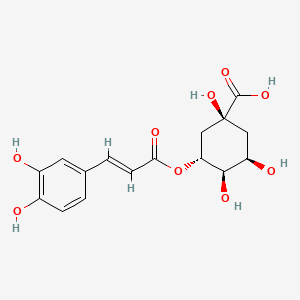
(E)-Chlorogenic acid (CGA; Wikidata: Q421964) is a hydroxycinnamic acid ester formed by condensation of caffeic acid with quinic acid. It belongs to the Phenolic Acids and is among the most abundant polyphenol in the plant kingdom, concentrated in coffee beans, dandelion (Taraxacum officinale), chicory (Cichorium intybus), bamboo shoots and many other sources — coffee being by far the largest dietary contributor in most populations. It occurs as three positional isomers, 3-CQA, 4-CQA and 5-CQA, according to which hydroxyl of the quinic acid ring is esterified, with 5-CQA the most prevalent; roasting isomerizes and degrades a substantial fraction, so content falls as roast darkens.
Its antioxidant activity rests on the catechol group of the caffeic moiety, which donates hydrogen atoms to radicals and chelates transition metals. It inhibits carbohydrate-digesting enzymes, chiefly intestinal α-glucosidases and alpha-amylase (Amylase alpha 1C (AMY1C)), which slows the release of glucose from a meal and is the mechanistic basis for its study in type 2 diabetes; it also inhibits hepatic glucose-6-phosphatase, reducing glucose output. Trials of chlorogenic-acid-rich extracts report modest reductions in blood pressure and postprandial glucose, consistent with these actions but smaller than in vitro potency suggests. Beyond metabolism it shows anti-inflammatory activity, partly through macrophage and microglial signaling, along with antimicrobial, antiproliferative and anti-aging effects in skin cells.
The gap between assay and effect is largely a matter of what reaches the circulation. Only a minority of ingested chlorogenic acid is absorbed intact in the small intestine; most passes to the colon, where microbial esterases hydrolyze it to caffeic and quinic acids and further degrade these to smaller Phenolic Acids, which are absorbed and conjugated — so the compounds circulating after a cup of coffee are largely metabolites rather than the parent ester. Its structural kinship to trans-caffeic acid, ferulic acid and other Phenolic Acids places it in a well-characterized network of phytochemicals studied alongside quercetin, luteolin, apigenin, naringenin and gallic acid.
Recent Publications Summary
Recent studies have continued to examine (E)-chlorogenic acid as a bioactive phenolic with roles in metabolic regulation, antioxidant activity, and analytical detection. In hyperlipidemic C57BL/6J mice, dietary chlorogenic acid supplementation improved lipid metabolism and glucose handling, lowering serum total cholesterol, triglycerides, and low-density lipoprotein cholesterol, reducing hepatic lipid accumulation, and modulating lipid metabolism-related genes together with IRS1 signaling and CD36-mediated lipid uptake. This work also linked the effects to gut-liver axis remodeling, including enrichment of Lactobacillus, Ligilactobacillus, and Bacteroides and restoration of metabolites such as L-glutathione and chenodeoxycholic acid glycine conjugate 42300531Jun. In a separate in vitro liver-adipose co-culture model, chlorogenic acid mitigated olanzapine-induced increases in lipid content, extracellular glucose, and triglycerides without affecting cell viability, supporting its potential to counter metabolic dysfunction in a multi-tissue setting 42102059May.
Several publications focused on chlorogenic acid as a major phenolic constituent in complex plant extracts and food matrices. In oolong tea and white mulberry leaf combinations, chlorogenic acid, along with cryptochlorogenic and neochlorogenic acids, was identified as a key contributor to enhanced hypoglycemic potential during simulated digestion, showing sustained bioaccessibility, negative correlation with α-amylase and α-glucosidase activities, and direct binding to enzyme active sites in docking analyses 42090917May. Chlorogenic acid was also highlighted as a major phenolic in sunflower meal extract, where it was associated with strong antioxidant activity, prebiotic potential, and in vitro/in silico α-glucosidase inhibitory effects 41844108Mar. In Achillea arabica and Bellis annua extracts, chlorogenic acid was among the principal Phenolic Acids detected by UHPLC-QTOF-MS2 or LC-ESI-MS/MS profiling, contributing to the antioxidant and multifunctional bioactivity profiles of these botanicals 42126671May42012914Apr.
Other studies addressed chlorogenic acid in coffee-related systems and supplement quality control. NMR and sensory experiments showed that the caffeine-chlorogenate complex does not alter caffeine bitterness, while interactions between caffeine and melanoidins were associated with a marked reduction in bitter intensity in coffee beverages 42234800Jun. A colorimetric sensing platform using silver-modified faujasite zeolite enabled quantitative monitoring of chlorogenic acid in coffee washing water, with successful application to coffee wastewater and reported specificity toward related polyphenols 42126488May. In commercial green coffee bean extract supplements, quantitative HPLC-DAD analysis of chlorogenic acid isomers revealed wide variability in chlorogenic acid content, frequent mislabelling, and regulatory non-compliance, including products claiming high CGA content with none detected and “decaffeinated” products exceeding caffeine thresholds 42154619May.
Across these reports, chlorogenic acid was repeatedly associated with antioxidant and metabolic effects, but the evidence was context-dependent and often derived from mixtures, model systems, or analytical applications rather than isolated clinical testing. One machine-learning study of Pandani tectorii radix et rhizoma used chlorogenic acid among six Phenolic Acids to predict ABTS radical scavenging activity, underscoring its relevance as a contributor to antioxidant capacity in plant materials 42290108Jun.
What Changes, What Holds
1. Chlorogenic acid now looks like a broader metabolic modulator, not just a glucose-focused phytochemical
NEW DIRECTION New mouse and co-culture work extends the established account of (E)-chlorogenic acid as an antioxidant and antidiabetic candidate by tying it to lipid handling, hepatic fat accumulation, IRS1/CD36-linked signaling, and gut-liver axis remodeling. That does not displace the baseline glucose-enzyme story, but it widens the plausible therapeutic frame beyond postprandial glycemia alone and suggests metabolic effects may depend on tissue crosstalk and microbiome changes 42300531Jun42102059May.
2. Food-matrix studies strengthen chlorogenic acid’s role as a contributor to enzyme-linked hypoglycemic and antioxidant effects
REINFORCES These reports do not change what (E)-chlorogenic acid is understood to do; they sharpen the idea that its activity often emerges within complex extracts rather than as a lone purified agent. The new work supports the baseline view that chlorogenic acid can contribute to α-glucosidase/α-amylase inhibition and antioxidant capacity, while also underscoring that bioaccessibility and mixture context matter for how much of that potential is realized 42090917May41844108Mar.
3. Coffee and supplement analyses show that chlorogenic acid is analytically important but commercially inconsistent
METHOD The new sensing and quality-control studies change how chlorogenic acid is measured and monitored, not what it biologically does. They add practical tools for detecting it in coffee-related matrices and reveal substantial variability and mislabelling in commercial products, which matters for exposure assessment and reproducibility of studies using “green coffee” preparations, but they do not revise the baseline pharmacology itself 42126488May42154619May.
4. Chlorogenic acid remains a context-dependent bioactive marker rather than a stand-alone proven therapeutic
REINFORCES This synthesis does not add a new role so much as it cautions against overreading the baseline. The recent work keeps chlorogenic acid aligned with antioxidant and metabolic effects, but much of the evidence comes from mixtures, model systems, or indirect prediction rather than isolated clinical testing, so the practical claim remains contributory and conditional rather than definitive 42290108Jun.
Overview update candidates: broader metabolic/lipid-regulatory effects; gut-liver axis and microbiome involvement; analytical/quality-control methods for chlorogenic acid detection; stronger emphasis on context dependence in mixtures and model systems.
(e)-chlorogenic acid
Background Contexts
In the literature, the biological baseline, pathological conditions, or disease models commonly surrounding (e)-chlorogenic acid are described as follows:
- Achillea arabica Kotschy (Organism) — 1 paper: PMIDs 42126671
- Amazonian Robusta coffee (Other) — 1 paper: PMIDs 41806720
- bioactive natural compounds (Other) — 1 paper: PMIDs 41519042
- biofilm-forming capacity (Other) — 1 paper: PMIDs 42025853
- cellular senescence (Biological Process) — 1 paper: PMIDs 41938013
- Coffee Beverages (Other) — 1 paper: PMIDs 42234800
- Dandelion (Taraxacum mongolicum Hand.-Mazz.) (Organism) — 1 paper: PMIDs 42068787
- diabetic nephropathy (Disease) — 1 paper: PMIDs 42216852
- diet-induced metabolic dysfunction (Biological Process) — 1 paper: PMIDs 42102059
- Green coffee bean extract (Therapy) — 1 paper: PMIDs 42154619
- maize and coffee samples (Other) — 1 paper: PMIDs 42234800
- multidrug-resistant (MDR) Gram-negative pathogens (Disease) — 1 paper: PMIDs 42191794
Methodologies & Technologies Used
Researchers utilize the following experimental methods, imaging platforms, computational models, or biological reagents to study (e)-chlorogenic acid:
- 2,2-diphenyl-1-picrylhydrazyl (Technology) — 3 papers: PMIDs 42068787, 42012914, 41806606
- gas chromatography-mass spectrometry (Technology) — 2 papers: PMIDs 42216852, 41806720
- preparative HPLC (Technology) — 2 papers: PMIDs 42068787, 42025853
- (+)-catechin (Chemical) — 1 paper: PMIDs 42025853
- 1H nuclear magnetic resonance (Technology) — 1 paper: PMIDs 42234800
- 2,2'-azino-bis(3-ethylbenzothiazoline-6-sulfonic acid) (Other) — 1 paper: PMIDs 42012914
- 3,3',5,5'-tetramethylbenzidine (Chemical) — 1 paper: PMIDs 41519042
- 3-CQA (Chemical) — 1 paper: PMIDs 42154619
- 3T3-L1 preadipocytes (Cell Line) — 1 paper: PMIDs 42102059
- 4-CQA (Chemical) — 1 paper: PMIDs 42154619
- 4T1 tumor mice model (Organism) — 1 paper: PMIDs 41638952
- 5-CQA (Chemical) — 1 paper: PMIDs 42154619
Molecular Interventions & Targets
The primary molecular pathways, regulatory genes, enzymes, or therapeutic agents actively targeted and manipulated in relation to (e)-chlorogenic acid include:
- apigenin (Chemical) — 2 papers: PMIDs 42126671, 42068787
- methylxanthine (Chemical) — 2 papers: PMIDs 42234800, 42154619
- 3,5-dicaffeoylquinic acid (Chemical) — 1 paper: PMIDs 42290108
- acetylcholinesterase (Protein) — 1 paper: PMIDs 42012914
- active ingredients (Other) — 1 paper: PMIDs 42068787
- Adenovirus (Disease) — 1 paper: PMIDs 42049942
- alpha-glucosidase (Protein) — 1 paper: PMIDs 41844108
- amylase alpha 1C (Protein) — 1 paper: PMIDs 42012914
- antioxidant (Other) — 1 paper: PMIDs 42068787
- Bambusa nutans Wall. ex Munro (Organism) — 1 paper: PMIDs 42216852
- Bellis annua (Organism) — 1 paper: PMIDs 42012914
- Caffeine-Chlorogenate Complex (Other) — 1 paper: PMIDs 42234800
Observed Outcomes & Phenotypes
The phenotypic changes, physiological endpoints, or clinical metrics observed and measured in connection with (e)-chlorogenic acid include:
- antibacterial and bactericidal activity (Biological Process) — 2 papers: PMIDs 42191794, 42025853
- trans-caffeic acid (Chemical) — 2 papers: PMIDs 42216852, 42011008
- 0.47-1.17 mg L-1 (Clinical Metric) — 1 paper: PMIDs 42126488
- 1-20 mg L-1 (Clinical Metric) — 1 paper: PMIDs 42126488
- 100% accurate classification (Clinical Metric) — 1 paper: PMIDs 41519042
- 1OSE-cosmosiin complex (Protein) — 1 paper: PMIDs 42126671
- 2,2'-azino-bis(3-ethylbenzothiazoline-6-sulfonic acid) (Other) — 1 paper: PMIDs 42068787
- 2-nonanol (Chemical) — 1 paper: PMIDs 41806720
- 3,4,5-trimethoxycinnamic acid (Chemical) — 1 paper: PMIDs 42011008
- 4-methylcatechol (Chemical) — 1 paper: PMIDs 42300531
- 50% CGAs (Clinical Metric) — 1 paper: PMIDs 42154619
- 50% inhibition concentration (IC50) (Clinical Metric) — 1 paper: PMIDs 41806606
General Takeaways & Clinical Potentials
The high-level concepts, clinical translations, and overarching conclusions proposed in the research surrounding (e)-chlorogenic acid are summarized below:
- A. arabica (Organism) — 1 paper: PMIDs 42126671
- accurate labelling (Other) — 1 paper: PMIDs 42154619
- Amazonian Robusta processing (Other) — 1 paper: PMIDs 41806720
- antioxidant and enzyme-inhibitory agents (Therapy) — 1 paper: PMIDs 42012914
- B. nutans extracts (Therapy) — 1 paper: PMIDs 42216852
- Chemoimmunotherapy (Therapy) — 1 paper: PMIDs 41638952
- clinical use in age-related neurodegenerative disorders (Other) — 1 paper: PMIDs 42011008
- fermentation time (Other) — 1 paper: PMIDs 41806720
- food and pharmaceutical industry (Other) — 1 paper: PMIDs 42068787
- functional food (Other) — 1 paper: PMIDs 42216852
- Functional food applications (Other) — 1 paper: PMIDs 41844108
- genotype selection (Other) — 1 paper: PMIDs 41806720