donepezil
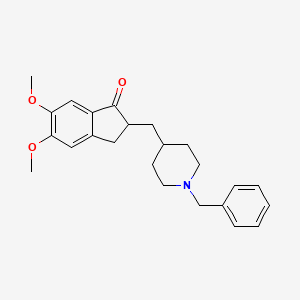
Overview
Donepezil is a centrally acting Acetylcholinesterase (AChE) inhibitor used in the symptomatic treatment of cognitive impairment, especially in Alzheimer’s disease. By inhibiting Acetylcholinesterase (AChE), it increases synaptic acetylcholine availability in the brain, supporting cholinergic neurotransmission that is typically reduced in neurodegenerative disease. In biomedical research, donepezil is frequently used as a reference drug, positive control, or comparator in studies evaluating novel anti-Alzheimer’s agents.
Beyond its established therapeutic role, donepezil is commonly used in preclinical models of memory loss and neurodegeneration to benchmark compounds that target Acetylcholinesterase (AChE), Butyrylcholinesterase (BCHE), oxidative stress, neuroinflammation, and related pathways involving Amyloid beta (Aβ), Microtubule-associated protein tau (MAPT), NMDA receptor antagonist memantine, and inflammatory mediators such as Interleukin-1β (IL-1β) and TNF. Its repeated use in experimental systems reflects its importance as a standard against which new neuroprotective or cognition-enhancing interventions are measured.
Recent Publications Summary
Recent publications involving donepezil primarily used it as a reference standard or comparator in Alzheimer’s disease-related research, especially in studies evaluating novel cholinesterase inhibitors and multitarget neuroprotective agents. In a series of medicinal chemistry and screening studies, newly synthesized quinazolinone-chalcone, coumarin-benzothiazole, thieno[3,2-d]pyrimidine, coumarin-based, and benzimidazole derivatives were assessed for acetylcholinesterase (AChE) and butyrylcholinesterase (BuChE) inhibition relative to donepezil, with several candidates reported to match or surpass donepezil in potency in vitro 42149153May41965189Apr41871474Mar41691754Feb41628818Feb. These studies consistently framed donepezil as the benchmark against which new dual cholinesterase inhibitors were compared, reflecting its continued role as a standard therapy in anti-Alzheimer drug discovery.
Several of the newer compounds showed stronger enzyme inhibition than donepezil in the reported assays. In one study, selected coumarin-based derivatives exhibited nanomolar AChE inhibition, with compound 10f also showing BuChE inhibition that was described as about two-fold greater than donepezil, and it was further advanced to GSK-3β testing 41691754Feb. Another study reported thieno[3,2-d]pyrimidine-phenolic Mannich base hybrids with low-nanomolar Ki values against AChE and BChE, surpassing both tacrine and donepezil in enzymatic and binding analyses 41871474Mar. Similarly, a benzimidazole derivative, IMS48, outperformed donepezil in vitro against both AChE and BuChE and also improved learning and behavioral outcomes in an Alzheimer-like rat model, where donepezil served as the positive control 41628818Feb. A separate study of quinazolinone-chalcone hybrids also benchmarked top-ranked compounds against donepezil in AChE/BuChE assays, identifying several candidates with notable inhibitory activity 42149153May.
Donepezil was also used in a broader neuroprotective comparison context. A multitarget compound, HCM-01, was tested in glutamate-exposed primary hippocampal neuronal cultures and produced a statistically significant improvement in neuronal viability, with a greater protective effect than donepezil and memantine under those conditions 42051019Apr. In addition, a study evaluating Malpighia glabra fruit extract reported in vitro inhibitory activity among its biological effects and examined synergistic effects with pharmaceutical drugs, including donepezil, although the abstract provides limited detail on the donepezil-specific findings 41944642Apr. Together, these publications position donepezil as both a clinical reference and a comparator in the ongoing search for more potent, multifunctional therapies for Alzheimer’s disease.
Beyond therapeutic comparison studies, donepezil was also the analyte in a new analytical method for drug quantification. A green spectrofluorimetric quenching assay using erythrosine B was developed for the determination of donepezil HCl in tablets and spiked human plasma, based on ion-pair complex formation under mild acidic conditions 42378690Jun. The method showed linear response over 20–500 ng/mL for donepezil, with a reported limit of quantification of 17.56 ng/mL, and demonstrated high recovery in complex matrices, supporting its potential for rapid clinical monitoring 42378690Jun.
What Changes, What Holds
1. Donepezil remains the benchmark against which new cholinesterase inhibitors are judged
REINFORCES Recent medicinal chemistry studies continue to use donepezil as the reference standard in Alzheimer’s disease drug discovery, which strengthens rather than alters its established role as a comparator and positive control. The main implication is continuity: donepezil is still functioning as the field’s yardstick for AChE/BuChE inhibition, and the new compounds are being positioned relative to it rather than replacing that role 42149153May41965189Apr.
2. Some experimental inhibitors now appear more potent than donepezil in vitro, but that does not displace its clinical role
REINFORCES These comparisons sharpen the baseline by showing that donepezil is no longer the upper bound in several assay systems, yet they do not overturn its established use in symptomatic Alzheimer’s treatment or as a benchmark. The more consequential point is that potency gaps are now large enough to justify follow-up, especially where stronger enzyme inhibition was paired with behavioral benefit in an animal model; still, replication and translational testing are needed before any practical change 41691754Feb41871474Mar41628818Feb.
3. Donepezil is being outperformed in broader neuroprotective assays, but only as a comparator
NEW DIRECTION HCM-01’s greater protection than donepezil in glutamate-exposed hippocampal neurons adds a new comparative dimension that the Overview does not cover: donepezil is not just a cholinesterase benchmark, but a reference that can be surpassed in non-enzymatic neuroprotection assays. That said, this is still early preclinical evidence, and the Malpighia glabra study is too limited in the summary to change the account beyond showing that donepezil is being used in combination/synergy contexts as well 42051019Apr41944642Apr.
4. Donepezil now has a new analytical quantification method for plasma and tablets
METHOD The spectrofluorimetric assay changes how donepezil is measured rather than what is known about its pharmacology or clinical use. This is a practical addition for quality control and potential therapeutic monitoring, especially because the method is described as sensitive and applicable to human plasma, but it does not alter the established therapeutic or research role of the drug 42378690Jun.
Overview update candidates: none.
donepezil
Background Contexts
In the literature, the biological baseline, pathological conditions, or disease models commonly surrounding donepezil are described as follows:
- Alzheimer's disease (Disease) — 3 papers: PMIDs 42289507, 42267754, 41921869
- cognitive diseases (Disease) — 2 papers: PMIDs 42149153, 42051019
- advanced dementia (Disease) — 1 paper: PMIDs 41628818
- Beta amyloid (Protein) — 1 paper: PMIDs 42267754
- CD33 (Protein) — 1 paper: PMIDs 42267754
- cholinergic dysfunction (Biological Process) — 1 paper: PMIDs 41871474
- Cognitive decline (Disease) — 1 paper: PMIDs 42167685
- Malpighia glabra L. (Organism) — 1 paper: PMIDs 41944642
- microtubule associated protein tau (Protein) — 1 paper: PMIDs 42267754
- neuronitis (Clinical Metric) — 1 paper: PMIDs 41871474
- overt diabetes (Disease) — 1 paper: PMIDs 42289507
- sialylation (Biological Process) — 1 paper: PMIDs 42267754
Methodologies & Technologies Used
Researchers utilize the following experimental methods, imaging platforms, computational models, or biological reagents to study donepezil:
- L-scopolamine (Therapy) — 3 papers: PMIDs 42267754, 42167685, 41910542
- molecular docking studies (Technology) — 3 papers: PMIDs 42051019, 41797133, 41691754
- aluminum chloride (Chemical) — 2 papers: PMIDs 41921869, 41628818
- Beta amyloid (Protein) — 2 papers: PMIDs 42267754, 42167685
- D-gal (Chemical) — 2 papers: PMIDs 41921869, 41628818
- Molecular dynamics simulations (Technology) — 2 papers: PMIDs 42051019, 41691754
- Morris water navigation task (Technology) — 2 papers: PMIDs 42051019, 41910542
- Passive Avoidance (Other) — 2 papers: PMIDs 42167685, 42051019
- Y-maze (Technology) — 2 papers: PMIDs 42167685, 41910542
- α-streptozocin (Chemical) — 2 papers: PMIDs 42289507, 42051019
- 2,2-diphenyl-1-picrylhydrazyl (DPPH) (Technology) — 1 paper: PMIDs 41944642
- 2-amino-4-methoxybenzenethiol (Chemical) — 1 paper: PMIDs 41797133
Molecular Interventions & Targets
The primary molecular pathways, regulatory genes, enzymes, or therapeutic agents actively targeted and manipulated in relation to donepezil include:
- acetylcholinesterase (Protein) — 5 papers: PMIDs 42289507, 42149153, 41871474, 41797133, etc.
- butyrylcholinesterase (Protein) — 4 papers: PMIDs 41871474, 41797133, 41691754, 41628818
- 4-allyl pyrocatechol (Therapy) — 1 paper: PMIDs 42267754
- acarbose (Therapy) — 1 paper: PMIDs 41944642
- acetyl cholinesterase (Protein) — 1 paper: PMIDs 41628818
- alpha-glucosidase (Protein) — 1 paper: PMIDs 41944642
- benzimidazole (Chemical) — 1 paper: PMIDs 41628818
- Buche (Protein) — 1 paper: PMIDs 42149153
- canagliflozin (Therapy) — 1 paper: PMIDs 42289507
- Ficus deltoidea (Organism) — 1 paper: PMIDs 41921869
- glycogen synthase kinase 3β (Protein) — 1 paper: PMIDs 41691754
- HCM-01 (Therapy) — 1 paper: PMIDs 42051019
Observed Outcomes & Phenotypes
The phenotypic changes, physiological endpoints, or clinical metrics observed and measured in connection with donepezil include:
- acetylcholinesterase (Protein) — 2 papers: PMIDs 41910542, 41628818
- 5-Hydroxynoracronycine (Chemical) — 1 paper: PMIDs 41871474
- 50% inhibition concentration (IC50) (Clinical Metric) — 1 paper: PMIDs 41797133
- acetyl cholinesterase (Protein) — 1 paper: PMIDs 42167685
- acetylcholine (Protein) — 1 paper: PMIDs 41910542
- Allograft inflammatory factor 1 (Gene) — 1 paper: PMIDs 41871474
- antiamyloidogenic effect (Biological Process) — 1 paper: PMIDs 42051019
- antioxidant enzyme levels (Clinical Metric) — 1 paper: PMIDs 41628818
- behavioral alterations (Clinical Metric) — 1 paper: PMIDs 41628818
- benzothiazole-based oxadiazole derivatives (Chemical) — 1 paper: PMIDs 41797133
- Beta-secretase 1 (Protein) — 1 paper: PMIDs 41628818
- Brain derived neurotrophic factor (Protein) — 1 paper: PMIDs 42167685
General Takeaways & Clinical Potentials
The high-level concepts, clinical translations, and overarching conclusions proposed in the research surrounding donepezil are summarized below:
- Alzheimer's disease (Disease) — 2 papers: PMIDs 41797133, 41691754
- neuroprotective effects (Clinical Metric) — 2 papers: PMIDs 42051019, 41910542
- Cognitive decline (Disease) — 1 paper: PMIDs 41910542
- dendritic plasticity and remodeling (Biological Process) — 1 paper: PMIDs 42289507
- dual cholinesterase inhibition (Biological Process) — 1 paper: PMIDs 42149153
- functional food (Other) — 1 paper: PMIDs 41944642
- lead optimization for Alzheimer's disease therapy (Other) — 1 paper: PMIDs 42149153
- multitarget preclinical candidate (Other) — 1 paper: PMIDs 42051019
- multitarget therapeutic agent (Other) — 1 paper: PMIDs 42167685
- Neurodegenerative Disorders (Disease) — 1 paper: PMIDs 41871474
- novel strategies for therapy of AD (Other) — 1 paper: PMIDs 42289507
- PAPS nanoparticle formulation (Therapy) — 1 paper: PMIDs 42267754