docetaxel
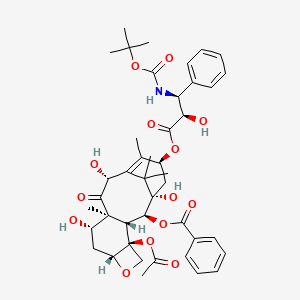
Overview
Docetaxel is a chemotherapeutic agent belonging to the taxane family, primarily used in the treatment of various malignancies, including breast, lung, and prostate Cancers. It functions by inhibiting microtubule depolymerization, thereby disrupting the normal mitotic spindle formation during cell division, which ultimately leads to apoptosis in rapidly dividing cancer cells. Its efficacy has made it a cornerstone in cancer therapy, particularly in combination with other treatments such as androgen deprivation therapy (ADT) and immunotherapy.
Recent Publications Summary
Recent publications have examined docetaxel across several solid tumor settings, most often as part of combination regimens or as a comparator in real-world effectiveness studies. In metastatic castration-sensitive prostate cancer, triplet therapy incorporating darolutamide, androgen deprivation therapy, and docetaxel was associated with strong prostate-specific antigen responses and favorable short-term survival in a multicenter real-world cohort, with a 1-year castration-resistant prostate cancer-free survival of 89.8% and overall survival of 98.8% 42424546Jul. A related European subgroup analysis from ARASENS assessed the efficacy and safety of darolutamide plus androgen deprivation therapy and docetaxel in patients with metastatic hormone-sensitive prostate cancer, building on the trial’s reported reduction in risk of death with the triplet regimen 41967349Apr. Other prostate cancer studies used docetaxel as an alternative first-line comparator in metastatic hormone-sensitive disease 42258330Jun and explored whether baseline testosterone may modify the mortality benefit of adding docetaxel to radiation therapy and androgen deprivation therapy in nonmetastatic high-risk prostate cancer 42175549May. In high-risk localized prostate cancer, a survival modeling analysis from GETUG-12 further revisited relapse patterns after docetaxel-containing treatment 41855781Mar.
In breast cancer, docetaxel was evaluated both as a standard taxane backbone and as a target for sensitization strategies. Updated subgroup analyses of EMERALD compared eribulin with physician’s choice of docetaxel or paclitaxel plus trastuzumab and pertuzumab in HER2-positive locally advanced or metastatic breast cancer, finding similar progression-free and overall survival across treatment groups, with peripheral sensory neuropathy more frequent with paclitaxel 42420599Jul. The PHILA trial similarly studied pyrotinib or placebo combined with trastuzumab and docetaxel in untreated HER2-positive metastatic breast cancer 41839514Mar. Mechanistic and formulation studies focused on improving docetaxel sensitivity or delivery in breast cancer cells, including suppression of LncRNA AC008406.3 to sensitize cells to docetaxel via cuproptosis 42189063May, cRGD-modified pH-sensitive liposomes co-delivering docetaxel and ABCG2 siRNA to enhance efficacy in triple-negative breast cancer 41865608Mar, and co-encapsulated magnetic nanoparticles carrying docetaxel and verapamil for exploratory in vitro and in vivo therapy 41895480Mar.
Beyond prostate and breast cancer, docetaxel was studied in gastrointestinal and lung cancer, as well as in nanomedicine platforms. A multicenter real-world cohort in locally advanced gastric adenocarcinoma compared neoadjuvant docetaxel, oxaliplatin, and S-1 with oxaliplatin and S-1 alone, reporting a higher major pathological response rate with the docetaxel-containing regimen without more severe postoperative complications 41450028Dec. In esophageal squamous cell carcinoma, a retrospective single-institution study evaluated a biweekly divided-dose docetaxel, cisplatin, and 5-fluorouracil regimen aimed at improving tolerability of standard neoadjuvant DCF therapy 42527061Jul. In advanced non-small cell lung cancer, docetaxel served as part of retrospective studies assessing combination with ramucirumab for malignant pleural effusion and cerebral edema 42067397May and as the chemotherapy comparator in a quasi-experimental analysis of second-line pembrolizumab versus docetaxel 42037076Apr. At the preclinical level, docetaxel-conjugated prodrug nanoassemblies were shown to exhibit topology-dependent differences in assembly, release, efficacy, and safety 42043486Apr, and docetaxel was also used to demonstrate synergy with a tumor-targeted CD40 agonist, where immune activation and antitumor effects were strongest in combination with docetaxel among several tested chemotherapies 41989931Apr.
What Changes, What Holds
1. Triplet docetaxel regimens strengthen, rather than replace, its role in advanced prostate cancer
REINFORCES Docetaxel continues to look like a useful backbone in metastatic hormone-sensitive and castration-sensitive prostate cancer, now with real-world and subgroup data supporting its place inside triplet treatment rather than as a standalone cytotoxic option 42424546Jul41967349Apr. The newer work sharpens expectations for response and short-term survival, but it does not alter the established account that docetaxel is a chemotherapy component combined with androgen deprivation therapy and other systemic agents.
2. Docetaxel remains a standard breast-cancer taxane while combination and delivery strategies try to improve its performance
REINFORCES The new breast-cancer studies keep docetaxel within the expected taxane framework and mainly ask how to optimize benefit, tolerability, or delivery rather than redefining its role 42420599Jul41839514Mar. Signals of comparable efficacy across taxane choices, plus sensitization and nanodelivery approaches, leave the baseline intact: docetaxel is still being used as an established chemotherapy partner in HER2-positive and triple-negative disease.
3. Docetaxel is being tested in additional solid-tumor settings and as a research platform for combination therapy
NEW DIRECTION Gastric, esophageal, and lung-cancer studies expand docetaxel beyond the baseline’s listed breast, lung, and prostate uses into regimen refinement, comparator roles, and supportive preclinical modeling 41450028Dec42527061Jul. The established account does not cover these specific settings or the immune-activation and nanoassembly work, so this is an extension of scope rather than a contradiction. It suggests a broader experimental and adjunctive role, while leaving the core taxane mechanism unchanged.
Overview update candidates: broadened use in gastric and esophageal cancer regimens; docetaxel as a comparator and combination partner in additional real-world lung-cancer studies; preclinical nanomedicine and immune-combination findings.
docetaxel
Background Contexts
In the literature, the biological baseline, pathological conditions, or disease models commonly surrounding docetaxel are described as follows:
- metastatic castration-sensitive prostate cancer (Disease) — 3 papers: PMIDs 42424546, 41632522, 41578933
- Metastatic Hormone-Sensitive Prostate Cancer (Disease) — 3 papers: PMIDs 42533722, 42258330, 41967349
- androgen deprivation therapy (Therapy) — 2 papers: PMIDs 41855781, 41578933
- breast cancer (Disease) — 2 papers: PMIDs 42571049, 42503543
- chemoresistance (Biological Process) — 2 papers: PMIDs 42495756, 41865608
- triple-negative breast cancer (Disease) — 2 papers: PMIDs 42047284, 41865608
- advanced Non-Small Cell Lung Cancer (Disease) — 1 paper: PMIDs 42067397
- Anthracycline (Therapy) — 1 paper: PMIDs 42594101
- B16-F10 (Cell Line) — 1 paper: PMIDs 41989931
- bone marrow suppression (Disease) — 1 paper: PMIDs 42571049
- cancer cell line (Cell Line) — 1 paper: PMIDs 42594139
- cancer nanomedicine (Disease) — 1 paper: PMIDs 42043486
Methodologies & Technologies Used
Researchers utilize the following experimental methods, imaging platforms, computational models, or biological reagents to study docetaxel:
- carboplatin (Therapy) — 2 papers: PMIDs 42571049, 42503543
- Cox proportional hazards model (Technology) — 2 papers: PMIDs 42424546, 41450028
- paclitaxel (Therapy) — 2 papers: PMIDs 42594101, 42503543
- (chemo)radiotherapy (Biological Process) — 1 paper: PMIDs 42175549
- 2D Model (Technology) — 1 paper: PMIDs 42593938
- 3D model (Technology) — 1 paper: PMIDs 42593938
- adjuvant chemotherapy (Therapy) — 1 paper: PMIDs 42571049
- Age (Other) — 1 paper: PMIDs 42527061
- androgen deprivation therapy (Therapy) — 1 paper: PMIDs 42175549
- Applicability-Domain-Guided Integration Strategy (Technology) — 1 paper: PMIDs 42593938
- ARASENS trial (Other) — 1 paper: PMIDs 41967349
- Attention-based mechanism (Technology) — 1 paper: PMIDs 42594139
Molecular Interventions & Targets
The primary molecular pathways, regulatory genes, enzymes, or therapeutic agents actively targeted and manipulated in relation to docetaxel include:
- darolutamide (Therapy) — 3 papers: PMIDs 42424546, 41967349, 41632522
- androgen deprivation therapy (Therapy) — 2 papers: PMIDs 41967349, 41632522
- androgen receptor pathway inhibitor (Therapy) — 2 papers: PMIDs 42258330, 41578933
- oxaliplatin (Therapy) — 2 papers: PMIDs 41989931, 41450028
- androgen receptor signaling inhibitor (Therapy) — 1 paper: PMIDs 42533722
- Anti-programmed cell death 1 (Protein) — 1 paper: PMIDs 41989931
- ARPI-doublet therapy (Therapy) — 1 paper: PMIDs 41578933
- ATP binding cassette subfamily G member 2 (Junior blood group) (Protein) — 1 paper: PMIDs 41865608
- bevacizumab (Therapy) — 1 paper: PMIDs 42067397
- Biweekly Divided-dose DCF (Therapy) — 1 paper: PMIDs 42527061
- Caelyx (Therapy) — 1 paper: PMIDs 41989931
- capecitabine (Therapy) — 1 paper: PMIDs 41450028
Observed Outcomes & Phenotypes
The phenotypic changes, physiological endpoints, or clinical metrics observed and measured in connection with docetaxel include:
- antitumor efficacy (Clinical Metric) — 2 papers: PMIDs 42047284, 42043486
- apoptotic process (Biological Process) — 2 papers: PMIDs 42495756, 41865608
- cell viability (Clinical Metric) — 2 papers: PMIDs 42495756, 41865608
- oxidative stress (Biological Process) — 2 papers: PMIDs 42429881, 42420599
- 1,975 patients (Clinical Metric) — 1 paper: PMIDs 42037076
- 11.5 mo (Clinical Metric) — 1 paper: PMIDs 42037076
- 34.8-month follow-up (Clinical Metric) — 1 paper: PMIDs 41450028
- 5-year overall survival (OS) (Clinical Metric) — 1 paper: PMIDs 41450028
- 6.9 mo (Clinical Metric) — 1 paper: PMIDs 42037076
- abdominal pain (Disease) — 1 paper: PMIDs 42571049
- acute inflammatory response (Biological Process) — 1 paper: PMIDs 41895480
- Adverse Events (Other) — 1 paper: PMIDs 41632522
General Takeaways & Clinical Potentials
The high-level concepts, clinical translations, and overarching conclusions proposed in the research surrounding docetaxel are summarized below:
- chemoresistance (Biological Process) — 2 papers: PMIDs 42495756, 41865608
- APC activation markers (Clinical Metric) — 1 paper: PMIDs 41989931
- APC and T-cell activation markers (Clinical Metric) — 1 paper: PMIDs 41989931
- Biweekly Divided-dose DCF (Therapy) — 1 paper: PMIDs 42527061
- breast cancer (Disease) — 1 paper: PMIDs 41895480
- capillary density (Clinical Metric) — 1 paper: PMIDs 42503543
- Capillary length (Clinical Metric) — 1 paper: PMIDs 42503543
- Capillary loop diameter (Clinical Metric) — 1 paper: PMIDs 42503543
- cheminformatics (Other) — 1 paper: PMIDs 42593938
- Chemotherapy-Induced Alopecia (Other) — 1 paper: PMIDs 42594101
- Clinical Practice (Other) — 1 paper: PMIDs 42594101
- Colonic Necrosis (Biological Process) — 1 paper: PMIDs 42571049