DL-methionine
Overview
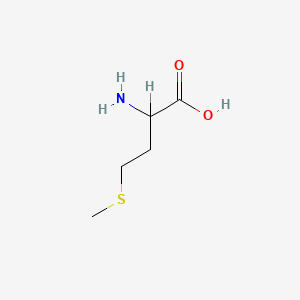
DL-methionine is the racemic mixture of both enantiomers of methionine, an essential sulfur-containing amino acid that mammals cannot synthesize and must obtain from diet. Chemically 2-amino-4-(methylthio)butanoic acid (Wikidata: Q180341), it is the entry point of one-carbon metabolism: methionine adenosyltransferase converts it to S-adenosylmethionine (SAM), the universal methyl donor for methylation of DNA, RNA, proteins and lipids. Transferring that methyl group leaves S-adenosylhomocysteine, which is hydrolyzed to homocysteine, and the cycle closes either by remethylation back to methionine using folate- and vitamin B12-dependent enzymes, or by diversion through the transsulfuration pathway to cysteine and glutathione. The racemic DL form is used in animal nutrition and supplementation because D-methionine is converted to the active L form in vivo. Its position in that cycle, alongside Metabolites such as DL-homocysteine, is why disturbances of methionine metabolism surface in neurodegenerative disease, epigenetic dysregulation and cancer.
Because SAM availability sets the ceiling on methylation capacity, methionine supply is transmitted directly to gene expression through histone and DNA methylation — one of the clearest routes by which diet reaches the epigenome. Restricting dietary methionine extends lifespan in rodents and other model organisms and improves metabolic measures, an effect attributed in part to reduced SAM and altered one-carbon flux.
Tumors are conspicuously methionine-dependent, growing poorly on homocysteine even when able to remethylate it — the Hoffman effect — and this vulnerability is being exploited through dietary restriction and methioninase. Related dependencies have proved more tractable still: Cancers with MTAP deletion accumulate a metabolite that partially inhibits PRMT5, making them selectively sensitive to inhibitors of PRMT5 or MAT2A. Methionine availability also influences the activity of oncogenic transcriptional co-activators, including Yes-associated protein 1 (YAP1) (YAP), whose activity is suppressed under methionine restriction in some cancer models rather than driven by methionine directly, and it sustains flux through amino acid transporters such as SLC6A15/B0AT2.
Recent Publications Summary
Recent publications involving DL-methionine focused mainly on its role as a dietary methionine supplement in animal nutrition and as part of broader methionine-targeted cancer research. In broiler chickens, dietary supplementation with DL-methionine, betaine, or turmeric extract improved growth performance, including final body weight, body weight gain, and feed conversion ratio, with the strongest responses seen in the methionine- and betaine-supplemented groups 42223732Jun. The study also assessed serum biochemistry, myogenic gene expression, and intestinal histomorphology, indicating that DL-methionine was evaluated as a methyl-donor nutrient within a physiological and molecular framework 42223732Jun.
In oncology, methionine restriction was investigated as a therapeutic strategy rather than DL-methionine supplementation. A nude-mouse model of lung-cancer bone metastasis showed that a low-methionine diet combined with reduced-dose cisplatinum eradicated experimental metastases, supporting synergy between methionine limitation and cisplatin-based treatment 42379791Jun. In oral squamous cell carcinoma, methionine deprivation suppressed cell proliferation and migration in vitro, and dietary methionine restriction reduced tumor growth in xenografts but caused systemic toxicity; to address this, an attenuated Salmonella typhimurium strain engineered to express L-methioninase was used to selectively reduce tumor methionine and achieve superior antitumor efficacy in an orthotopic model 41786042Mar.
Other recent work placed methionine in broader metabolic and analytical contexts. In Alzheimer’s disease, methionine, homocysteine, and methylation levels were examined as predictors of cognitive decline, reflecting interest in methionine-related one-carbon metabolism in neurodegeneration 42201257May. Separately, a mass spectrometry method paper addressed artificial methionine oxidation during LC/MS peptide mapping of monoclonal antibodies, showing that high-concentration TCEP injections could clean reactive oxygen species from LC systems and reduce artifactual methionine oxidation, thereby improving post-translational modification analysis 42034288Apr.
Additional studies highlighted methionine’s biochemical importance in protein structure and metal binding. One report showed that methionine residues in linusorbs were critical for covalent chelation of zinc ions, with oxidation of methionine to methionine sulfoxide or sulfone markedly reducing Zn2+ binding capacity 41863922Mar. Another study on the amino acid transporter SLC6A15 noted that methionine is among the neutral amino acid transported by this CNS-expressed protein, although methionine itself was not the experimental intervention 42118683May.
What Changes, What Holds
1. DL-methionine remains a practical methyl-donor supplement in animal nutrition
REINFORCES Broiler data continue to support the established view that DL-methionine functions as a usable dietary methionine source in vivo, with effects on growth and related physiological readouts consistent with its role as a methyl-donor nutrient 42223732Jun. This does not change the baseline account, but it does add a recent in vivo example linking supplementation to performance and intestinal/molecular measures rather than to any new mechanism.
2. Methionine limitation, not supplementation, is emerging as the relevant anticancer lever
NEW DIRECTION Work in lung-cancer bone metastasis and oral squamous cell carcinoma points in the opposite direction from the Overview’s emphasis on methionine as a metabolic dependency and therapeutic vulnerability: the actionable strategy here is restriction or enzymatic depletion, not giving DL-methionine 42379791Jun41786042Mar. That leaves the baseline intact, but it sharpens the translational implication that methionine biology in cancer may be exploited by starving tumors of the amino acid, with systemic toxicity still a major constraint.
3. Methionine-related biomarkers and oxidation artifacts are becoming more important than methionine itself in some assays
METHOD The Alzheimer’s and LC/MS papers do not revise methionine biology so much as expand how it is measured and interpreted: one treats methionine, homocysteine, and methylation as candidate predictors of cognitive decline, while the other shows that apparent methionine oxidation can be introduced during peptide mapping and reduced by cleaning the LC system 42201257May42034288Apr. Together they reinforce that methionine status is analytically and clinically sensitive, but they mainly change study practice.
4. Methionine’s chemistry still matters for protein function and transporter annotation
REINFORCES The zinc-binding report extends the baseline’s biochemical framing by showing that methionine oxidation can directly weaken a protein’s metal-chelating capacity, which is consistent with methionine’s broader susceptibility to redox-linked functional change 41863922Mar. The transporter paper simply adds methionine to the substrate list for SLC6A15 without altering the established view that methionine participates in amino acid transport and CNS metabolism 42118683May. Neither finding displaces the Overview; both refine it.
Overview update candidates: methionine restriction/depletion as a therapeutic strategy in cancer; methionine-related biomarkers and oxidation control as important analytical/clinical considerations.
dl-methionine
Background Contexts
In the literature, the biological baseline, pathological conditions, or disease models commonly surrounding dl-methionine are described as follows:
- glioma (Disease) — 2 papers: PMIDs 42387647, 42156569
- Alzheimer's disease (Disease) — 1 paper: PMIDs 42201257
- B16-F10 melanoma (Organism) — 1 paper: PMIDs 41604978
- Biological Disease-Modifying Antirheumatic Drugs (Other) — 1 paper: PMIDs 42034288
- camptothecin (Chemical) — 1 paper: PMIDs 42115538
- cGAS protein (Protein) — 1 paper: PMIDs 41604978
- glioblastoma (Disease) — 1 paper: PMIDs 41663008
- hippo signaling (Pathway) — 1 paper: PMIDs 41663008
- lung cancer (Disease) — 1 paper: PMIDs 42379791
- MC-38 colon cancer (Disease) — 1 paper: PMIDs 41604978
- MET Amplification (Biological Process) — 1 paper: PMIDs 42381268
- neuropsychiatric co-morbidities (Disease) — 1 paper: PMIDs 42118683
Methodologies & Technologies Used
Researchers utilize the following experimental methods, imaging platforms, computational models, or biological reagents to study dl-methionine:
- Acoustic Droplet Ejection-Mass Spectrometry (Technology) — 1 paper: PMIDs 42118683
- axitinib (Therapy) — 1 paper: PMIDs 42387647
- azd-8055 (Therapy) — 1 paper: PMIDs 42387647
- density functional theory (Technology) — 1 paper: PMIDs 41863922
- dual-platform screening approach (Technology) — 1 paper: PMIDs 42118683
- gefitinib (Therapy) — 1 paper: PMIDs 42387647
- GPS1 (Organism) — 1 paper: PMIDs 41786042
- high-resolution LC-MS/MS (Technology) — 1 paper: PMIDs 42115538
- Hubbard broiler chicks (Organism) — 1 paper: PMIDs 42223732
- immune prognostic signature (Other) — 1 paper: PMIDs 42387647
- K6R/K359R mutations (Gene) — 1 paper: PMIDs 42156569
- LC columns (Technology) — 1 paper: PMIDs 42034288
Molecular Interventions & Targets
The primary molecular pathways, regulatory genes, enzymes, or therapeutic agents actively targeted and manipulated in relation to dl-methionine include:
- Amino Acids (Chemical) — 1 paper: PMIDs 42118683
- anti-PD-L1 antibody (Therapy) — 1 paper: PMIDs 41604978
- betaine (Chemical) — 1 paper: PMIDs 42223732
- blood DNA methylation (Biological Process) — 1 paper: PMIDs 42201257
- cisplatin (Therapy) — 1 paper: PMIDs 42379791
- curcumin (Chemical) — 1 paper: PMIDs 42223732
- deruxtecan (Therapy) — 1 paper: PMIDs 42115538
- DL-homocysteine (Chemical) — 1 paper: PMIDs 42201257
- DL-methionine (RS)-S-oxide (Chemical) — 1 paper: PMIDs 41863922
- Intracellular ROS (Chemical) — 1 paper: PMIDs 42034288
- K6 and K359 (Protein) — 1 paper: PMIDs 42156569
- L-isoleucine (Chemical) — 1 paper: PMIDs 42118683
Observed Outcomes & Phenotypes
The phenotypic changes, physiological endpoints, or clinical metrics observed and measured in connection with dl-methionine include:
- anti-tumor efficacy (Other) — 1 paper: PMIDs 41786042
- body weight gain (Clinical Metric) — 1 paper: PMIDs 42223732
- buffers (Other) — 1 paper: PMIDs 42034288
- CD276 (Protein) — 1 paper: PMIDs 42387647
- Cognitive decline (Disease) — 1 paper: PMIDs 42201257
- cognitive function (Other) — 1 paper: PMIDs 42201257
- enhanced throughput, sensitivity, and physiological relevance (Clinical Metric) — 1 paper: PMIDs 42118683
- feed conversion ratio (Clinical Metric) — 1 paper: PMIDs 42223732
- final body weight (Clinical Metric) — 1 paper: PMIDs 42223732
- globulin (Clinical Metric) — 1 paper: PMIDs 42223732
- high molecular weight species (Other) — 1 paper: PMIDs 42115538
- immune prognostic signature (Other) — 1 paper: PMIDs 42387647
General Takeaways & Clinical Potentials
The high-level concepts, clinical translations, and overarching conclusions proposed in the research surrounding dl-methionine are summarized below:
- accelerating the identification of SLC6A15 modulators for therapeutic applications (Other) — 1 paper: PMIDs 42118683
- combinatorial therapeutic strategies (Other) — 1 paper: PMIDs 42156569
- Formulation Development (Other) — 1 paper: PMIDs 42115538
- MET alteration (Gene) — 1 paper: PMIDs 42387647
- methionine dependency (Biological Process) — 1 paper: PMIDs 41786042
- methionine-LSD1 axis (Other) — 1 paper: PMIDs 42156569
- oxidative scavengers (Other) — 1 paper: PMIDs 42115538
- phytobiotic and methyl-donor supplementation (Other) — 1 paper: PMIDs 42223732
- process optimization (Other) — 1 paper: PMIDs 42115538
- storage condition recommendations (Other) — 1 paper: PMIDs 42115538
- therapeutic vulnerabilities (Other) — 1 paper: PMIDs 41663008
- tumor microenvironment-targeting therapy (Therapy) — 1 paper: PMIDs 41786042