Diclofenac
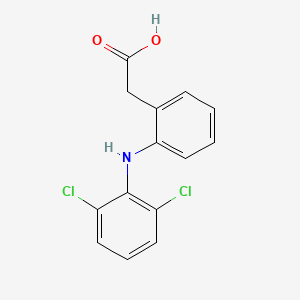
Overview
Diclofenac is a nonsteroidal anti-inflammatory drug (NSAID) widely used in therapy for pain and inflammation. Its pharmacological activity is primarily associated with inhibition of cyclooxygenase enzymes, especially Cyclooxygenase 2 (COX-2) (COX-2), leading to reduced prostaglandin synthesis and downstream anti-inflammatory, analgesic, and antipyretic effects. In biomedical research, diclofenac is frequently used as a reference compound for comparing analgesic potency, COX-2 inhibition, and related pharmacological responses.
Beyond its therapeutic use, diclofenac is also an important environmental micropollutant because it is commonly detected in wastewater and surface waters. This dual role has made it a recurring subject in studies of drug efficacy, toxicology, environmental fate, and wastewater treatment. Recent research has examined diclofenac alongside compounds such as ibuprofen, indomethacin, mefenamic acid, naproxen, and (RS)-ketoprofen, both as a comparator drug in pharmacological assays and as a contaminant targeted for removal in engineered treatment systems.
Recent Publications Summary
Recent publications on diclofenac have focused on its use as a comparator, formulation component, or environmental contaminant, rather than on large clinical efficacy trials. In cancer pain management, one report noted that the efficacy of switching from prior NSAIDs to transdermal diclofenac in patients with cancer had not yet been fully evaluated, highlighting ongoing interest in its role for mild cancer pain and as an adjunct to opioids in more severe pain 42379803Jun. Another study developed a thermoresponsive, mucoadhesive in-situ nasal gel incorporating diclofenac sodium with Lablab purpureus mucilage and Pluronic F127, aiming to enhance intranasal delivery by improving bioavailability, mucosal retention, and tolerability 42107051May.
Diclofenac also appeared in drug delivery and pharmacology studies. A cationic bionanocomplex based on aryl-modified chitosan derivatives was prepared for controlled release of diclofenac sodium alongside other drugs, with the system characterized for particle size, stability, swelling, cytotoxicity, and loading behavior 41832027Mar. In anti-inflammatory screening, diclofenac sodium served as a reference COX inhibitor in a pyrimidine series, where several synthesized compounds showed stronger or more selective Cyclooxygenase 2 (COX-2) inhibition than diclofenac, underscoring its continued use as a benchmark in anti-inflammatory drug discovery 41806609Mar.
Beyond therapeutic development, diclofenac was detected in environmental and analytical studies. In Jakarta’s Ciliwung River, localized spikes of diclofenac suggested point-source inputs from healthcare or residential discharge within a broader pattern of cumulative pharmaceutical loading downstream 42301429Jun. A graphene-based electrochemical sensing platform also showed that diclofenac produced responses comparable to other emerging contaminants such as ibuprofen, glyphosate, and 17β-estradiol under optimized electro-Fenton conditions, supporting its relevance in water-quality monitoring 42060697Apr.
safety-related work in calves with bovine respiratory disease complex found that diclofenac sodium, especially when combined with tilmicosin, was associated with elevated cardiac biomarkers including heart-type fatty acid-binding protein and Cardiac troponin I (TNNI3), along with increases in aspartate aminotransferase, alanine aminotransferase, and L-lactate dehydrogenase, suggesting early subclinical myocardial injury and additive hepatocellular and myocardial stress 42018377Apr.
What Changes, What Holds
1. Transdermal and intranasal diclofenac remain exploratory delivery strategies rather than settled practice
REINFORCES Interest in cancer pain and in mucoadhesive nasal formulations extends diclofenac into delivery optimization, but it does not alter the baseline account of the drug as an NSAID used for pain and inflammation. The cancer-pain report mainly underscores that switching strategies and adjunctive use still need clearer evaluation, while the nasal gel work is formulation development aimed at improving bioavailability and retention 42379803Jun42107051May.
2. Diclofenac continues to function as a benchmark compound in anti-inflammatory discovery
REINFORCES The new screening work does not displace the established role of diclofenac as a reference drug for comparing COX-2 inhibition and analgesic-related pharmacology; it sharpens that role by showing how newer compounds are judged against it. The controlled-release nanocomplex is likewise a delivery study, not a new biological role, so it leaves the baseline account intact 41806609Mar41832027Mar.
3. Environmental monitoring is now showing where diclofenac enters waterways, not just that it is present
NEW DIRECTION The river study adds source-pattern information to the baseline view of diclofenac as a wastewater and surface-water micropollutant. Localized spikes point toward point-source discharge from healthcare or residential inputs, which moves the discussion from simple detection to likely origin and downstream loading. The sensing platform reinforces its relevance for water-quality surveillance rather than changing the established environmental role 42301429Jun42060697Apr.
4. Diclofenac may carry clinically relevant cardiac and hepatic risk in calves with respiratory disease
NEW DIRECTION safety findings in calves add a harm signal in an animal setting that the baseline does not cover. Because the overview says nothing about cardiotoxicity or hepatotoxicity, this is not a contradiction of established benefit, but it does broaden diclofenac’s risk profile and raises concern about combination use with tilmicosin. Confirmation in larger veterinary studies would be needed before generalizing 42018377Apr.
Overview update candidates: environmental source attribution in waterways; veterinary cardiac/hepatic safety signal in calves.
diclofenac
Background Contexts
In the literature, the biological baseline, pathological conditions, or disease models commonly surrounding diclofenac are described as follows:
- nonsteroidal anti-inflammatory drugs (Therapy) — 2 papers: PMIDs 42379803, 42093172
- atherosclerosis (Disease) — 1 paper: PMIDs 41633290
- bovine respiratory disease complex (Disease) — 1 paper: PMIDs 42018377
- Cadmium(II) (Chemical) — 1 paper: PMIDs 41930513
- Cancer (Disease) — 1 paper: PMIDs 42379803
- contaminants of emerging concern (Other) — 1 paper: PMIDs 42060697
- Diospyros sylvatica Roxb. (Organism) — 1 paper: PMIDs 42218796
- first pass effect (Biological Process) — 1 paper: PMIDs 42107051
- Jakarta's Ciliwung River (Other) — 1 paper: PMIDs 42301429
- N-aryl-chitosan derivatives (Other) — 1 paper: PMIDs 41832027
- naphthoquinone (Chemical) — 1 paper: PMIDs 42218796
- nitrate (Chemical) — 1 paper: PMIDs 41930513
Methodologies & Technologies Used
Researchers utilize the following experimental methods, imaging platforms, computational models, or biological reagents to study diclofenac:
- RAW 264.7 macrophages (Cell Line) — 2 papers: PMIDs 41806609, 41633290
- 1H NMR analysis (Technology) — 1 paper: PMIDs 41832027
- 2,2-diphenyl-1-picrylhydrazyl (Technology) — 1 paper: PMIDs 42218796
- 53 compounds (Other) — 1 paper: PMIDs 42301429
- acetic acid-induced writhing model (Technology) — 1 paper: PMIDs 42218796
- ADMET analysis (Technology) — 1 paper: PMIDs 42218796
- analgesic activities (Biological Process) — 1 paper: PMIDs 42218796
- Cytotoxic activity (Clinical Metric) — 1 paper: PMIDs 41806609
- drug-likeness (Other) — 1 paper: PMIDs 41806609
- electro-Fenton (Technology) — 1 paper: PMIDs 42060697
- Fixed biofilm reactors (Technology) — 1 paper: PMIDs 41930513
- glucose tolerance test (Technology) — 1 paper: PMIDs 42218796
Molecular Interventions & Targets
The primary molecular pathways, regulatory genes, enzymes, or therapeutic agents actively targeted and manipulated in relation to diclofenac include:
- Prostaglandin-endoperoxide synthase 2 (Protein) — 2 papers: PMIDs 41806609, 41633290
- 17β-estradiol (Chemical) — 1 paper: PMIDs 42060697
- amoxicillin (Therapy) — 1 paper: PMIDs 42060697
- analgesic (Therapy) — 1 paper: PMIDs 42301429
- antibiotic compounds (Therapy) — 1 paper: PMIDs 42301429
- Arachidonate 5-lipoxygenase (Protein) — 1 paper: PMIDs 41806609
- cardiovascular agent (Therapy) — 1 paper: PMIDs 42301429
- celecoxib (Therapy) — 1 paper: PMIDs 41806609
- chloroform fraction (Chemical) — 1 paper: PMIDs 42218796
- ethyl acetate fraction (Other) — 1 paper: PMIDs 42218796
- gabapentin (Therapy) — 1 paper: PMIDs 42301429
- glyphosate (Chemical) — 1 paper: PMIDs 42060697
Observed Outcomes & Phenotypes
The phenotypic changes, physiological endpoints, or clinical metrics observed and measured in connection with diclofenac include:
- -6.47 mV (Clinical Metric) — 1 paper: PMIDs 41633290
- 29 compounds (Other) — 1 paper: PMIDs 42218796
- 7 July 2005 London bombings (Chemical) — 1 paper: PMIDs 41806609
- Arg120, Ser530, Tyr355 (Other) — 1 paper: PMIDs 41633290
- biochar (Chemical) — 1 paper: PMIDs 41930513
- Cadmium(II) (Chemical) — 1 paper: PMIDs 41930513
- chemical oxygen demand (Clinical Metric) — 1 paper: PMIDs 42093172
- Chitinophagaceae (Organism) — 1 paper: PMIDs 42093172
- Comamonas (Organism) — 1 paper: PMIDs 42093172
- cumulative loading and limited attenuation (Other) — 1 paper: PMIDs 42301429
- cumulative pharmaceutical loading (Other) — 1 paper: PMIDs 42301429
- downstream concentrations (Clinical Metric) — 1 paper: PMIDs 42301429
General Takeaways & Clinical Potentials
The high-level concepts, clinical translations, and overarching conclusions proposed in the research surrounding diclofenac are summarized below:
- antioxidant, hypoglycemic, and analgesic potentials (Other) — 1 paper: PMIDs 42218796
- cardiac biomarkers (Other) — 1 paper: PMIDs 42018377
- clinical translation potential (Other) — 1 paper: PMIDs 42218796
- DKFS and TIL (Therapy) — 1 paper: PMIDs 42018377
- drug-induced cardiotoxicity (Disease) — 1 paper: PMIDs 42018377
- effective strategies for managing emerging contaminants (Other) — 1 paper: PMIDs 42301429
- gabapentin as a candidate sentinel indicator (Other) — 1 paper: PMIDs 42301429
- microbial metabolism (Biological Process) — 1 paper: PMIDs 41930513
- Mixed-pollutant wastewater (Other) — 1 paper: PMIDs 41930513
- monitoring and source-control priorities (Other) — 1 paper: PMIDs 42301429
- Pseudomonadota (Organism) — 1 paper: PMIDs 41930513
- total oxidizable contaminant burden (Clinical Metric) — 1 paper: PMIDs 42060697