ciprofloxacin
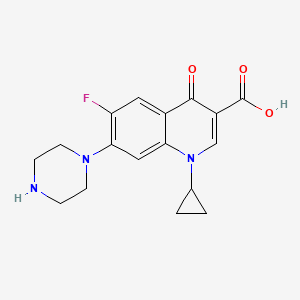
Overview
Ciprofloxacin is a second-generation fluoroquinolone antibiotic that acts by inhibiting bacterial DNA gyrase (topoisomerase II) and topoisomerase IV, enzymes essential for DNA replication, transcription, and repair. By stabilizing the enzyme–DNA cleavage complex, ciprofloxacin induces lethal double-strand breaks in bacterial chromosomes, producing rapid bactericidal activity against a broad spectrum of Gram-negative and Gram-positive organisms, including Pseudomonas aeruginosa, Staphylococcus aureus, Staphylococcus epidermidis, and members of the Enterobacteriaceae family. Its oral bioavailability, tissue penetration, and well-characterized pharmacokinetic profile have made it one of the most widely used antibiotics in clinical and research settings worldwide.
Beyond its classical antibacterial role, ciprofloxacin has attracted growing interest as a pharmacological scaffold for hybrid drug design and as a combination partner in novel drug delivery platforms. Metabolism via Cytochrome P450 (CYP) enzymes and interactions with co-administered agents such as celecoxib and methylxanthine-class drugs inform its clinical pharmacology and potential for drug–drug interactions. Its inclusion as a standard reference comparator in antimicrobial susceptibility testing makes it a benchmark against which new antibacterial candidates are routinely evaluated, ensuring its continued centrality in both clinical practice and translational research.
Recent Publications Summary
Recent research has focused on optimizing ciprofloxacin delivery and bioavailability through advanced formulation strategies. Nanoparticulate systems have demonstrated particular promise: thiolated gum ghatti nanoparticles loaded with ciprofloxacin showed 80% improved penetration compared to free ciprofloxacin in ocular applications, with no observable irritation 42541633Aug. To address ciprofloxacin's poor bioavailability during gastric-to-intestinal pH transitions, nucleation inhibitor-based formulations using structurally related fluoroquinolones have achieved significant improvements—danofloxacin sustained approximately 92% of ciprofloxacin's concentration at pH 7.0 compared to only 20% for ciprofloxacin alone, resulting in a 5.44-fold increase in systemic exposure 42046436Apr. Core-shell nanofiber dressings combining ciprofloxacin with epidermal growth factor-loaded nanoparticles have been designed to provide simultaneous antimicrobial protection and tissue regeneration for chronic wound healing 41762584Feb.
Ciprofloxacin is increasingly being evaluated in novel therapeutic contexts and combination formulations. A fixed-dose combination with celecoxib (PrimeC) was developed to target amyotrophic lateral sclerosis by modulating neuroinflammation, iron homeostasis, and dysregulated microRNAs 41837970Mar. Enzyme-triggered chitosan-based delivery systems have been developed for dental implant coatings, covalently binding ciprofloxacin via self-immolative linkers to enable selective antimicrobial release in response to bacterial infection 41691388Feb. Fluoroquinolone-uracil hybrid compounds have been designed to overcome methicillin-resistant pathogens, with lead compound A4 demonstrating enhanced activity against drug-resistant Staphylococcus epidermidis and promoting infected wound repair in vivo 41740352Feb.
Resistance mitigation strategies have centered on understanding ciprofloxacin's mechanisms of action and deploying combination approaches. High-throughput genetic screening in Escherichia coli identified novel genes beyond recN and recA that modulate ciprofloxacin-induced DNA supercompaction, including membrane-associated proteins such as yaiW, revealing both direct repair and indirect modulatory roles in antibiotic response 42328795Jun. Polysulfur-based cationic polymers have been shown to potentiate ciprofloxacin by disrupting bacterial outer membranes and facilitating antimicrobial cellular uptake 41643508Feb. Natural products with efflux pump inhibitory activity—such as lawsone—have been investigated for restoring ciprofloxacin susceptibility in multidrug-resistant Staphylococcus aureus by targeting resistance-mediating efflux pumps 41592470Jan. Endophytic fungal metabolites have demonstrated synergistic activity with ciprofloxacin against resistant pathogens including methicillin-resistant Staphylococcus aureus 42171756May. Environmental assessments have revealed ciprofloxacin's persistence and resistance-selection potential: in tropical agricultural regions, ciprofloxacin was identified as a high-risk pharmaceutical contaminant in surface waters with significant potential for selecting antibiotic resistance in aquatic ecosystems 42118225May, while in wastewater treatment systems, ciprofloxacin inhibited nitrification and reduced Nitrosomonas abundance in microalgal-bacterial aerobic granular sludge 42085791May.
Novel fluoroquinolone-derived structural analogues are being designed to match or exceed ciprofloxacin's antimicrobial potency. DNA gyrase remains a validated target: azopyrazolo[1,5-a]pyrimidine derivatives achieved inhibitory activity on DNA gyrase equivalent to ciprofloxacin, with IC50 values ranging from 1.76 to 3.04 μM 42025601Apr. Similarly, 1,3-thiazolidin-4-one derivatives synthesized via microwave-assisted methodology achieved up to 82% of ciprofloxacin's antibacterial activity against Escherichia coli through optimized aromatic N-substituents with electron-withdrawing groups 42216860May.
What Changes, What Holds
1. Delivery engineering now matters as much as the drug itself for ciprofloxacin performance
NEW DIRECTION Advanced formulations are extending ciprofloxacin beyond its baseline role as a broadly used antibiotic with known pharmacokinetics, by showing that delivery systems can materially change penetration, exposure, and local tolerability 42541633Aug42046436Apr. The chronic-wound nanofiber work also points to a combined antimicrobial-regenerative use case that sits outside the established account of ciprofloxacin as a conventional antibacterial agent 41762584Feb.
2. Ciprofloxacin is being repurposed into noninfectious disease and trigger-responsive device applications
NEW DIRECTION A celecoxib-containing fixed-dose product for amyotrophic lateral sclerosis extends ciprofloxacin into a therapeutic space not covered by the Overview, which discusses antibacterial use, scaffold design, and drug interactions rather than disease-modifying neurologic therapy 41837970Mar. The dental implant coating and hybrid-compound work likewise broadens its role from standard antibiotic to infection-responsive material and medicinal-chemistry template, without displacing the baseline antibacterial account 41691388Feb41740352Feb.
3. Resistance control is increasingly framed as a systems problem around ciprofloxacin, not just a drug-target problem
NEW DIRECTION Genetic screening, membrane-potentiating polymers, efflux inhibition, and synergistic natural products all reinforce the established DNA-gyrase/topoisomerase mechanism while showing that susceptibility can be reshaped by repair, transport, and uptake pathways 42328795Jun41643508Feb. The environmental findings add a separate but important consequence: ciprofloxacin can persist and select resistance outside the patient, which the Overview does not cover 42118225May42085791May.
4. Ciprofloxacin remains a valid benchmark for gyrase inhibition even as new analogues try to match it
REINFORCES The new analogue studies do not overturn the established mechanism; they instead confirm DNA gyrase as a durable target and use ciprofloxacin as the comparator for potency and optimization 42025601Apr42216860May. What changes is not the baseline understanding of ciprofloxacin, but the sense that its activity can now be approximated by newer scaffolds rather than treated as uniquely fixed.
Overview update candidates: improved formulation-dependent bioavailability/penetration and combined antimicrobial-tissue repair platforms; resistance-modulating host/bacterial pathways and environmental resistance-selection risk.
ciprofloxacin
Background Contexts
In the literature, the biological baseline, pathological conditions, or disease models commonly surrounding ciprofloxacin are described as follows:
- Pseudomonas aeruginosa (Organism) — 2 papers: PMIDs 42077202, 41806369
- Staphylococcus aureus (Organism) — 2 papers: PMIDs 42025853, 41592470
- amyotrophic lateral sclerosis (Disease) — 1 paper: PMIDs 41837970
- antibacterial implant coatings (Technology) — 1 paper: PMIDs 41691388
- antibiotic (Therapy) — 1 paper: PMIDs 42541438
- antimicrobial resistance (Other) — 1 paper: PMIDs 41643508
- bacterial infectious disease (Disease) — 1 paper: PMIDs 41691388
- biofilm formation (Biological Process) — 1 paper: PMIDs 42541438
- biofilm-forming capacity (Other) — 1 paper: PMIDs 42025853
- conjunctivitis (Disease) — 1 paper: PMIDs 42541633
- Dental implants (Technology) — 1 paper: PMIDs 41691388
- fluoroquinolone (Therapy) — 1 paper: PMIDs 42541633
Methodologies & Technologies Used
Researchers utilize the following experimental methods, imaging platforms, computational models, or biological reagents to study ciprofloxacin:
- player versus player (Chemical) — 2 papers: PMIDs 42046436, 41762584
- proton nuclear magnetic resonance (1H NMR) spectroscopy (Technology) — 2 papers: PMIDs 42046436, 41740352
- titanium (Chemical) — 2 papers: PMIDs 42541438, 41691388
- zeta potential (Clinical Metric) — 2 papers: PMIDs 42541633, 42025853
- (+)-catechin (Chemical) — 1 paper: PMIDs 42025853
- (E)-chlorogenic acid (Chemical) — 1 paper: PMIDs 42025853
- 3-mercaptopropionic acid (Chemical) — 1 paper: PMIDs 42541633
- 3-pyridyl isothiocyanate (Chemical) — 1 paper: PMIDs 42216860
- ADMET profiling (Technology) — 1 paper: PMIDs 42216860
- azopyrazolo[1,5-a]pyrimidines (Chemical) — 1 paper: PMIDs 42025601
- Carbon-13 NMR spectroscopy (Technology) — 1 paper: PMIDs 41740352
- chitosan (Chemical) — 1 paper: PMIDs 41691388
Molecular Interventions & Targets
The primary molecular pathways, regulatory genes, enzymes, or therapeutic agents actively targeted and manipulated in relation to ciprofloxacin include:
- levofloxacin (Therapy) — 2 papers: PMIDs 42118225, 42046436
- tetracycline (Therapy) — 2 papers: PMIDs 42085791, 41592470
- 1,10-PS+ (Therapy) — 1 paper: PMIDs 41643508
- 1,3-thiazolidin-4-one (Chemical) — 1 paper: PMIDs 42216860
- 2,4-di-tert-butylphenol (Chemical) — 1 paper: PMIDs 42171756
- 2-phenethylamine (Chemical) — 1 paper: PMIDs 42171756
- 3-chlorophenyl derivative (8) (Chemical) — 1 paper: PMIDs 42216860
- 4P (Chemical) — 1 paper: PMIDs 42077202
- A4 (Chemical) — 1 paper: PMIDs 41740352
- benzyl alcohol (Chemical) — 1 paper: PMIDs 42171756
- catechol-conjugated benzothiazole derivatives (Chemical) — 1 paper: PMIDs 42077202
- cefotaxime (Chemical) — 1 paper: PMIDs 42025601
Observed Outcomes & Phenotypes
The phenotypic changes, physiological endpoints, or clinical metrics observed and measured in connection with ciprofloxacin include:
- Escherichia coli (Organism) — 3 papers: PMIDs 42541438, 42216860, 42025601
- Staphylococcus aureus (Organism) — 3 papers: PMIDs 42541438, 42216860, 42025601
- antibacterial and bactericidal activity (Biological Process) — 2 papers: PMIDs 42025853, 41762584
- Candida albicans (Organism) — 2 papers: PMIDs 42171756, 42025601
- Pseudomonas aeruginosa (Organism) — 2 papers: PMIDs 42216860, 42025601
- 15 different pharmaceuticals (Chemical) — 1 paper: PMIDs 42118225
- 15 hit strains (Other) — 1 paper: PMIDs 42328795
- A. naeslundii (Organism) — 1 paper: PMIDs 41691388
- Amikacin (Therapy) — 1 paper: PMIDs 41806369
- anti-virulence (Other) — 1 paper: PMIDs 42025853
- Antibacterial activity (Clinical Metric) — 1 paper: PMIDs 41691388
- Antibacterial Efficacy (Other) — 1 paper: PMIDs 42541438
General Takeaways & Clinical Potentials
The high-level concepts, clinical translations, and overarching conclusions proposed in the research surrounding ciprofloxacin are summarized below:
- ADME (Other) — 1 paper: PMIDs 41592470
- allosteric inhibitor (Other) — 1 paper: PMIDs 42216860
- Androgen receptor (AR) (Protein) — 1 paper: PMIDs 41592470
- antibacterial synergist (Other) — 1 paper: PMIDs 42077202
- antimicrobial potentiator (Other) — 1 paper: PMIDs 41643508
- antimicrobial sensitivity (Other) — 1 paper: PMIDs 41643508
- Bacterial infection (Disease) — 1 paper: PMIDs 42541633
- biofilm formation (Biological Process) — 1 paper: PMIDs 42541438
- broad-spectrum in vitro bioactivities (Other) — 1 paper: PMIDs 42171756
- Cytochrome P450 (CYP) (Protein) — 1 paper: PMIDs 41592470
- cytochrome P450 family 19 subfamily A member 1 (Protein) — 1 paper: PMIDs 41592470
- emerging threats (Other) — 1 paper: PMIDs 42118225