chrysin
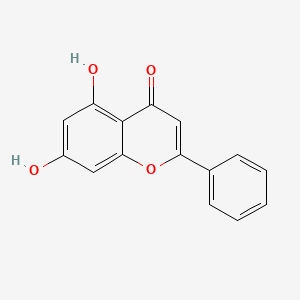
Overview
Chrysin is a naturally occurring flavonoid compound found in a variety of plant-derived materials, including propolis and medicinal plants. Chemically, it belongs to the flavone subclass of flavonoids and has attracted biomedical interest because of its reported antioxidant, anti-inflammatory, and enzyme-modulating properties in preclinical research. In the recent literature provided here, chrysin appears primarily as a bioactive phytochemical and as a computationally prioritized small molecule for disease-related target engagement.
Biologically, chrysin has been investigated in contexts involving neuroinflammation, renal injury, bacterial biofilm formation, and cancer-related signaling. The studies summarized below suggest that it may interact with proteins such as p38α, p38γ, and Estrogen Receptor Alpha (ERα), and may influence pathways associated with oxidative stress, inflammatory mediators such as IL18, Interleukin-1β (IL-1β), C-C motif chemokine ligand 2, and broader protective signaling networks including SIRT6/NRF2/GPX4 signaling pathway and Superoxide Dismutase (SOD)-related antioxidant responses. However, the evidence in the provided sources is largely preclinical and computational, with only limited experimental validation.
Recent Publications Summary
Recent studies have continued to evaluate chrysin as a bioactive flavonoid with potential therapeutic and bioinformatic relevance across cancer, renal injury, and infectious disease models. In a diethylnitrosamine-induced hepatocellular carcinoma rat model, chrysin was administered orally at 50 mg/kg for 8 weeks, alone or in combination with apigenin, after tumor induction; the study assessed biochemical and histopathological outcomes in blood and liver tissue and reported that DEN-induced HCC was associated with activation of tumor-promoting signaling pathways, with chrysin included among the tested flavonoids for potential therapeutic effects 42346026Jun. In a separate in silico breast cancer study, chrysin was identified as a stable ligand for p38α, with docking and molecular dynamics analyses supporting strong stability in the p38α-chrysin complex and suggesting potential anti-breast cancer activity, although experimental validation was not provided 41819753Mar. Chrysin was also highlighted in a multiscale computational drug-discovery study for glioma, where it was among the compounds ranked highly by the CANDO platform as a new prediction for glioma-associated therapeutic potential 41968358Apr.
Beyond oncology, chrysin has been investigated for protective effects in renal dysfunction. In a tramadol-induced nephrotoxicity model, chrysin partially or substantially improved elevated kidney injury markers, inflammatory mediators, oxidative stress indices, and disrupted metabolic and RNA-network parameters, including restoration of Nrf2, PPARγ, XCT, GPX4, and FPN protein levels, increases in antioxidant enzymes such as SOD, CAT, and GPX, and reductions in MDA and multiple injury biomarkers 42002091Apr. The authors concluded that chrysin mitigated tramadol-driven renal dysfunction through regulation of RNA networks, antioxidant pathways, and ketogenic metabolism 42002091Apr.
Chrysin has also appeared in studies focused on antimicrobial and enzyme-target interactions. In a red propolis flavonoid study targeting Staphylococcus aureus sortase A, chrysin showed favorable docking and molecular dynamics behavior, strong binding free energy, and interactions with eight active-site residues, including two from the catalytic triad; in vitro crystal violet staining further confirmed significant antibiofilm activity against S. aureus 41082329Oct. In a phytochemical and docking analysis of Salvia heldreichiana, chrysin was identified by HPLC as one of the major bioactive constituents, and docking suggested strong binding affinities toward selected protein targets alongside rosmarinic acid 42220228Jun.
What Changes, What Holds
1. Chrysin is gaining support as a candidate in oncology, but the evidence remains computational or preclinical rather than practice-changing
NEW DIRECTION These studies extend the baseline’s cancer-related signaling theme into hepatocellular carcinoma, breast cancer, and glioma, but they do not overturn the established view that chrysin is mainly a preclinical bioactive flavonoid with limited validation. The p38α docking result is consistent with the earlier target-engagement narrative, while the HCC and glioma findings add new disease contexts that still need experimental confirmation before they can be treated as established therapeutic roles 42346026Jun41819753Mar.
2. Chrysin now has stronger evidence for renal protection through antioxidant and metabolic network restoration
REINFORCES This work sharpens, rather than changes, the baseline’s account of chrysin as a modulator of oxidative stress and protective signaling. The renal data fit the existing pattern of antioxidant and pathway-level effects, but they add a more detailed mechanistic picture involving Nrf2-linked defenses, GPX4, and related injury markers. The main limitation remains the same: the evidence is still preclinical, so the renal benefit is promising but not yet established for human use 42002091Apr.
3. Chrysin’s antimicrobial relevance is now supported by direct antibiofilm activity, not just target docking
NEW DIRECTION The sortase A work moves beyond the Overview’s general enzyme-modulating profile by adding a concrete anti-biofilm phenotype against Staphylococcus aureus, which the baseline did not specifically cover. That said, it does not displace the established antioxidant or anti-inflammatory account; it broadens chrysin’s functional map into infectious disease biology. The Salvia heldreichiana docking result is supportive but secondary, reinforcing that chrysin continues to appear as a plausible bioactive constituent in multi-target phytochemical screens 41082329Oct42220228Jun.
Overview update candidates: renal antioxidant pathway restoration; direct antibiofilm activity against Staphylococcus aureus; additional oncology target-engagement and preclinical anticancer signals.
chrysin
Background Contexts
In the literature, the biological baseline, pathological conditions, or disease models commonly surrounding chrysin are described as follows:
- breast cancer (Disease) — 1 paper: PMIDs 41819753
- Calcific Aortic Valve Disease (Disease) — 1 paper: PMIDs 42334640
- cognitive diseases (Disease) — 1 paper: PMIDs 42149389
- Computational Analysis of Novel Drug Opportunities (Technology) — 1 paper: PMIDs 41968358
- drug discovery (Other) — 1 paper: PMIDs 42334640
- glioma (Disease) — 1 paper: PMIDs 41968358
- liver tumours (Disease) — 1 paper: PMIDs 42346026
- multidrug-resistant infections (Disease) — 1 paper: PMIDs 42334640
- Salvia heldreichiana (Organism) — 1 paper: PMIDs 42220228
- Sortase A (Protein) — 1 paper: PMIDs 41082329
- Staphylococcus aureus (Organism) — 1 paper: PMIDs 41082329
Methodologies & Technologies Used
Researchers utilize the following experimental methods, imaging platforms, computational models, or biological reagents to study chrysin:
- molecular docking studies (Technology) — 3 papers: PMIDs 42220228, 41819753, 41082329
- 2-acetylaminofluorene (Chemical) — 1 paper: PMIDs 42346026
- active site prediction (Technology) — 1 paper: PMIDs 41819753
- ADME/drug-likeness predictions (Technology) — 1 paper: PMIDs 41082329
- attention-based fusion layer (Technology) — 1 paper: PMIDs 42334640
- Autodock Vina (Technology) — 1 paper: PMIDs 41082329
- BALB/c nude mice (Organism) — 1 paper: PMIDs 42149389
- CAVER tunnel analysis (Technology) — 1 paper: PMIDs 42220228
- crystal violet staining assay (Technology) — 1 paper: PMIDs 41082329
- fingerprint study (Technology) — 1 paper: PMIDs 41819753
- GROMACS-2021 (Technology) — 1 paper: PMIDs 41082329
- hard negative mining strategy (Technology) — 1 paper: PMIDs 42334640
Molecular Interventions & Targets
The primary molecular pathways, regulatory genes, enzymes, or therapeutic agents actively targeted and manipulated in relation to chrysin include:
- acetylcholinesterase (Protein) — 2 papers: PMIDs 42220228, 41968358
- galangin (Chemical) — 2 papers: PMIDs 41819753, 41082329
- 1ACJ (Protein) — 1 paper: PMIDs 42220228
- 2Y9X (Protein) — 1 paper: PMIDs 42220228
- 3NVY (Protein) — 1 paper: PMIDs 42220228
- 4-hydroxybenzoic acid (Chemical) — 1 paper: PMIDs 42220228
- apigenin (Chemical) — 1 paper: PMIDs 42346026
- Beta amyloid (Protein) — 1 paper: PMIDs 42149389
- CDK2 (Protein) — 1 paper: PMIDs 41968358
- cryptotanshinone (Chemical) — 1 paper: PMIDs 41968358
- Dihydrofolate reductase (Protein) — 1 paper: PMIDs 41968358
- ERα (Protein) — 1 paper: PMIDs 41819753
Observed Outcomes & Phenotypes
The phenotypic changes, physiological endpoints, or clinical metrics observed and measured in connection with chrysin include:
- 3-hydroxybutyrate (Chemical) — 1 paper: PMIDs 42002091
- 43-month-old spayed mixed-breed female cat (Protein) — 1 paper: PMIDs 42002091
- acetyl coenzyme A (Chemical) — 1 paper: PMIDs 42002091
- Annexin V (Protein) — 1 paper: PMIDs 42346026
- antibiofilm activity (Biological Process) — 1 paper: PMIDs 41082329
- Area Under the Receiver Operating Characteristic Curve (Clinical Metric) — 1 paper: PMIDs 42334640
- astrocytic activation (Biological Process) — 1 paper: PMIDs 42149389
- binding free energy (Clinical Metric) — 1 paper: PMIDs 41082329
- BIRC5 (Protein) — 1 paper: PMIDs 42346026
- C-C motif chemokine ligand 2 (Biological Process) — 1 paper: PMIDs 42002091
- caspase-3 (Protein) — 1 paper: PMIDs 42346026
- chitinase 3 like 1 (Protein) — 1 paper: PMIDs 42002091
General Takeaways & Clinical Potentials
The high-level concepts, clinical translations, and overarching conclusions proposed in the research surrounding chrysin are summarized below:
- Antitumor Effects (Clinical Metric) — 1 paper: PMIDs 42346026
- biochemical and histopathological findings (Other) — 1 paper: PMIDs 42346026
- clinical biomarker discovery (Other) — 1 paper: PMIDs 42334640
- experimental validation (Other) — 1 paper: PMIDs 41819753
- further studies (Other) — 1 paper: PMIDs 41082329
- lead molecules (Chemical) — 1 paper: PMIDs 41819753
- nephroprotective agent (Other) — 1 paper: PMIDs 42002091
- new antibiofilm agents (Therapy) — 1 paper: PMIDs 41082329
- oxidative stress-related and enzyme-associated disorders (Disease) — 1 paper: PMIDs 42220228
- real-world virtual drug screening (Other) — 1 paper: PMIDs 42334640