carbamazepine
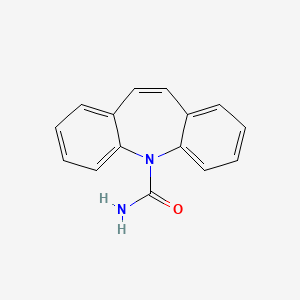
Overview
Carbamazepine is a widely used antiepileptic drug with additional clinical use in certain pain syndromes, including trigeminal neuralgia. Pharmacologically, it is valued for its ability to reduce abnormal neuronal excitability, which underlies its seizure-suppressing and analgesic effects. In biomedical research, carbamazepine is often studied as a model poorly soluble, modified-release oral drug, because its dissolution behavior can strongly influence formulation performance and drug exposure.
Beyond its established therapeutic role, carbamazepine is also used in mechanistic studies of neurobiology and drug delivery. Recent work has examined how it affects inflammatory and signaling pathways in the nervous system, including nitric oxide and hydrogen sulfide-related processes, while formulation studies have focused on improving its release from tablets and alternative dosage forms. These investigations reflect both its clinical importance and the challenges posed by its physicochemical properties.
Recent Publications Summary
Recent studies have examined carbamazepine's psychiatric tolerability and overall safety profile in patients with newly diagnosed focal onset epilepsy. Within the international Human Epilepsy Project cohort, sodium channel blockers including carbamazepine were evaluated alongside levetiracetam and lamotrigine to assess psychiatric adverse effects during a 2-year follow-up period, providing comparative evidence on the psychiatric safety of this widely used antiseizure medication 42574692Aug.
Beyond psychiatric concerns, carbamazepine-induced cutaneous and systemic adverse reactions remain significant clinical considerations. While HLA-B15:02 screening has become standard practice to prevent severe adverse reactions in Asian populations, supplementary susceptibility alleles—particularly HLA-B15:21—confer residual risk even in HLA-B*15:02-negative patients, indicating the need for expanded genetic screening strategies 42504015Jul. The potential for severe, multiorgan complications was illustrated in a case of carbamazepine-induced drug-induced hypersensitivity syndrome accompanied by primary adrenal insufficiency, acute interstitial nephritis, and hypothyroidism developing within 6 weeks of therapy initiation 42366784Jun.
Mechanistic investigations have linked carbamazepine's antiepileptic effects to modulation of hydrogen sulfide (H₂S) homeostasis in the brain. Using a brain-permeable fluorescent probe, researchers achieved the first direct visualization of carbamazepine-induced H₂S downregulation in an epileptic mouse model, demonstrating correlation between this modulation and both seizure suppression and anti-inflammatory effects, thereby elucidating novel redox-mediated neuroprotective mechanisms 42117508May.
Formulation optimization has focused on improving carbamazepine bioavailability and patient administration flexibility. Modified-release tablet systems have been refined to prevent alcohol-induced dose dumping through strategic selection of matrix formers and fillers 42082060May, with predictive in vitro dissolution methods developed using USP Apparatus 4 to forecast in vivo performance 42036896Apr. Emerging delivery platforms include milk formula-based semi-solid extrusion 3D printing for pediatric chewable dosage forms, which demonstrated enhanced drug release and dose accuracy 42031026Apr, and porous silicon nanoparticles designed for concurrent carbamazepine and hydrogen gas co-delivery as an innovative combination therapy approach 41936893Apr.
What Changes, What Holds
1. Comparative psychiatric safety profile established for focal epilepsy patients
NEW DIRECTION Psychiatric adverse effects were directly compared among sodium channel blockers and related agents over 2 years in the Human Epilepsy Project 42574692Aug. This dimension of safety—not previously characterized in the Overview—now has comparative evidence within a large focal epilepsy cohort. What remains unclear is whether psychiatric effects track with seizure control or guide drug selection in clinical practice.
2. HLA-B15:21 carriers face residual severe reaction risk despite negative HLA-B15:02 status
NEW DIRECTION Supplementary HLA-B15:21 alleles confer susceptibility to severe reactions even when HLA-B15:02 screening is negative 42504015Jul, requiring expanded genetic screening in clinical practice beyond current standard testing. A reported case illustrates potential for multiorgan complications including primary adrenal insufficiency and acute interstitial nephritis 42366784Jun, though the Overview is silent on carbamazepine's adverse-reaction profile and thus does not commit to a competing claim.
3. H₂S downregulation correlates with seizure suppression and neuroprotection
REINFORCES Direct visualization of carbamazepine-induced hydrogen sulfide downregulation in an epileptic mouse model links the mechanism to both seizure control and anti-inflammatory effects 42117508May. This work sharpens what the Overview already flags about hydrogen sulfide-related processes by identifying downregulation specifically and tying it to seizure suppression, thereby confirming the neuroprotective pathway the baseline anticipated.
4. Pediatric and combination-delivery formulations emerge as new platforms
NEW DIRECTION Milk-based 3D-printed chewable tablets and porous silicon nanoparticles for concurrent carbamazepine and hydrogen gas co-delivery represent emerging pediatric and combination-therapy platforms 42031026Apr41936893Apr. Since the Overview discusses formulation research broadly, these emerging systems introduce pediatric-specific and innovative combination applications beyond its scope. Additional refinements to modified-release tablets and development of predictive in vitro dissolution methods extend traditional formulation optimization.
Overview update candidates: HLA-B*15:21 genetic screening recommendations; hydrogen sulfide downregulation as antiepileptic mechanism; comparative psychiatric safety in focal epilepsy patients.
carbamazepine
Background Contexts
In the literature, the biological baseline, pathological conditions, or disease models commonly surrounding carbamazepine are described as follows:
- active ingredient (Other) — 2 papers: PMIDs 42264055, 42177921
- Antiseizure Medication (Therapy) — 2 papers: PMIDs 42574692, 42247656
- antibiotic resistance genes (Gene) — 1 paper: PMIDs 42391956
- anxiety (Disease) — 1 paper: PMIDs 42574692
- arable farming (Other) — 1 paper: PMIDs 41787959
- Biopharmaceutics Classification System Class II (Other) — 1 paper: PMIDs 42463987
- CNS disorders (Disease) — 1 paper: PMIDs 41936893
- contaminants of emerging concern (Other) — 1 paper: PMIDs 41787959
- Crystal polymorph (Biological Process) — 1 paper: PMIDs 42264055
- Cutaneous Adverse Drug Reaction (Disease) — 1 paper: PMIDs 42504015
- depression (Disease) — 1 paper: PMIDs 42574692
- Dose dumping (Other) — 1 paper: PMIDs 42082060
Methodologies & Technologies Used
Researchers utilize the following experimental methods, imaging platforms, computational models, or biological reagents to study carbamazepine:
- (S)-etiracetam (Therapy) — 1 paper: PMIDs 42247656
- 0.1 N HCl (Other) — 1 paper: PMIDs 42082060
- activated sludge (Technology) — 1 paper: PMIDs 41985610
- Advanced oxidation (Biological Process) — 1 paper: PMIDs 42391956
- aggregation (Biological Process) — 1 paper: PMIDs 42463987
- biorelevant dissolution (Other) — 1 paper: PMIDs 42031026
- Box-Behnken experimental design (Technology) — 1 paper: PMIDs 42036896
- centrifugal chemical vapor deposition (Technology) — 1 paper: PMIDs 41936893
- Cerium Single-Atom Nanozyme (Technology) — 1 paper: PMIDs 41989020
- compaction pressure (Other) — 1 paper: PMIDs 42177921
- Cox regression (Other) — 1 paper: PMIDs 42574692
- density functional theory (Technology) — 1 paper: PMIDs 41989020
Molecular Interventions & Targets
The primary molecular pathways, regulatory genes, enzymes, or therapeutic agents actively targeted and manipulated in relation to carbamazepine include:
- intravenous paracetamol (Therapy) — 3 papers: PMIDs 42177921, 42082060, 42031026
- ibuprofen (Therapy) — 2 papers: PMIDs 42391956, 42031026
- theophylline (Therapy) — 2 papers: PMIDs 42177921, 42082060
- (S)-etiracetam (Therapy) — 1 paper: PMIDs 42574692
- aspirin (Therapy) — 1 paper: PMIDs 42177921
- atenolol (Chemical) — 1 paper: PMIDs 41985610
- dihydrogen (Chemical) — 1 paper: PMIDs 41936893
- gliclazide (Chemical) — 1 paper: PMIDs 41985610
- HLA-B*15:21 (Gene) — 1 paper: PMIDs 42504015
- lamotrigine (Therapy) — 1 paper: PMIDs 42574692
- metformin (Therapy) — 1 paper: PMIDs 41985610
- methylxanthine (Chemical) — 1 paper: PMIDs 41985610
Observed Outcomes & Phenotypes
The phenotypic changes, physiological endpoints, or clinical metrics observed and measured in connection with carbamazepine include:
- confidence interval (Other) — 2 papers: PMIDs 42574692, 42504015
- odds ratio (Clinical Metric) — 2 papers: PMIDs 42574692, 42504015
- *HNO2 (Chemical) — 1 paper: PMIDs 41989020
- academic skills (Clinical Metric) — 1 paper: PMIDs 42247656
- Acute interstitial nephritis (Disease) — 1 paper: PMIDs 42366784
- Aminoglycoside resistance genes (Gene) — 1 paper: PMIDs 42391956
- Amorphous form (Other) — 1 paper: PMIDs 42264055
- antibiotic resistance genes (Gene) — 1 paper: PMIDs 42391956
- API dispersion (Other) — 1 paper: PMIDs 42031026
- aspirin (Therapy) — 1 paper: PMIDs 41787959
- AUC0-t (Clinical Metric) — 1 paper: PMIDs 42036896
- axillary lymph node (Cellular Component) — 1 paper: PMIDs 42366784
General Takeaways & Clinical Potentials
The high-level concepts, clinical translations, and overarching conclusions proposed in the research surrounding carbamazepine are summarized below:
- formulation optimization (Other) — 2 papers: PMIDs 42036896, 41936893
- bioequivalence studies (Other) — 1 paper: PMIDs 42036896
- chewable dosage forms (Other) — 1 paper: PMIDs 42031026
- cognitive vulnerabilities (Biological Process) — 1 paper: PMIDs 42247656
- contaminated fertilizers (Chemical) — 1 paper: PMIDs 41787959
- crystal polymorphism (Biological Process) — 1 paper: PMIDs 42264055
- digital design tool (Other) — 1 paper: PMIDs 42177921
- dual delivery of drugs and H2 (Other) — 1 paper: PMIDs 41936893
- Environmental Health (Other) — 1 paper: PMIDs 41985610
- FaSSIF (Chemical) — 1 paper: PMIDs 42463987
- formulation adjustments (Other) — 1 paper: PMIDs 42082060
- H2S-mediated neuroprotection (Biological Process) — 1 paper: PMIDs 42117508