bortezomib
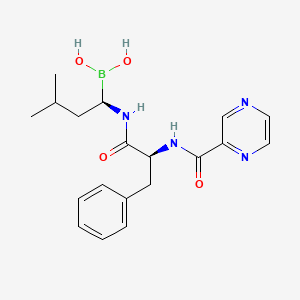
Overview
Bortezomib (trade name Velcade) is a first-generation, reversible inhibitor of the 26S proteasome and one of the most pivotal agents in modern hematologic oncology. It functions by blocking the ubiquitin-proteasome pathway, which cells rely on to degrade misfolded, damaged, or regulatory proteins. By preventing this degradation, bortezomib triggers the accumulation of pro-apoptotic factors and disrupts the nuclear factor-κB (NF-κB) signaling cascade, ultimately inducing programmed cell death in malignant cells. Its selective cytotoxicity against rapidly proliferating tumor cells — particularly plasma cells — established it as a cornerstone drug in the treatment of multiple myeloma and, subsequently, mantle cell lymphoma.
Beyond its established hematologic indications, bortezomib continues to be investigated in a broad array of solid tumors and rare hematologic malignancies, including AL amyloidosis, diffuse large B-cell lymphoma (DLBCL), colorectal cancer, and uterine leiomyosarcoma. Its mechanism of action — inducing proteotoxic stress and activating the unfolded protein response — provides a rational basis for combination strategies with immunomodulatory agents, monoclonal antibodies, and novel Targeted therapies. Resistance to bortezomib, driven by mechanisms including proteasome subunit mutations, upregulation of survival pathways, and alterations in the tumor microenvironment, remains a central challenge motivating ongoing drug development efforts.
Recent Publications Summary
Recent studies demonstrate bortezomib's continued efficacy in treating newly diagnosed multiple myeloma when incorporated into quadruplet regimens alongside emerging agents. The XVRd regimen (selinexor combined with bortezomib, lenalidomide, and dexamethasone) achieved an overall response rate of 93.3% in newly diagnosed patients with high-risk features, including extramedullary disease and plasma cell leukemia 42544613Aug. Similarly, selinexor combined with bortezomib, lenalidomide, and dexamethasone (SVRD) produced an overall response rate of 89.7% with complete resolution of extramedullary disease in 79.3% of newly diagnosed patients, with 12-month progression-free and overall survival rates of 87.9% and 96.3%, respectively 41564431Jan. In a real-world comparison of transplant-eligible newly diagnosed patients, the daratumumab-containing regimen (DVRd) showed a 63% lower risk of disease progression or death compared to the triplet bortezomib, lenalidomide, and dexamethasone (VRd) approach 42444515Jul.
Mechanistic investigations reveal multiple pathways through which bortezomib's efficacy can be enhanced or modulated. Triptonide, a small-molecule extracted from Tripterygium wilfordii Hook. f., synergizes with bortezomib by enhancing DNA damage through inhibition of TRIP13-mediated DNA repair pathways, including non-homologous end joining and homologous recombination, with effects validated across multiple myeloma cell lines, primary cells, and xenograft models 42464653Jul. Knockdown of MYBL2, an oncogene upregulated in multiple myeloma, enhances both ferroptosis and bortezomib sensitivity by transcriptionally regulating CDKN3 and inactivating PI3K/Akt signaling 42345518Jun. Additionally, belantamab mafodotin combined with bortezomib and dexamethasone (BVd) was explored in patients with relapsed/refractory multiple myeloma 41770089Mar.
biomarker studies provide insight into patient response dynamics during bortezomib-containing therapy. In patients receiving VRd, circulating monocytic myeloid-derived suppressor cells (M-MDSCs) expanded significantly during induction therapy and normalized after autologous stem cell transplantation 42374568Jun. Notably, patients achieving partial response or less showed greater M-MDSC expansion (median +1.56%) compared to those achieving very good partial response or better (median +0.50%), suggesting that M-MDSC expansion patterns associate with depth of treatment response 42374568Jun.
safety surveillance data highlight both infectious and neurological concerns with bortezomib-containing regimens. Pharmacovigilance analysis of over 54,000 cases revealed elevated signals for neurological disorders specifically associated with VRd therapy, with reporting trends showing a modest decline in VRd cases after 2020 42171749May. Bortezomib-induced peripheral neuropathy demonstrates inter-individual variability in susceptibility, with whole exome sequencing identifying 90,465 associated single nucleotide polymorphisms and a distinct co-mutation signature involving 33 zinc-finger family genes linked to inflammatory response mechanisms 42055794Apr. In studies of daratumumab-containing regimens combined with bortezomib or other agents, grade 3/4 infection incidence was higher with combination therapy versus monotherapy, though exposure-adjusted rates were generally comparable 42085642May.
Beyond multiple myeloma, bortezomib demonstrates activity in other hematologic and solid malignancies. In newly diagnosed systemic light-chain amyloidosis, a frequency-adjusted, cyclophosphamide-free daratumumab regimen was compared with bortezomib and dexamethasone 41560662Jan. Bortezomib also exhibits cytotoxic effects in non-hematologic malignancies; in uterine leiomyosarcoma cells, proteasome inhibition by bortezomib induced stress-response-mediated cytotoxicity through multiple mechanisms including reactive oxygen species production and mitochondrial membrane depolarization 41861709Mar.
What Changes, What Holds
1. Bortezomib remains a backbone drug, but newer combinations are improving depth of response in high-risk newly diagnosed myeloma
REINFORCES These data extend the established role of bortezomib in multiple myeloma rather than replacing it: the drug still functions as a core component of frontline therapy, now being paired with newer agents to intensify responses in difficult disease. The real-world comparison also suggests that bortezomib triplets may be outperformed by antibody-containing regimens in transplant-eligible patients, which tempers any assumption that VRd is still the best default. 42544613Aug41564431Jan42444515Jul
2. Bortezomib sensitivity can be amplified by targeting DNA repair, ferroptosis, and partner-drug synergy
NEW DIRECTION The Overview already frames bortezomib as a proteasome inhibitor used in combination strategies, but these studies add a more specific mechanistic layer: resistance and response may be modulated by DNA repair capacity and ferroptotic control. That does not overturn the baseline mechanism; it suggests actionable vulnerabilities that could refine combination design and biomarker selection. The belantamab-containing regimen also fits this broader theme of combination intensification. 42464653Jul42345518Jun
3. Immune-cell dynamics may help explain why some patients respond less well to bortezomib-based induction
METHOD This work does not change what bortezomib is or its core use; it adds a response-associated biomarker readout during therapy. The main implication is that circulating suppressor-cell expansion could become a monitoring tool for depth of response or immune reconstitution, especially around transplant, but it remains correlative rather than practice-changing. It sharpens how bortezomib-containing regimens are studied, not the drug’s established role. 42374568Jun
4. Neuropathy and infection risk remain important limits on bortezomib-containing regimens, and susceptibility may be genetically patterned
REINFORCES The Overview already notes resistance and combination use, but not toxicity; these findings add clinically relevant safety detail without contradicting the baseline. They strengthen the need for vigilance around neurologic adverse effects and infections, and they suggest that inherited variation may partly explain who develops neuropathy. That is useful for risk stratification, but it is still early and does not yet alter the drug’s established place in therapy. 42171749May42055794Apr42085642May
5. Bortezomib’s activity extends beyond myeloma, but the new evidence mainly reinforces its broader investigational reach
REINFORCES The Overview already states that bortezomib is being explored in AL amyloidosis and solid tumors; these reports simply add more support for that wider scope, including systemic light-chain amyloidosis and uterine leiomyosarcoma. The mechanistic detail in leiomyosarcoma is interesting, but it does not displace the established proteotoxic-stress model. Overall, this paragraph broadens the list of settings where bortezomib remains biologically active, without changing the drug’s core identity. 41560662Jan41861709Mar
Overview update candidates: bortezomib-containing quadruplets in newly diagnosed myeloma; comparative inferiority of VRd to daratumumab-containing therapy in some transplant-eligible patients; DNA repair and ferroptosis as modifiers of bortezomib response; mechanistic rationale for new combination partners; genetic susceptibility to bortezomib-induced neuropathy; heightened neurologic and infectious toxicity signals in combination regimens.
bortezomib
Background Contexts
In the literature, the biological baseline, pathological conditions, or disease models commonly surrounding bortezomib are described as follows:
- multiple myeloma (Disease) — 13 papers: PMIDs 42544613, 42464653, 42444515, 42387202, etc.
- AL amyloidosis (Disease) — 1 paper: PMIDs 42212672
- Anti-CD38 monoclonal antibody (Therapy) — 1 paper: PMIDs 42212933
- autophagy genes (Gene) — 1 paper: PMIDs 41858619
- Bortezomib-Induced Peripheral Neuropathy (Disease) — 1 paper: PMIDs 42055794
- Castleman's disease (Disease) — 1 paper: PMIDs 42501235
- colorectal cancer (Disease) — 1 paper: PMIDs 42049351
- cytotoxic T cell (Cellular Component) — 1 paper: PMIDs 41858619
- diffuse large B-cell lymphoma (Disease) — 1 paper: PMIDs 41886633
- DREAMM-6 arm B study (Other) — 1 paper: PMIDs 41770089
- high-risk features (Other) — 1 paper: PMIDs 42544613
- HIV (Organism) — 1 paper: PMIDs 42501235
Methodologies & Technologies Used
Researchers utilize the following experimental methods, imaging platforms, computational models, or biological reagents to study bortezomib:
- 2-arylaminopyrimidine derivatives (Chemical) — 1 paper: PMIDs 41895096
- Alcyone (Other) — 1 paper: PMIDs 42085642
- Autologous stem cell transplantation (Therapy) — 1 paper: PMIDs 42374568
- bioinformatic analysis (Technology) — 1 paper: PMIDs 42345518
- bone marrow examination (Technology) — 1 paper: PMIDs 42501235
- bortezomib-lenalidomide (Therapy) — 1 paper: PMIDs 42387202
- Bortezomib-resistant KM3 cells (Cell Line) — 1 paper: PMIDs 41895096
- cell counting kit-8 assay (Technology) — 1 paper: PMIDs 42345518
- co-medication assessment (Technology) — 1 paper: PMIDs 42171749
- Colorectal Cancer Cells (Cellular Component) — 1 paper: PMIDs 42049351
- Cox regression (Other) — 1 paper: PMIDs 42444515
- cyclophosphamide (Therapy) — 1 paper: PMIDs 42212672
Molecular Interventions & Targets
The primary molecular pathways, regulatory genes, enzymes, or therapeutic agents actively targeted and manipulated in relation to bortezomib include:
- dexamethasone (Therapy) — 8 papers: PMIDs 42544613, 42444515, 42374568, 42171749, etc.
- lenalidomide (Therapy) — 6 papers: PMIDs 42544613, 42444515, 42374568, 42171749, etc.
- daratumumab (Therapy) — 4 papers: PMIDs 42444515, 42171749, 42085642, 41560662
- selinexor (Therapy) — 2 papers: PMIDs 42544613, 41564431
- 6-O-carboxypropyl-α-tocotrienol (Therapy) — 1 paper: PMIDs 42049351
- 7n (Chemical) — 1 paper: PMIDs 41895096
- ablim2 (Gene) — 1 paper: PMIDs 42055794
- Anselamimab (Therapy) — 1 paper: PMIDs 42212672
- anti-CD47 nanobodies (Protein) — 1 paper: PMIDs 41858619
- Autologous stem cell transplantation (Therapy) — 1 paper: PMIDs 41564431
- B cell maturation antigen (BCMA) (Protein) — 1 paper: PMIDs 42212933
- belantamab mafodotin (Therapy) — 1 paper: PMIDs 41770089
Observed Outcomes & Phenotypes
The phenotypic changes, physiological endpoints, or clinical metrics observed and measured in connection with bortezomib include:
- progression-free survival (Clinical Metric) — 3 papers: PMIDs 42544613, 42212933, 41886633
- bortezomib sensitivity (Clinical Metric) — 2 papers: PMIDs 42345518, 42049351
- complete response (Clinical Metric) — 2 papers: PMIDs 42544613, 42212933
- infection (Disease) — 2 papers: PMIDs 42212933, 42085642
- overall survival (Clinical Metric) — 2 papers: PMIDs 42544613, 42212933
- partial response (Clinical Metric) — 2 papers: PMIDs 42544613, 42374568
- reactive oxygen species (Chemical) — 2 papers: PMIDs 42345518, 41861709
- very good partial response (Clinical Metric) — 2 papers: PMIDs 42544613, 42374568
- adverse event (Clinical Metric) — 1 paper: PMIDs 42212933
- Annexin V (Protein) — 1 paper: PMIDs 41861709
- anti-MM activity (Other) — 1 paper: PMIDs 42464653
- anticancer effect (Biological Process) — 1 paper: PMIDs 42049351
General Takeaways & Clinical Potentials
The high-level concepts, clinical translations, and overarching conclusions proposed in the research surrounding bortezomib are summarized below:
- daratumumab (Therapy) — 2 papers: PMIDs 42501235, 42444515
- dexamethasone (Therapy) — 2 papers: PMIDs 42501235, 42444515
- 7n (Chemical) — 1 paper: PMIDs 41895096
- anti-myeloma activity (Other) — 1 paper: PMIDs 42115585
- antifibril antibody (Protein) — 1 paper: PMIDs 42212672
- antiplasma cell dyscrasia therapy (Therapy) — 1 paper: PMIDs 42212672
- CD47-expressing malignancies (Disease) — 1 paper: PMIDs 41858619
- chemosensitization (Biological Process) — 1 paper: PMIDs 41858619
- clinically viable strategy for recalibrating age-related skeletal disorders (Other) — 1 paper: PMIDs 42115585
- cyclophosphamide (Therapy) — 1 paper: PMIDs 42501235
- cytotoxicity (Clinical Metric) — 1 paper: PMIDs 41861709
- durable responses (Clinical Metric) — 1 paper: PMIDs 41858619