amphotericin B
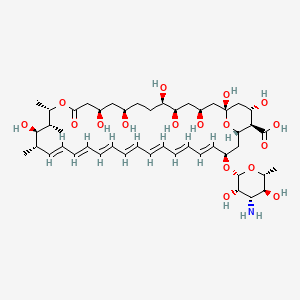
Overview
Amphotericin B is a broad-spectrum polyene antifungal agent used for serious systemic fungal infections and, in some settings, for parasitic diseases such as cutaneous leishmaniasis. It is a clinically important drug because of its potent activity against a wide range of pathogenic fungi, including Candida species and invasive molds, and because it remains a key option when infections are severe, refractory, or life-threatening. In the recent literature provided, amphotericin B is described as an FDA-approved therapy with recognized efficacy but also with substantial toxicity concerns, particularly when administered systemically.
Its biological activity is generally attributed to binding ergosterol in fungal cell membranes, leading to membrane disruption and cell death. This mechanism underlies its use against invasive fungal disease, but the same membrane-associated effects also contribute to adverse reactions that have driven the development of improved formulations, especially liposomal amphotericin B. Recent research has continued to focus on balancing efficacy and toxicity through drug delivery innovations, combination therapy, and alternative administration routes.
Recent Publications Summary
Recent work on amphotericin B (AmB) has concentrated less on the drug itself than on the delivery systems and adjuncts needed to make it usable, reflecting its persistent liabilities: poor aqueous solubility, pH-dependent aggregation, physiological instability, and dose-limiting systemic toxicity 42150646May41780885Mar42083326May. A nanocubosomal in-situ gelling system built from glyceryl monooleate, poloxamer 407, and DMSO was developed for ophthalmic delivery in fungal keratitis, optimized by a Quality-by-Design central composite design across 13 batches; the lead dispersion reached 158.9 ± 2.6 nm with low polydispersity (0.162 ± 0.007), 91.2 ± 1.1% entrapment efficiency, and a zeta potential of −32.8 ± 1.3 mV, with the very low pH 7.4 solubility (0.2 ± 0.03 µg/mL) and modest lipophilicity (log P 0.46 ± 0.01) of AmB supporting preferential partitioning into the lipid domain 42150646May. For central nervous system mycoses, an HS15–lecithin–cholesterol nanocomplex was formulated as a nasal spray to bypass the blood–brain barrier via olfactory and trigeminal routes, screened on encapsulation efficiency and shown to be stable on standing, dilution, and spraying while achieving higher and more sustained intracerebral exposure than systemic dosing would allow 41780885Mar. Liposomal carriers remain the most clinically validated of these platforms, and AmB-type formulations sit within a broader review of liposomal engineering that catalogues the field's unresolved translational problems — formulation stability, manufacturing scalability, and immunogenicity on repeated dosing 42026392Apr.
Delivery innovation extends to parasitic disease. A three-by-three array of 1 mm hollow stainless steel microneedles was used to inject Fungizone/AmB directly into cutaneous leishmaniasis lesions in Leishmania mexicana-infected mice, the rationale being an off-clinic route for impoverished populations for whom lipid formulations are unaffordable and cold-chain dependent 42083326May. Twenty consecutive days of treatment constrained lesion growth by up to 2.8 mm and reached statistical significance (p = 0.008), whereas a 10-day course produced only a 1.1 mm maximum difference versus placebo and did not (p = 0.075); reduced parasite burden by limiting dilution persisted for weeks after treatment stopped 42083326May. AmB also serves as the comparator against which alternative antileishmanial strategies are positioned, as in the photodynamic inactivation of Leishmania amazonensis by furanocoumarin-rich Trichocline plicata extracts acting through singlet oxygen and superoxide generation under UVA 42066647May.
A parallel strand uses AmB as a susceptibility-testing reference and as a partner in combination screening. Against 40 clinical Candida isolates identified by Vitek 2, chromogenic agar, and germ tube testing, an ethanolic Curcuma longa extract was assessed by CLSI-compliant broth microdilution and disc diffusion, with combination disc testing probing synergy with either fluconazole or AmB and crystal violet assays measuring antibiofilm activity — a design motivated by rising non-albicans Candida species, resistance, and biofilm-driven treatment failure 42409910Jul. Bisabolane-type sesquiterpenes from the marine fungus Aspergillus sp. WHUF04-170 yielded two compounds that potentiated AmB against C. albicans, including reference strains SC5314 and C. albicans ATCC 10231 as well as drug-resistant clinical isolates, while other compounds in the series acted independently on Helicobacter pylori 41651325Feb. Benzimidazole-2-substituted phenyl alkane sulfonate derivatives were benchmarked directly against AmB, with compounds 3c and 3i achieving MICs of 8.2 ± 1.84 and 9.8 ± 1.92 µg/mL against C. albicans versus 11.8 ± 0.41 µg/mL for the reference drug; ergosterol supplementation raised their MICs, indicating that these analogues share AmB's mechanism of ergosterol binding and membrane disruption alongside ROS-mediated damage 41831427Mar.
Clinically, liposomal AmB features in the management of rare and refractory invasive mycoses. In a patient with acute myeloid leukemia who developed breakthrough invasive pulmonary infection during antifungal prophylaxis, therapy was switched to liposomal AmB; cultures remained negative and PCR on paraffin-embedded lung tissue identified Coprinopsis cinerea (Hormographiella aspergillata). Radiology worsened after liposomal AmB was started and peaked at first follow-up CT before improving, after which isavuconazole step-down was initiated, and surgical resection ultimately enabled cord blood transplantation 41895473Mar. On the trial-design side, hierarchical composite endpoints were applied retrospectively to three randomized cryptococcal meningitis trials after a Delphi survey of 34 respondents prioritized mortality and serious adverse events; in AMBITION-cm, single-dose liposomal AmB gave a Better DOOR Probability of 55% (95% CI 51–59%) and a win ratio of 1.23 (95% CI 1.03–1.46), supporting superiority over standard of care, while oral AmB in the ENACT phase II trial yielded a BDP of 52% (95% CI 42–63%) and a win ratio of 1.14 (95% CI 0.68–1.91), which was not statistically distinguishable 41495969Jan. Together these analyses argue that tolerability and adverse-event burden — the same properties driving the formulation work above — deserve formal weight in AmB efficacy assessment rather than reliance on all-cause mortality alone.
What Changes, What Holds
1. Delivery systems, not the core drug, are now the main innovation frontier -- NEW DIRECTION -- Recent work does not revise amphotericin B’s antifungal mechanism or its role in severe infection; it shows that the limiting problem is still how to make the drug usable. The emphasis on nanocubosomes, nasal complexes, and liposomal engineering extends the baseline account by highlighting formulation constraints—solubility, aggregation, instability, and toxicity—as the dominant translational bottlenecks rather than new pharmacology 42150646May41780885Mar.
2. Local and device-assisted delivery may expand use in parasitic disease, but only as a practical workaround -- NEW DIRECTION -- Direct lesion injection and comparator use in leishmaniasis do not overturn amphotericin B’s established parasitic role; they suggest a route to make an old indication more feasible where standard lipid formulations are inaccessible. The important change is operational: the drug may be deployable without clinic-based infusion infrastructure, yet the evidence remains preclinical and does not settle whether this approach can replace conventional treatment 42083326May.
3. Amphotericin B remains the benchmark, while new compounds mostly imitate or augment it -- REINFORCES -- The screening and combination studies keep amphotericin B in its established position as a reference antifungal and antileishmanial comparator. Findings that other agents potentiate it or appear to share ergosterol-linked membrane effects sharpen the baseline mechanism rather than displace it. The main implication is that amphotericin B still anchors susceptibility testing and combination development, even as resistance and biofilm problems motivate search for adjuncts 42409910Jul41651325Feb41831427Mar.
4. Liposomal amphotericin B still matters most when disease is rare, refractory, and treatment-limiting toxicity is a concern -- REINFORCES -- The clinical case and trial reanalysis both support the baseline view that formulation and tolerability are central to amphotericin B’s modern use. One report shows liposomal therapy remaining part of salvage management in an invasive mold infection, while the composite-endpoint work argues that adverse events should count formally in judging benefit. Together they strengthen, rather than challenge, the idea that efficacy alone is an incomplete measure of this drug’s value 41895473Mar41495969Jan.
Overview update candidates: delivery-system innovation as the main frontier; device-assisted local delivery for cutaneous leishmaniasis; formal incorporation of tolerability/adverse events into amphotericin B efficacy assessment.
amphotericin b
Background Contexts
In the literature, the biological baseline, pathological conditions, or disease models commonly surrounding amphotericin b are described as follows:
- COVID-19 (Disease) — 2 papers: PMIDs 42215061, 41866895
- acute myeloid leukemia (Disease) — 1 paper: PMIDs 41895473
- Aspergillus flavus (Organism) — 1 paper: PMIDs 42262093
- blood–brain barrier (Biological Process) — 1 paper: PMIDs 41780885
- Candida (Organism) — 1 paper: PMIDs 42409910
- central nervous system (Other) — 1 paper: PMIDs 41780885
- Coprinopsis cinerea (Organism) — 1 paper: PMIDs 41895473
- Curcuma longa (Organism) — 1 paper: PMIDs 42409910
- cutaneous leishmaniasis (Disease) — 1 paper: PMIDs 42066647
- CYP51 (Protein) — 1 paper: PMIDs 42262093
- enhanced permeability and retention effect (Biological Process) — 1 paper: PMIDs 42026392
- formulation stability (Other) — 1 paper: PMIDs 42026392
Methodologies & Technologies Used
Researchers utilize the following experimental methods, imaging platforms, computational models, or biological reagents to study amphotericin b:
- posaconazole (Therapy) — 3 papers: PMIDs 42262093, 42215061, 41866895
- caspofungin (Therapy) — 2 papers: PMIDs 42224217, 41866895
- voriconazole (Therapy) — 2 papers: PMIDs 42262093, 42224217
- Aspergillus sp. WHUF04-170 (Organism) — 1 paper: PMIDs 41651325
- Benzimidazole-2-substituted phenyl alkane sulfonate derivatives (Chemical) — 1 paper: PMIDs 41831427
- Carbopol 934 (Chemical) — 1 paper: PMIDs 42150646
- chest computed tomography (CT) (Technology) — 1 paper: PMIDs 41895473
- chromogenic agar (Technology) — 1 paper: PMIDs 42409910
- cord blood transplantation (Therapy) — 1 paper: PMIDs 41895473
- crystal violet microtiter plate assay (Technology) — 1 paper: PMIDs 42409910
- deferasirox (Therapy) — 1 paper: PMIDs 41866895
- density functional theory (DFT) calculations (Technology) — 1 paper: PMIDs 42085808
Molecular Interventions & Targets
The primary molecular pathways, regulatory genes, enzymes, or therapeutic agents actively targeted and manipulated in relation to amphotericin b include:
- C. albicans ATCC 10231 (Organism) — 4 papers: PMIDs 42224217, 42190773, 41831427, 41651325
- 6α-(3'-methoxy-4'-hydroxybenzoyl)-lup-20(29)-ene-3-one (Chemical) — 1 paper: PMIDs 42224217
- Acinetobacter baumannii (Organism) — 1 paper: PMIDs 41831427
- Amfocare (Therapy) — 1 paper: PMIDs 42150646
- bisabolane-type sesquiterpenes (Chemical) — 1 paper: PMIDs 41651325
- Candida glabrata (Organism) — 1 paper: PMIDs 42224217
- Candida krusei (Organism) — 1 paper: PMIDs 42224217
- Candida parapsilosis (Organism) — 1 paper: PMIDs 42224217
- Candida tropicalis (Organism) — 1 paper: PMIDs 42224217
- Compounds 3h, 3i, and 3j (Chemical) — 1 paper: PMIDs 41831427
- CYP51C (Protein) — 1 paper: PMIDs 42262093
- DCM-SP.Ext. (Other) — 1 paper: PMIDs 42066647
Observed Outcomes & Phenotypes
The phenotypic changes, physiological endpoints, or clinical metrics observed and measured in connection with amphotericin b include:
- nephrotoxicity (Other) — 2 papers: PMIDs 42190773, 41780885
- 10 nm lithography process (Clinical Metric) — 1 paper: PMIDs 41780885
- anti-biofilm activity (Biological Process) — 1 paper: PMIDs 42224217
- antibiofilm properties (Biological Process) — 1 paper: PMIDs 42409910
- antimicrobial activity (Clinical Metric) — 1 paper: PMIDs 41651325
- Area Under the Receiver Operating Characteristic Curve (Clinical Metric) — 1 paper: PMIDs 42190773
- binding interactions (Biological Process) — 1 paper: PMIDs 42085808
- bioactive functional groups (Other) — 1 paper: PMIDs 42409910
- biofilm formation (Biological Process) — 1 paper: PMIDs 42190773
- bioresponsive behaviour (Other) — 1 paper: PMIDs 42150646
- Bofutrelvir (Chemical) — 1 paper: PMIDs 42085808
- C. albicans ATCC 10231 (Organism) — 1 paper: PMIDs 42150646
General Takeaways & Clinical Potentials
The high-level concepts, clinical translations, and overarching conclusions proposed in the research surrounding amphotericin b are summarized below:
- anti-leishmanial efficacy (Clinical Metric) — 1 paper: PMIDs 42085808
- antimicrobial resistance (Other) — 1 paper: PMIDs 42409910
- appropriate antifungal therapy (Other) — 1 paper: PMIDs 41895473
- azole resistance (Biological Process) — 1 paper: PMIDs 42262093
- benzimidazole-based sulfonate hybrids (Chemical) — 1 paper: PMIDs 41831427
- biofilm-associated Candida infections (Disease) — 1 paper: PMIDs 42409910
- Candida infections (Disease) — 1 paper: PMIDs 42409910
- clinically refractory fungal meningitis (Disease) — 1 paper: PMIDs 41780885
- combination regimens (Other) — 1 paper: PMIDs 41651325
- cost-effective plant-based agents (Other) — 1 paper: PMIDs 42066647
- curcumin derivatives (Chemical) — 1 paper: PMIDs 42409910
- ergosterol-associated membrane targeting (Biological Process) — 1 paper: PMIDs 41831427