17β-estradiol
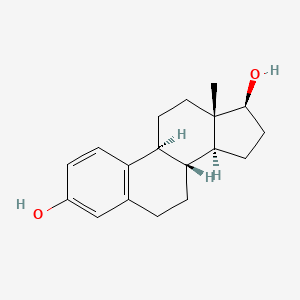
Overview
17β-Estradiol (E2) is the primary and most biologically potent endogenous estrogen in humans, classified as a steroid hormone biosynthesized predominantly in the ovaries, with secondary production in the adrenal cortex, placenta, testes, and peripheral adipose tissue. It is derived from testosterone via aromatization, a reaction catalyzed by the enzyme aromatase (CYP19A1), and exerts its effects principally through binding to estrogen receptors Estrogen Receptor Alpha (ERα) and ERβ — nuclear transcription factors that regulate gene expression across a broad array of tissues including the reproductive tract, bone, cardiovascular system, and central nervous system. Chemically designated as estra-1,3,5(10)-triene-3,17β-diol (molecular formula C₁₈H₂₄O₂), E2 maintains characteristic phenolic A-ring and β-hydroxyl configurations that confer high receptor affinity. Its role extends well beyond reproductive physiology: E2 modulates cell proliferation, apoptosis, vascular tone, lipid metabolism, and neuroprotection, making it a target of sustained interest in oncology, endocrinology, reproductive medicine, and environmental toxicology.
Beyond its endogenous roles, 17β-estradiol is recognized as an environmental contaminant of emerging concern (EC). Excreted by humans and livestock and incompletely removed by conventional water treatment, E2 enters aquatic ecosystems where, even at trace concentrations (nanograms per liter), it acts as an endocrine-disrupting chemical (EDC), perturbing hormonal signaling in wildlife and raising concern about indirect human exposure through drinking water and food chains.
Recent Publications Summary
Recent work on 17β-estradiol clusters into three loosely connected strands: analytical detection of the hormone as an environmental contaminant, its role as a clinical biomarker of reproductive and metabolic status, and its receptor-mediated signaling in cancer biology.
On the analytical side, 17β-estradiol appears repeatedly as a benchmark endocrine-disrupting chemical for new sensing platforms. A ratiometric fluorescence biosensor coupled a target-activated spherical nucleic acid to an enzyme–nanozyme redox cascade, in which aptamer recognition of 17β-estradiol or bisphenol A triggers a Nb.BbvCI-powered DNA walking circuit on gold nanoparticles and releases alkaline phosphatase; the liberated enzyme generates L-ascorbate from ascorbic acid 2-phosphate, reducing CoOOH nanoflakes in a g-C3N4/CoOOH nanohybrid and producing a self-calibrating two-wavelength readout at 448 nm and 556 nm 41604759Jan. A separate portable electrochemical platform based on laser-induced and screen-printed graphene electrodes used hydrogen peroxide-assisted redox mediation with chronoamperometric detection to measure the cumulative burden of oxidizable organic contaminants in water; estradiol responded comparably to Diclofenac, ibuprofen, and glyphosate under optimized electro-Fenton conditions, with amoxicillin serving as the model calibrant at sub-ppb sensitivity and close agreement with HPLC-MS 42060697Apr. Together these reports position 17β-estradiol less as a therapeutic agent than as a persistent trace contaminant requiring on-site, standard-independent quantification.
Clinically, estradiol was evaluated as one input among several hormonal markers. Machine learning models were developed to predict early pregnancy outcomes by combining baseline levels and dynamic changes in β-human chorionic gonadotropin, progesterone, and estradiol, treating serial hormone trajectories rather than single measurements as the predictive signal 42044144Apr. In a metabolic setting, overnight wakefulness was found to impair next-day postprandial glucose in young women independently of sex hormones, addressing whether estradiol and progesterone levels modulate night shift-induced impairments in glucose regulation 41618682Jan.
In cancer biology, estrogen signaling was examined in colorectal cancer, where obesity elevates estrogen, 27-hydroxycholesterol, and insulin-like growth factors, yet hormone replacement therapy is epidemiologically associated with reduced incidence and mortality in postmenopausal women. ERβ, the predominant colonic estrogen receptor, correlated strongly with insulin-like growth factor-binding protein-5 (IGFBP-5) in tumor tissue, high IGFBP-5 expression tracked with poor outcomes, and co-immunoprecipitation confirmed a direct ERβ–IGFBP-5 interaction; ERβ knockdown reduced proliferation, migration, and IGFBP-5 levels. Notably, both estrogen and 27-hydroxycholesterol suppressed proliferation and IGFBP-5 expression through ERβ-independent routes, and combining ERβ silencing with estrogen or 27-hydroxycholesterol treatment enhanced DNA damage and apoptosis 42047268Apr.
Methodological groundwork relevant to targeted degradation of receptor proteins was also reported: native mass spectrometry was applied for the first time to a full Cullin-RING E3 ligase, the pentameric von Hippel-Lindau Cullin 2 RING complex (CRL2VHL), characterizing its interactions with partner components in cases where cryo-electron microscopy and X-ray crystallography are impractical because of transient species, flexible or disordered domains, or air–water interface dissociation 42378227Jun.
17β-estradiol
Background Contexts
In the literature, the biological baseline, pathological conditions, or disease models commonly surrounding 17β-estradiol are described as follows:
- postmenopausal osteoporosis (Disease) — 2 papers: PMIDs 42485058, 42466703
- 2-ME sulfamates (Chemical) — 1 paper: PMIDs 41905481
- 2-methoxyestradiol (Chemical) — 1 paper: PMIDs 41905481
- agroecology (Other) — 1 paper: PMIDs 42217488
- aromatase inhibitors (Therapy) — 1 paper: PMIDs 42530772
- bisphenol A (Chemical) — 1 paper: PMIDs 42217488
- breast cancer (Disease) — 1 paper: PMIDs 42530772
- calcium (Chemical) — 1 paper: PMIDs 42056822
- chimeric small molecule therapeutics (Biological Process) — 1 paper: PMIDs 42378227
- contaminants of emerging concern (Other) — 1 paper: PMIDs 42060697
- cryopreserved ovarian cortical tissue (Therapy) — 1 paper: PMIDs 42013788
- Endocrine-disrupting chemicals (Chemical) — 1 paper: PMIDs 41604759
Methodologies & Technologies Used
Researchers utilize the following experimental methods, imaging platforms, computational models, or biological reagents to study 17β-estradiol:
- 2-aryl/alkylaminomethyl estratriene analogues (Chemical) — 1 paper: PMIDs 41905481
- ACBI3 (Other) — 1 paper: PMIDs 42378227
- Aged Mice (Organism) — 1 paper: PMIDs 42176571
- alkaline phosphatase (Protein) — 1 paper: PMIDs 41604759
- anastrozole (Therapy) — 1 paper: PMIDs 42171893
- aptamer (Other) — 1 paper: PMIDs 41604759
- artificial root exudates (Other) — 1 paper: PMIDs 42217488
- ascorbic acid 2-phosphate (Chemical) — 1 paper: PMIDs 41604759
- bilateral ovariectomy (Other) — 1 paper: PMIDs 42485058
- brain–computer interface (Technology) — 1 paper: PMIDs 42466703
- BRD4BD2 (Gene) — 1 paper: PMIDs 42378227
- CoOOH nanoflakes (Other) — 1 paper: PMIDs 41604759
Molecular Interventions & Targets
The primary molecular pathways, regulatory genes, enzymes, or therapeutic agents actively targeted and manipulated in relation to 17β-estradiol include:
- progesterone (Chemical) — 2 papers: PMIDs 42044144, 41618682
- (25R)-cholest-5-ene-3β,26-diol (Chemical) — 1 paper: PMIDs 42047268
- 3,17–bis-sulfamates (Chemical) — 1 paper: PMIDs 41905481
- 3–sulfamates (Chemical) — 1 paper: PMIDs 41905481
- amoxicillin (Therapy) — 1 paper: PMIDs 42060697
- anastrozole (Therapy) — 1 paper: PMIDs 42171893
- Anterior communicating artery aneurysm (Disease) — 1 paper: PMIDs 42031397
- bisphenol A (Chemical) — 1 paper: PMIDs 41604759
- cAMP/PKA/CREB pathway (Pathway) — 1 paper: PMIDs 42466703
- cholecalciferol (Therapy) — 1 paper: PMIDs 42056822
- CRL2VHL (Protein) — 1 paper: PMIDs 42378227
- CUL2 (Protein) — 1 paper: PMIDs 42378227
Observed Outcomes & Phenotypes
The phenotypic changes, physiological endpoints, or clinical metrics observed and measured in connection with 17β-estradiol include:
- testosterone (Chemical) — 3 papers: PMIDs 42359783, 42171893, 42056822
- calcium (Chemical) — 2 papers: PMIDs 42485058, 42056822
- Peroxisome Proliferator Activated Receptor Gamma Co-activator 1 Alpha (Protein) — 2 papers: PMIDs 42485058, 42359783
- reactive oxygen species (Chemical) — 2 papers: PMIDs 42485058, 42060697
- TNF receptor superfamily member 11b (Protein) — 2 papers: PMIDs 42485058, 42466703
- 2'-deoxyadenosine triphosphate (Biological Process) — 1 paper: PMIDs 42176571
- adenosine triphosphate (Chemical) — 1 paper: PMIDs 42485058
- ALPL (Gene) — 1 paper: PMIDs 42471705
- AMPKα (Pathway) — 1 paper: PMIDs 42359783
- apoptotic cells (Cellular Component) — 1 paper: PMIDs 42013788
- Aromatase Inhibitor Therapy (Therapy) — 1 paper: PMIDs 42530772
- atretic ovarian regression (Biological Process) — 1 paper: PMIDs 42171893
General Takeaways & Clinical Potentials
The high-level concepts, clinical translations, and overarching conclusions proposed in the research surrounding 17β-estradiol are summarized below:
- all-male tilapia production (Other) — 1 paper: PMIDs 42171893
- ALPL (Gene) — 1 paper: PMIDs 42471705
- breast cancer (Disease) — 1 paper: PMIDs 42530772
- Cerebral aneurysm risk (Disease) — 1 paper: PMIDs 42031397
- cholecalciferol (Therapy) — 1 paper: PMIDs 42056822
- efficacy (Other) — 1 paper: PMIDs 42530772
- embryonic developmental competence (Other) — 1 paper: PMIDs 42176571
- estratriene-based anticancer agents (Therapy) — 1 paper: PMIDs 41905481
- estrogen pollution (Other) — 1 paper: PMIDs 42217488
- fertility preservation (Other) — 1 paper: PMIDs 42013788
- follicular activation (Biological Process) — 1 paper: PMIDs 42013788
- glycosaminoglycan catabolic process (Biological Process) — 1 paper: PMIDs 42471705